Posted on 03/31/2020 8:08:17 AM PDT by Kaslin
A Seattle patient just became the first American to receive a potential breakthrough vaccine for COVID-19. That vaccine -- developed by Moderna, a Massachusetts biotech start-up -- is one of several experimental coronavirus vaccines and treatments that pharmaceutical firms are developing around the country.
The industry's lightning-fast reaction is a testament to the ingenuity of America's scientists -- and the dynamism of America's drug-development system. And it's a reminder that Washington's ongoing effort to defund pharmaceutical innovation puts millions of lives at risk.
To say that drug firms have moved quickly to combat this pandemic is an understatement. In the nearly three months since the first case of COVID-19 made headlines, drug companies across the country have snapped into action.
Many companies have promising therapies in the pipeline. In addition to Moderna, Pennsylvania-based Inovio and Johnson & Johnson have potential vaccines. Remdesivir, an antiviral from Gilead Sciences that has shown promise against the novel coronavirus, has undergone multiple clinical trials. AbbVie, an Illinois life sciences company, is investigating whether its HIV medication Kaletra can be used to treat COVID-19. Another U.S. firm, Thermo Fisher, just won approval for a new COVID-19 test -- a development that could vastly improve detection efforts across the country.
While impressive, the breakneck response of American research firms isn't completely surprising. After all, America does pharmaceutical innovation better than any other country.
The United States develops two-thirds of the world's new drugs. In the last ten years, American drug firms have spent over half a trillion dollars on research and development -- more than the private investments of all other countries combined.
Our unrivaled research infrastructure naturally puts the American pharmaceutical sector in the best position to address an emergency like COVID-19, which demands high-quality drug-development in a hurry.
Americans should be proud of our nation's prowess in life-sciences research. Yet, for the past several years, many in Washington have sought to destroy the market incentives that undergird the country's drug-innovation ecosystem.
A bill introduced last year by Senators Chuck Grassley (R-Iowa) and Ron Wyden (D-Oregon), for instance, would fine drug companies that increase the price of certain drugs covered by Medicare Part D faster than the rate of inflation.
Similarly, H.R.3 -- a sweeping prescription drug bill recently approved by the House -- would effectively cap the price Medicare pays for particular drugs at 120 percent of the price paid in six reference countries.
Both policies amount to government-imposed price controls -- precisely the sorts of market interventions that have hamstrung drug development in places like Germany, France, and the United Kingdom.
Before the widespread adoption of price controls, Europe was a drug development juggernaut. In the 1970s, those three countries alone combined to produce 45 percent of new therapies invented worldwide. From 2001 to 2010, they produced just 20 percent. Our country develops the most new drugs today because we maintained a free market for prescription medicines.
Companies undertake tremendous risk when developing drugs. On average, developing just one medicine takes more than a decade and costs over $2.5 billion after accounting for all of the medicines that don't pan out.
Investors will tolerate that risk because, in the United States, drug companies can sell their products at a fair market price. This means that a successful drug has the opportunity to break even, and sometimes turn a profit.
But the economic logic of drug development vanishes if the government can simply dictate whatever price it deems appropriate.
If any of the price-control reforms on the table took effect, private investment in medical research would quickly flee to less risky ventures. From there, it wouldn't take long for the world's most powerful engine of drug discovery to break down.
A collapse in medical innovation would be harmful in the best of times. But during a global-health emergency like the COVID-19 pandemic -- a moment that demands the full force of America's biotech ingenuity -- it would be nothing short of calamitous.
reads like it came off the desk of a pharma lobbyists
perhaps even the same lobbyist who wrote the part of Obamacare that has allowed extreme price gouging even in the absence of changes in demand
Granted, our research and development process in the U.S. is very long and the most careful in the world; and without a good profit, there would not be enough money to develop new medicines. But come on. Surely there is a middle ground between pharma companies paying themselves top dollar and building themselves grand palaces to work in versus reducing the price of tablets that, once developed, are churned out by the million to treat common ailments.
I have a very common ailment that is costing me almost $1.50 per day. If I drop a tablet half the size of an aspirin on the bathroom floor, I hunt around until I find it and take it anyway.
Little irritates me more than seeing annual reports from pharma companies with lavish color pictures of their “corporate responsibility” sending medications whose development and manufacture Americans have paid through the nose for to third world consumers for free. Sorry; there’s a limit to my being exploited because I have a chronic illness. I prefer to give to my own choices of charity.
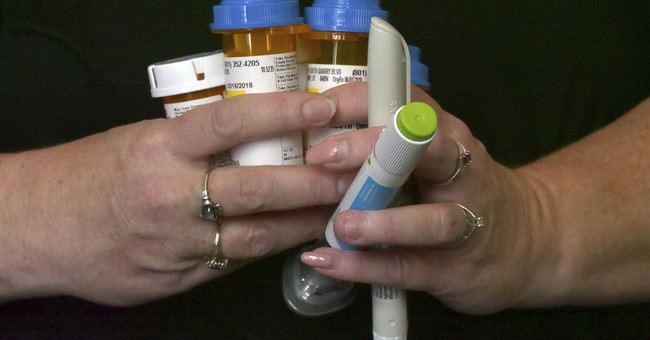
I can’t help but think of the parasite CEO skank who raised the price of an allergy pen (or some such) far above any reasonable amount, priced it out of reach of their client base, and then was forced to bring it back down due to backlash.
Ditto to your reply #3.
The Victosa that that I inject daily has a cash price of $1250 per month in my area, I say “in my area” because it varies by region. My sister, who lives 350 miles from me, has a cash price of $860 per month.
We both have insurance, mine is $15 deductible, hers is even lower.
What the Sam Hill is that all about?
Darned if I know. Possibly there are different taxations and different insurance regulations built in to the different states.
Disclaimer: Opinions posted on Free Republic are those of the individual posters and do not necessarily represent the opinion of Free Republic or its management. All materials posted herein are protected by copyright law and the exemption for fair use of copyrighted works.