Posted on 07/29/2019 9:07:36 AM PDT by Kaslin
In our current state of divisive modern politics, we are often caught in a trap of specificity. Driven either by a politically-inclined media, or our understandably-emotional nature, we often find ourselves obsessing over individual cases or unique and rare instances, allowing them to become wholly representative of a wider subject of debate.
The most recent example would be Jessica Yaniv, the biological male who became the temporary face of the debate surrounding transgender rights after claiming that female-only salons were breaching his human rights when they refused to provide him with Brazilian waxing services.
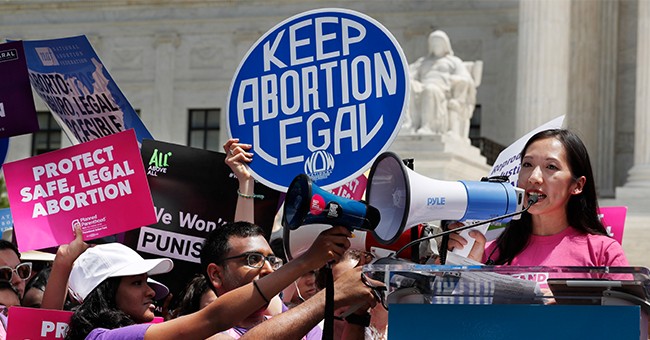
This type of hyper-focus occurs time and time again. The debate surrounding abortion often devolves into looking at pregnancies which are the result of rape or incest. Pregnancies which result from rape or incest are certainly emotionally provocative, but they are statistically rare. According to the Guttmacher Institute, only 1 percent of women who decided to have an abortion did so because they were victims of rape, and 0.5 percent because they were victims of incest. Discussions regarding general immigration policies frequently spiral into accusations of support or defense of rare and unsubstantiated mistreatment of migrants at individual detention centers. Finally, if you criticize progressive health care viewpoints, you will be mischaracterized as someone who wants Jimmy Kimmel’s child to go untreated for their rare heart condition.
The overarching problem is that we become blinded – often intentionally – by specificity with the foolish impression that details are synonymous with substance. As a result, we become totally distracted by emotional and rare instances, sacrificing the underlying fundamental debate as a result.
Ultimately, all political debates can be whittled down to a battle between rights, whether they be positive or negative rights, with the pursuit of a “rights hierarchy” of one form or another. Time spent focussing on rare and superficial instances of a broader debate does nothing to further this deeper objective. With this in mind, it is crucial that all political debate is based upon these underlying fundamental principles. If this can be achieved, we could provide a sense of clarity which is sorely missing from our current levels of discourse.
The debate surrounding Jessica Yaniv and his demand that others should be forced to wax his scrotum without their consent was presented as a matter of transgender rights, and whether self-identification should supersede gender identification by others. By setting aside the specific, and focusing on the fundamental, the debate surrounding Jessica Yaniv ceases to be an argument of “transgender rights” (where 0.6 percent of Americans identify as transgender), and becomes an argument of the universal “right to freedom of association," which applies to every U.S. citizen.
Should any non-consenting private individual be forced to associate or provide service to another individual? Regardless of the identity group of the “victim” or “perpetrator," if we respect the fundamental American principles of freedom, the answer is clearly no. Indeed, the very notion of victim in this case becomes an irrelevant detail which only distracts from principled debate.
We must return to discourse built upon shared fundamental principles if we want to break free of our ideologically stagnant, emotional, and divisive political society. Sacrificing these principles in favor of ideologically-irrelevant and overly-specific instances will drag us further away from a society which rejects selfishness and respects individualistic freedom.
I always bristle at this phrase:
“If it saves a single life, it’s worth it.”
Oh yeah? Then why are we still driving cars?
This is an important concept and is being driven by the far greater detail we are accumulating on a daily basis from electronic media and the conveniences they provide. Andy Warhol’s observation that en the future everyone will have 15 minutes of fame was correct as a metaphor for everyone with a smart phone and an Address Book or Twitter/etc. following. Conservatives should perceive this as a boon because it’s getting harder to sweep things under the rug or squelch the voice of the individual. For now, we see that it allows pissing and moaning over personal suffering, but that’s because the Internet is still in its infancy. We are witnessing the creation of a new global aesthetic - that of form vs. function as opposed to ornament.
You speak as if logic and civics are not already taught in school. It isn’t about the teaching, it’s about the understanding. Look at who’s in our schools—the clientele isn’t who it used to be. The key word in ‘critical thinking’ is thinking. That’s extremely hard, if not impossible, for many to learn, or ever do.

Disclaimer: Opinions posted on Free Republic are those of the individual posters and do not necessarily represent the opinion of Free Republic or its management. All materials posted herein are protected by copyright law and the exemption for fair use of copyrighted works.