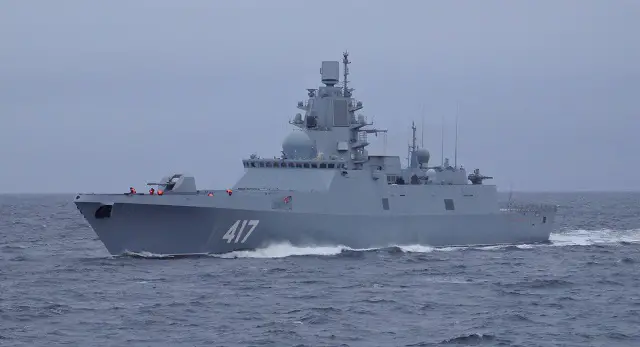
Admiral Gorshkov frigate
Posted on 05/07/2017 9:03:26 PM PDT by sukhoi-30mki
A major military defeat can unexpectedly turn into a victory. Indeed, the actions of the Russian aircraft carrier Admiral Kuznetsov operating off the Syrian coast could easily be qualified as a failure (see EDM, October 27, 2016; November 15, 2016). The ship inched around the coast of Europe on its way to Syria, desperately puffing thick, black smoke due to a problem with its power plant. Then, during training operations in the Eastern Mediterranean, the Kuznetsov lost two warplanes, which fell into the sea due to technical faults, without any opposition from the enemy. However, the Navy won a decisive victory—they earned the sympathy of President Vladimir Putin. After the return of the aircraft carrier to its home port in Murmansk, the Russian president took full responsibility for the fact that the ship was sent to perform tasks for which it was not intended: “The [defense] minister and the chief of the General Staff know that your mission, and the preparations for it, are my personal initiative. I would like to thank the defense minister and the chief of the General Staff, representatives of the industry who, upon receiving the instruction a year ago, promptly prepared the equipment, the materiel for you; and you, in turn, prepared your subordinates and brilliantly executed the tasks that were set forth,” Putin said, while meeting with a group of sailors of the Kuznetsov back in February (Kremlin.ru, February 23).
Since the Russian president is essentially politically infallible domestically, the Kuznetsov’s failure was ultimately declared a victory. Moreover, the Navy was victorious in the battle. Hence, the Navy will most likely obtain maximum funding under the next rearmament program (see EDM, March 14). A few months ago, experts assumed that the Navy would be the main victim of the inevitable reductions in the military budget in conditions of economic crisis. But Putin unexpectedly said, at the meeting of the military-industrial Commission, in Rybinsk, in late April, “By the end of 2016, the share of modern weapons and equipment in the Navy was about 47 percent. At the same time, the total share of modern equipment and weapons in the Armed Forces as a whole is 58.3 percent […] we must solve the problem: within the next three years, by 2020, the share of modern weapons and equipment both in the Army and Navy should rise to 70 percent… The Navy must have a balanced ship fleet capable of carrying out the full range of peacetime and wartime tasks in the near and far maritime zones, ensuring Russia’s naval presence in all strategically important regions of the World Ocean” (Kremlin.ru, April 25).
However, hopes that the Kremlin will invest in hugely ambitious projects such as the construction of a new aircraft carrier will most likely prove mistaken. Just days before Putin’s speech, Defense Minister Sergei Shoigu expressed a more modest approach: that frigates similar to the Admiral Gorshkov will become the mainstay of the Russian Navy. “Such multi-purpose frigates, equipped with long-range precision weapons, should become the Navy’s main combat ships in the near future,” Shoigu told the defense ministry’s board meeting (Mil.ru, April 21).
According to the former commander of the Russian Navy, Admiral Igor Kasatonov, the defense minister’s words indicate a revision to the Russian concept for how to use its naval fleet. Frigates will be the Navy’s main ships, Kasatonov explained, because major sea battles are unlikely in the future. “The main task [of the Navy] is to attack shore facilities with cruise missiles. Our ships, submarines and aircraft strike Islamic State targets in Syria with Caliber [Kalibr] missiles from a long distance. So the validity of the [frigate-centric] concept is confirmed,” Kasatonov said (Vzglyad, April 21).
It should be noted, however, that Moscow is not foregoing its plans to build up capabilities to take on “potential enemy” aircraft carrier strike groups. Illustratively, Russia is carrying out repairs and modernization of its nuclear cruiser Admiral Nakhimov, which, like the cruiser Peter the Great, is slated to receive Onyx and Granite anti-ship missiles designed to destroy carrier-sized warships. Russian media also writes that soon cruisers will be equipped with Zircon hypersonic cruise missiles (Nezavisimaya Gazeta, April 25, 2016; see EDM, May 1, 2, 2017). However, it is indicative that Moscow is apparently refusing to build new warships with a displacement of more than 6,000–7,000 tons.
With the emphasis now on frigates, the vessel Admiral of the Fleet of the Soviet Union Gorshkov becomes the navy’s lead warship. This Russian frigate was laid down in 2006 and first floated in 2010. The warship started its tests on November 2014. The final stage of the Gorshkov’s sea trials was started on March 20, 2017. Project 22350 warships like the Gorshkov displace 4,500 tons and can develop a speed of 29 knots. They are specifically armed with Onyx and Caliber cruise missiles and Poliment-Redut anti-aircraft missile systems (Vzglyad, April 21, 2017; Gazeta.ru, July 15, 2016).
However, this project has serious problems. Only the lead ship of the series managed to obtain a gas turbine engine constructed at the Ukrainian Zorya-Mashproekt manufacturing plant. As the result of Russia’s war against Ukraine, starting in early 2014, all sales of Ukrainian-built military components to Russia were stopped. At the end of April 2017, the Russian government announced that it was able to start naval ship engine production at the Saturn plant in Rybinsk. The newspaper Vedomosti, quoting a source “close to the defense ministry” announced that the first М90FR engine for new frigates can be expected in 2019 (Vedomosti, April 21).
Another problem afflicting project 22350 frigates is that the defense enterprise Almaz-Antey still has not managed to finalize the sale of its advanced Poliment-Redut air-defense system to the Navy. A source in the Russian Military-Industrial Commission stated that Almaz-Antey broke the state defense order “because of its catastrophic backlog of the Poliment-Redut, mainly associated with the failure of the technical characteristics of the 9M96, 9М96D and 9М100 anti-aircraft guided missiles” (Gazeta.ru, July 15, 2016). “Because of Almaz-Antey’s failure to meet its development work on the Poliment-Redut and Shtil [naval version of the Buk anti-air missile], meeting the delivery dates of the project 22350 Admiral Gorshkov and project 11356 Admiral Makarov ships are now also under threat,” Deputy Defense Minister Yuri Borisov said in late March (TASS, March 24).
Thus, it is not particularly likely that Russia will have a “balanced” fleet within the next two years. However, that will probably not prevent military spokespeople from prematurely declaring that such a fleet exists—just as the Syrian campaign of the Admiral Kuznetsov was declared a major military victory.
Admiral Gorshkov frigate
You have to wonder if you’re not in the business of force projection, maintaining bubbles of control in trouble spots around the world if this isn’t a prudent strategy.
I’ve often wondered why several NATO nations operate carriers besides the US. Especially the French.
The prestige of having one, however inadequate compared to ours.
The Russians are in a bind. Their carriers and subs are inferior to ours. Loads of missile boats and frigates—provided the systems function—aren’t a bad idea for them.
>You have to wonder if you’re not in the business of force projection, maintaining bubbles of control in trouble spots around the world if this isn’t a prudent strategy.
Israel adopted the same policy some time ago.
>I’ve often wondered why several NATO nations operate carriers besides the US. Especially the French.
National pride just like once having battleships was a matter of national pride. They’re not yet the obsolete weapon platforms that WW2 battleship were but they’re clearly not the all powerful weapon they once were.
>The Russians are in a bind. Their carriers and subs are inferior to ours. Loads of missile boats and frigates—provided the systems function—aren’t a bad idea for them.
The age of carrier dominance is coming to an end. The coming age of rail guns, stealth drones and stealth cruise missiles will change the nature of sea warfare once again.


11 years to build and commission a small warship? I thought we were slow.
must have the name of the movie on the right...you know...for reference purposes...;)
okay did a reverse search...seems its the game starcraft II heart of the swarm...
thanks...
Two fleets meet. One with air superiority assets like a CVNs and the other doesn’t have them. The fleet with the CVNs win.
A fleet with no a/c carrier assets isn’t rally a fleet, it is a SDF.
A Harpoon will sink a cruiser. If, for the same money and operating costs, you can put several frigates out there, there's a better chance that SOME will survive a determined attack. Particularly if they are able to engage in mutual protection against incoming missile/air threats.
Two fleets meet. One being a carrier battle group. The other being a swarm of submarines with lots of torpedoes and missiles. Who wins?
Two fleets meet. One being a carrier battle group, and the other being a fleet of frigates armed with hypersonic SCRAMjet missiles launched from outside the combat radius of the F-35. Who wins?
So how long where in the Navy? Have had any formal training in Naval warfare? Have attended the Naval War college?
Disclaimer: Opinions posted on Free Republic are those of the individual posters and do not necessarily represent the opinion of Free Republic or its management. All materials posted herein are protected by copyright law and the exemption for fair use of copyrighted works.