
Posted on 07/03/2016 12:16:31 AM PDT by ameribbean expat
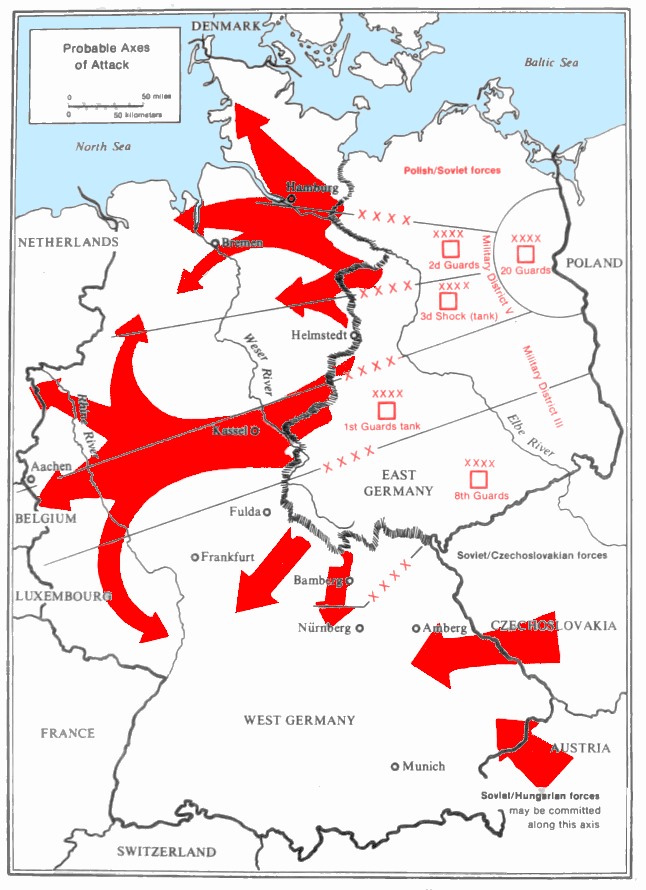
After the Cold War ended, the Polish government made public classified Soviet documents that revealed the likely war plan. The plan, known as “Seven Days to the Rhine,” was the basis of 1979 military exercise that assumed NATO as the aggressor, having nuked a series of twenty-five targets in Poland, including Warsaw and the port of Gdansk. The cover story of countering aggression was a mere fig leaf for the true nature of the anticipated conflict: a bolt-from-the-blue Soviet attack against NATO.
(Excerpt) Read more at nationalinterest.org ...
I met a guy from former USSR working in New York. He had been in their navy on a sub and what was remarkable was how he confirmed the training that paralleled the plot of Hunt for Red October.
Actually, at the peak of Soviet power relative to ours, just as Reagan was taking office, my fear was that they would quickly push through the Fulda Gap, where which we were vastly outnumbered - then take about 50 square miles and stop. If we had a leftist president, the Soviets would simply give assurances that it was all a misunderstanding, as they did with Kennedy over Cuba, and that would likely freeze us long enough to prevent a nuclear exchange.
Then the Soviets wouldn’t leave. Given that we had little offensive capability in Europe, relative to the Soviets, we’d have to decide if it’s worth starting WW3 to try to recover 50 square miles of German farmland. If we said no, which we would, then the Soviets would be in a position to start extracting some serious concessions from Western Europe, as in technology imports and very favorable trade deals.
Within a decade the Warsaw Pact would be as wealthy as Western Europe (who, by now would not be so wealthy, having to been forced to give much of it to their enemies). The Cold War will have still continued, but the momentum would have shifted to their side. Eventually, through political means, they would have severed us from Europe, and we’d be able to be dispensed with pretty soon after.
Thankfully that didn’t happen, but not every WW3 scenario has to be full-scale combat. With enough of an advantage, even a minor excursion by the Soviets could have won it for them.
In 1968, the thinking was the Russians would do 90 km (about 56 miles) for their first rest stop. Not a halt. Then, after both sides had used tactical nukes, the Russians would proceed to the English Channel - time from Fulda to the coast: 72 hours.
Part of the problem was that US troops could not be broken of the habit of giving positions down to minute detail in the clear, while the Russian used one day pads - that or be shot on the spot.
The other was there were far more Russian troops (by hundreds of thousands) than NATO (mainly US) and far too few tanks compared to the Russian 35,000 that would cross in the first wave. Had NATO messed up the Russian plan, then they would have begun using nukes on strategic targets - ie European cities and the US mainland.
It would have been an unfair fight with NATO on the losing side.
Some have said that NATO troops were better trained and could have at least fought to a stand still, but then it is difficult to stop a horde when retreat is not a viable option and casualties are not important, only victory.
Acquiring technology and bits of land does not make a nation wealthy. If it did the Soviet Union should have been the richest country in the world given all that they stole from Germany after WWII. It's what you do with resources that determines how much value you will create. And as Ludwig von Mises demonstrated, it is impossible to make rational economic calculations without market prices. Commies can't compete.
Curiously, France and the United Kingdom were to be spared nuclear strikes. This is probably because both had independent nuclear arsenals not tied to the United States.
In “Seven Days to the Rhine,” Soviet nuclear forces would destroy Hamburg, Dusseldorf, Cologne, Frankfurt, Stuttgart, Munich and the West German capital of Bonn. NATO headquarters in Brussels would be annihilated, as would the Belgian port of Antwerp. The Dutch capital and port of Amsterdam would also be destroyed. Denmark would suffer two nuclear strikes.
After destroying a dozen cities with nuclear weapons, did the Russian think the world would just sit back and go on about its business? At that point Russia would be inviting a full retaliatory strike on Moscow. And with that, we have a full-flown WWIII.
I highly recommend the movie “Jack Strong.” It is the story of the Polish Colonel, code named Jack Strong, who passed the Soviet War plans to the US at the height of the Cold War. He did it to avoid the tactical nuclear scenario, which was a central part of the Soviet plans. The problem for him was the Soviets planned for Poland to absorb the majority of the tactical nuke strikes.
Ping for later.

"No Comment"
During the 70s and 80s, we were taught to only send positions using the daily code pad and plastic converter. I can’t remember its name. We began our location “I shack: ......”
Once we got the new radios in the 1980s when we loaded a daily encryption key and then used a frequency skipping technology, the use of the cards became a backup.
“Acquiring technology and bits of land does not make a nation wealthy.”
It depends how far you take it. With the Soviet military threatening to snatch another 50 square miles, or perhaps 100 or 200, they get a lot of leverage.
Note that I mentioned trade deals - that’s where the big money would come from. The Soviets would demand cheap products, very cheap products, or else - and Europe would know, of course, that it wasn’t an empty threat.
Again, just my speculation - but if you get strong enough, are unopposed, are patient, and have evil intentions, you can accomplish a lot. Just ask the Baby Boomers now running the country.
In recognition of US weakness and disengagement from the defense of Europe, had Carter been reelected in 1980, the Europeans were planning to make a deal with the USSR. In return for a guarantee of security, the countries of continental Europe would finance the Soviet economy and support their technology base. The result would be a de facto Soviet victory in Europe and a tilt in their direction throughout the rest of the world. The US would then gradually be forced to accept terms similar to those arrived at between Europe and the Soviets.
Similar - and I agree. I think our survival rested on two things, which were due more to luck, give the way Democrats behaved in the Cold War
1) We had just enough weapons to make a full-scale nuke exchange an unpleasant prospect, even for the Russians.
2) Their leaders actually did not want World War 3, but they also weren’t about to get caught flat-footed as they did at the beginning of WW2.
Interesting. Plausible.
Flying the A-10 in Europe backs on the 80’s, we, the US, participated in many NATO TAC-Evals and the exercise always went for 3-days. . .maybe that was based on your scenario taking 3-days . .but maybe it was based on a well-time-to-go-nuke scenario.
Basically, we expected your scenario and if they went beyond that 3-day/50 mile constraint, then nukes.
Who knows.
What do you mean they would demand cheap products? Europe and the US never blockaded the Soviet Union except for militarily sensitive items. It was the Soviet Union that banned imports from the us; and they did so precisely because our products were both cheaper and better made than theirs. The USSR could have imported our products at any time and we would have been happy to sell to them.
In the end, the policies and vision of Ronald Reagan is what likely saved America and Europe from disaster. We owe him and his Administration a huge debt we can never properly repay.
Disclaimer: Opinions posted on Free Republic are those of the individual posters and do not necessarily represent the opinion of Free Republic or its management. All materials posted herein are protected by copyright law and the exemption for fair use of copyrighted works.