
Posted on 10/21/2015 8:53:30 PM PDT by sukhoi-30mki
It was announced yesterday that Saudi Arabia wants to purchase four extremely up-gunned Freedom-class Littoral Combat Ships (LCS). The deal will be worth $11.25 billion including weapons and support. This will also be the first export sale for the troubled LCS program, and these Saudi ships will be far more capable than any version of the LCS the Navy plans on procuring. This fact may present an incredible opportunity for the Navy to get the version of the Littoral Combat Ship they really need, and possibly at an awesome price.
Saudi Arabia’s highly upgraded variants of the Freedom-class Littoral Combat Ship will be formally called Multi-Mission Surface Combatant (MMSC), with the frigate class designation applied to them. Instead of chasing the mission-module dream like the U.S. Navy has, Saudi Arabia’s LCS will have their capabilities installed permanently, and these capabilities will include area air defense.
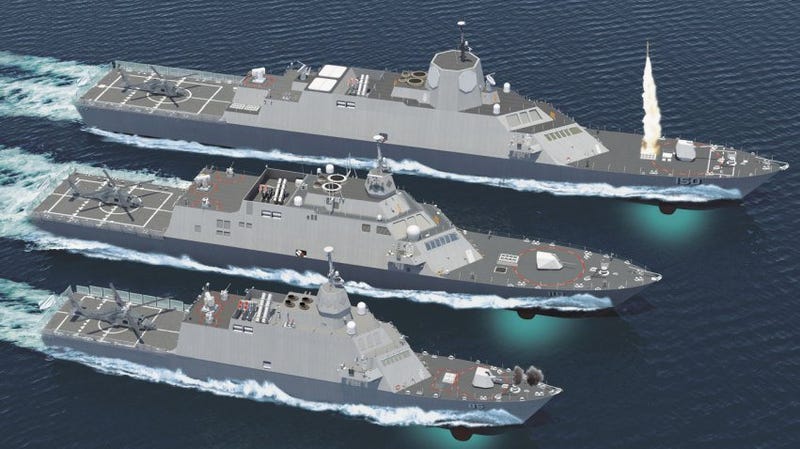
This is a Lockheed rendering of different evolved LCS concepts that were pitched during the Pentagon’s shuffling of the program. The Saudi MMSC is most closely based on the center concept although it is far from an exact match:.
Area air defense capability was controversially omitted from the Pentagon’s “up-gunned” version of the LCS, dubbed the Small Surface Combatant, that will be produced for the Navy for the last 20 ships in the total planned 52 ship LCS fleet. This means the Small Surface Combatant, although better armored and equipped than its LCS progenitor, will still not be able to operate independently in higher threat environments and will be unable to execute missions like shipping convoy escort when there is any sort of aerial threat present. Nor will they be able to pick up the slack from from the Navy’s overtaxed cruiser and destroyer fleets for missions that necessitate even rudimentary anti-air capability.
The Saudi’s Multi-Mission Surface Combatant’s area air defense capability will be provided by a 16 cell Mark 41 vertical launch system (VLS) capable of packing a whopping 64 super-agile RIM-162 Evolved Sea Sparrow Missiles (ESSM). The ESSM can be used against an array of threats, including high-speed cruise missiles and aircraft out to a range of about 30 miles. Even an anti-surface capability exists for the ESSM Block II, which allows it to fly out and strike ships over-the-horizon.
Saudi Arabia Is Buying The Littoral Combat Ship The U.S. Navy Desperately Needs Surveillance, cuing and guidance will be provided by the capable Airbus/Cassidian TRS-4D Active Electronically Scanned Array (AESA) radar system along with a Link 16 data link system. The TRS-4D can perform multiple tasks at once, and it is not just limited to aerial warfare. It can be used for surface surveillance and targeting as well as mapping and other functions.
In addition the the ESSM and the TRS-4D, these Saudi LCS derived frigates will also have an independent SeaRAM close-in weapon system loaded with RIM-116 Rolling Airframe Missiles.
This potent outfit will give the Saudi Arabian Navy a highly capable area air defense capability and their MMSC’s an extremely robust self defense capability. This capability can be used to deny enemies aerial access to roughly 3,000 square miles around the ship. It will also allow these ships to fight alone in much more hostile waters than American LCSs could, and would be ideally suited for shipping and convoy protection duties, as well as acting as a picket ship for smaller corvettes operating in a complex littoral environment.
These ships will also feature an upgraded main gun, tossing away the current LCS’s puny 57mm deck gun for the much more powerful and hugely versatile OTO Melara 76mm gun system. This advanced 76mm gun can be used for anti-air applications as well as anti-surface and ship-to-shore ones. There is a wide array of ammunition available, including shells with variable fusing, guided shells, and even the miniaturized “Volcano” guided rocket round.
The Volcano GPS guided precision munition can travel twice as far as other 76mm rounds, hitting targets with pin-point accuracy up to about 25 miles away. This is an incredibly valuable tool for supporting special forces missions while standing off safely up to two dozen miles from the shoreline. The DART round is another option for this gun and is guided by the gun system via beam riding. It can be used against aircraft and fast attack boats with devastating results, especially when fired in rapid succession.
A pair of fixed RGM-84 Harpoon launchers, each holding four missiles, will also be installed on the MMSCs, giving them a proven over-the-horizon anti-ship capability.
A compact low-frequency active/passive variable depth sonar will be installed under the MMSC’s bow, giving these ships persistent anti-submarine warfare capability. This will be backed up by a pair of MK-32 surface vessel torpedo tubes, each holding three torpedoes.
Just last August it was announced that Saudi Arabia was going to purchase ten MH-60R Seahawk multi-mission helicopters. These cutting edge anti-surface and anti-submarine warfare helicopters are the same helicopters Navy uses aboard many of its surface combatants. The MH-60R will give Saudi Arabia’s MMSCs the ability to perform a huge array of missions, form slinging AGM-114 Hellfire missiles at small boats, to chasing down and attacking submarines, to conducting maritime surveillance and special operations support missions.
All these major weapons components will be tied together by Lockheed Martin’s COMBATSS-21 combat system, which shares some capabilities with the vaunted AEGIS combat system found aboard American cruisers and destroyers. Additionally, a whole array of top-of-the-line electronic communications and missions systems will also be installed on these ships. These include advanced identification friend or foe systems, electronic countermeasures, electronic surveillance measures, and a highly advanced navigation suite with embedded jam-resistant GPS.
Saudi Arabia Is Buying The Littoral Combat Ship The U.S. Navy Desperately Needs
What this all adds up to is a very capable fleet of ships that can deliver a big punch and survive in contested environments, while still being able to whip around the littorals of the Persian Gulf at high-speed. They seem like a perfect solution for Saudi Arabia, a country that is increasingly under threat from losing massive income via the shutting down of major waterways that are surrounded by complex littorals, through which its oil exports travel.
These ships will allow Saudi Arabia to execute a whole slew of missions, some of which are usually only offered by far more expensive and larger surface combatants. This makes sense as they are the centerpiece of the Kingdom’s “Saudi Naval Expansion Program II,” which aims at totally revitalizing its eastern fleet based in the Persian Gulf. Aside from the four MMSCs, this program includes the procurement of 24 new patrol ships, a few advanced maritime patrol aircraft, a fleet of about four dozen unmanned aircraft and six corvettes. The total cost of the program will be just over $16 billion.
You can tell that the Saudis are looking to get the most out of these ships and are really preparing to use them should they have to as they bought a massive weapons package to go along with them. This includes enough ESSMs to restock their fleet eight times without having to be resupplied.
The deal’s total weapons package includes 532 Evolved Sea Sparrow Missiles, 48 RGM-84 Harpoon Block II Missiles, 188 RIM-116 Rolling Airframe Missiles, and 48 .50 caliber machine guns for close-in defense and force protection.
The kicker to the whole deal is that Saudi Arabia is going to foot the bill to develop this super Littoral Combat Ship of sorts, including all the systems and new weapons integration costs. Even training, facilities, spare parts, support and test equipment will be paid for as part of the deal.
This presents the U.S. Navy with an incredible opportunity. Piggyback on the Saudi’s purchase and buy a nearly identical version of their far more capable LCS derivative than the Navy’s dopey “up-gunned” Small Surface Combatant. The research and development costs will have been paid by the Saudis and the U.S. could simply buy more units to lower both the Saudis and the U.S. Navy’s unit costs.
Although not a perfect solution (buying an actual frigate, not a jet boat, would be ideal) this would give the U.S. Navy a perfect weapon system for smaller tasks that can now only be accomplished by much more expensive and complex Arleigh Burke Class destroyers or Ticonderoga Class Cruisers. The fact that the MMSC variant will be able to defend itself and control the airspace around it means that it could be deployed to higher threat areas without a destroyer or cruiser escort, and could even work as a maritime convoy escort in areas where anti-ship missiles or aerial assaults are a possibility. Buying the MMSC instead of the SSC would take tremendous pressure off the Navy’s heavily tasked cruiser and destroyer fleets.
Finally, by including the Mark 41 launch system in this design, American versions could field other weapons aside from the ESSM alone. Although likely not deep enough for RGM-109 Tomahawk cruise missiles, smaller sea-to-land missiles, like the Norwegian-built Naval Strike Missile, could give these highly enhanced Littoral Combat Ships a limited medium-range land-attack role without wasting additional deck-space with bolt-on box launchers.
The Navy has a real opportunity here to end the toothless Littoral Combat Ship debate and to do so without having to incur large development costs. The flexibility and economy that the MMSC concept provides offers the Navy the ability to build an improved surface fleet mix so that is can better match each ship’s capability set to the missions at hand.
Instead of only having the choice of assigning either a toothless and vulnerable LCS to a mission or a high-end destroyer or cruiser, the MMSC will be able to bridge the gap in the middle in a cost effective manner. It will also provide a vessel to the Navy that can protect older LCSs operating in higher-threat areas without having to assign a destroyer to escort them. Finally, taking advantage of the Saudi buy will also provide a great reason to finally shut down the wasteful second LCS class line, which would be the Independence Class LCS in this case.
In the end, the Multi-Mission Surface Combatant is the ship the Navy desperately needs. It represents a reasonable comprise when compared with developing a proper frigate all together or even paying for developing a more advanced LCS concept with similar capabilities ourselves.
The Navy should pounce on the the opportunity presented by the Saudi’s LCS buy and end the embarrassing Littoral Combat Ship debate once and for all by fielding MMSC, a non-ambiguous ship that is truly capable of independent multi-role combat in the 21st century.
Photos via U.S. Navy unless captioned otherwise
Will the Saudi version have special quarters for the gals that are so important to our US versions?
US wouldn’t know what to do with it.
Would fly rainbow flags, shoot missiles at glowbull warming and drop off Syrian “refugees” during downtime.
Sell em to the camel jockeys instead of the USN. They are pathetic as warships. They are in mortal danger and way outgunned from a T-72 on a beach.
No but if Israel buys them and they have to go through Germany for electronics, they’ll have a better ship than we can ever hope to .
“No but if Israel buys them and they have to go through Germany for electronics, they’ll have a better ship than we can ever hope to .”
I worked for the American subsidiary of an Israeli defense company. Their electronics are second to none. They continuously improved and upgraded their devices. The US generally doesn’t because of warehousing problems and documentation update requirements. Sometimes the documentation changes cost as much as the upgrade. Not a problem for Israel.
I’ve said from the beginning it needs at least a 3” gun; looks like the Saudis agree. I’d add some 1” or so guns at the corners for local defense.
I think the Israelis build most core electronics themselves (other than, may be, sonars). They are buying new corvettes from Germany but fitted with their own electronics.
Yeah, the OTO 76mm is a much better weapon than the 57mm.
Although I don’t see why these ships couldn’t mount a 5” gun. Which in addition to being a big improvement over the 76mm, would reduce costs due to commonality with the rest of the US surface fleet.
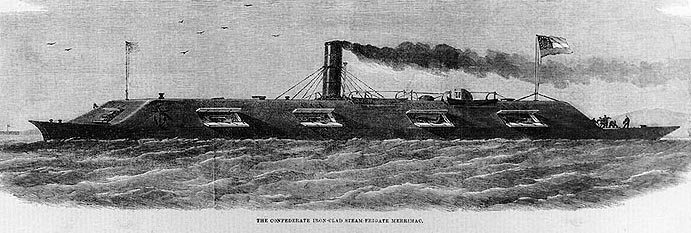
The Confederate Navy was way ahead of its time.
Function drives design. Sloped sides are better for making things bounce off. In the case of those ironclads it was cannon balls. In the case of modern surface combatants it’s radar waves.
Oh, and keep in mind that the reason this won’t happen is the same reason why the LCS design was so underarmed to begin with: producing an effective but low cost platform presents risks to the budgets for the effective but high cost platforms.
Isn’t the long term plan to phase out the 5” for a 6” (155mm) gun? Isn’t the navy about 15 years into a 5 year plan on that? Of course, it is incompatible with existing 155 guns, and no ammo exists for the new gun, but other than that, the program is fine.
(Sigh) The Desmoines class of cruisers had automatic 8 inch guns. That was a real punch
Probably a bit much for these small ships.
So why not just turn the battleships back on? I remember many years ago James Webb claiming that it took less money to refit a battleship than it did to build a destroyer.
Refitting is one thing. The costs associated with specialty schools and the crews are another and thats what drove the Iowas back out of service in the early 1990s. There are too few of them, they don’t provide enough coverage and they’re too expensive to operate for the capability they provide.
The LCS in concept is right for a lot of what the Navy needs, and for which. Burke Aegis destroyed is complete overkill. The upgraded Saudi LCS, however, is what the LCS should have been from the start.
That was the long-term plan starting with the Zumwalts. But there are only going to be three of them, and the third (LBJ) looks like it’ll lose one of it’s 155mm for a railgun.
In the meantime we’re continuing to build Burkes. I’m guessing that in the next 10 years or so there’ll be a move to “Flight IV” Burkes that’ll be reclassified as cruisers as the Ticonderogas retire. If only to preserve the O6 sea command billets ;-)
This affects not just the Navy, but also all the congressional districts and defense contractors which produce the parts for the more expensive platforms.
Much is made over the fact that the US has a much bigger defense budget than our major adversaries. Unexamined is how much of that defense budget is pissed away (or skimmed). Are we really getting the most bang for our bucks?
Interesting. Did the navy manage to get the gals on the battleships ever or was that all male?
Disclaimer: Opinions posted on Free Republic are those of the individual posters and do not necessarily represent the opinion of Free Republic or its management. All materials posted herein are protected by copyright law and the exemption for fair use of copyrighted works.