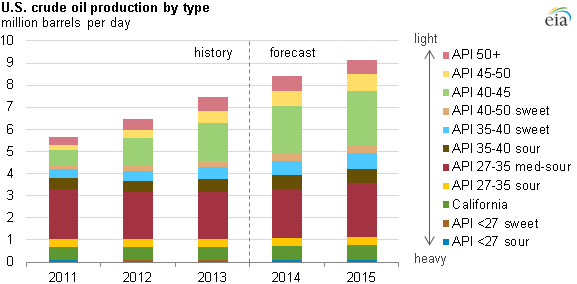
The API gravity of condensate is typically 50 degrees to 120 degrees.
Posted on 06/25/2014 4:54:38 AM PDT by thackney
The Obama administration has cleared the way for two energy companies to sell an ultralight variety of oil overseas after minimally processing it, a decision that tests the limits of a long-standing ban on exporting U.S. crude.
The move, which came in private classification orders issued by the Commerce Department’s Bureau of Industry and Security, effectively confirms that hydrocarbon known as condensate qualifies as a petroleum product once it has been processed in a distillation tower, and therefore is not barred by the 39-year-old ban on crude exports.
Unlike unprocessed crude, companies can freely sell gasoline, diesel and other petroleum products overseas.
New path for exports
The decision falls far short of what oil producers and some of their allies in Congress have been urging — including a wholesale repeal of the trade limits on crude. But it could provide a new avenue for the ultra-light condensate that flows along with crude out of many Texas wells tapping the Eagle Ford Shale and effectively delay a broader, deeper debate about broader crude exports.
Because the classification ruling is limited to condensate that has been run through a distillation tower, it does not apply more broadly to unprocessed condensate that has just flowed out of oil and gas wells.
Distillation involves using heat and condensation to separate hydrocarbons into their different streams and generally goes beyond simply stabilizing condensate for pipeline transport by boiling off butane and other light, volatile gases.
The classification rulings for Pioneer Natural Resources and Enterprise Product Partners, first reported by the Wall Street Journal, were confirmed by an energy industry lobbyist and congressional staff.
Pioneer said in a statement that BIS agreed with the company’s interpretation that the distillation process it uses to stabilize condensate from its Eagle Ford Shale wells “is sufficient to qualify the resulting hydrocarbon stream as a processed petroleum product eligible for export without a license.”
The company said the stabilization processes at its central gathering facilities in the Eagle Ford Shale involve a distillation unit that lowers vapor pressure and removes volatile lighter hydrocarbons.
The Commerce Department’s ruling does not change the decades-old regulations that effectively block most crude from crossing U.S. borders, but it is expected to embolden other oil companies to follow suit.
Department of Commerce Spokesman Jim Hock stressed that “there has been no change in policy on crude oil exports.”
“Consistent with the regulatory definition, crude oil that has been processed through a distillation tower which results in the crude becoming a petroleum product is no longer defined as crude oil,” Hock said. ”Petroleum product can be exported without a license, except in very limited circumstances.”
The move could counter fears of a condensate glut stemming from vigorous Eagle Ford prediction, said Benjamin Salisbury, with FBR Capital Markets & Co.
“It does not constitute a loosening of the ban on crude oil exports,” Salisbury added in a research note to clients. “Processing oil, including condensate, through a distillation tower has been the defining feature of a product allowable for export for years under Department of Commerce rules.”
Legal protection
The BIS classification orders issued to Pioneer and Enterprise are technically not needed to export refined petroleum products, but they provide a legal guarantee and assurance for companies that want to ensure they are not running afoul of U.S. trade law. That kind of legal protection may be especially valuable for first-moving companies testing the limits of the crude export ban.
Sen. Lisa Murkowski, R-Alaska, who has called for broad crude export sales, praised the move but said more needed to be done to ensure a global marketplace for the surging production of light, sweet crude from U.S. wells.
“Commerce’s decision to allow companies to process condensate and export the resulting products is a reasonable first step that reflects the new reality of our energy landscape,” Murkowski said. “The rules remain outdated, nonetheless, and should be modernized. I continue to urge the administration to fully lift the ban on crude oil and condensate exports.”
Murkowski also has urged the Obama administration to affirmatively rule that all condensate — whether or not it has been processed in a distillation tower — can be freely exported.
Free trade
An American Petroleum Institute spokesman said that “allowing export of processed condensate would be a very small step toward a much more important goal, which is free trade.”
“We’re pleased the administration is paying attention to the issue and urge policymakers to fully lift the restrictions that are limiting America’s potential as an energy superpower,” the spokesman said.
The rulings could at least temporarily assuage oil companies worried about excess light sweet crude and relieve some of the pressure posed by growing condensate production. The effect could be to postpone the point when the U.S. potentially produces more condensate than it can quickly use, effectively delaying broader changes to the nation’s oil export policy.
FBR’s Salisbury said the move is more likely a sign of the Obama administration’s willingness “to facilitate reasonable trade in energy rather than a stepping stone to export ban repeal.”
Chemically different
Although condensate is more like gasoline than crude, condensate has historically been swept under the oil export ban — at least as long as the light hydrocarbon is coming out of oil and gas wells. Under current regulations, condensate can be freely exported if it is produced at gas processing plants.
There is widespread disagreement — even within the oil industry — about how to define condensate. The ultra-light hydrocarbon generally flows as a liquid at normal temperatures even if it is a gas underground.
Because of the varying definitions, it is unclear how much condensate is produced inside the United States, though some energy experts say more than 1 million barrels are extracted daily.
The Energy Information Administration just launched studies looking more closely at domestic condensate production and other issues tied into the broader debate over crude exports.
Because of the amount of condensate flowing from the Eagle Ford formation — and its proximity to distillation equipment and ports along the Gulf Coast — the BIS rulings could help open the gate for more Texas condensate, once lightly distilled, to be sold overseas.
Already, several midstream companies have announced plans to build new condensate splitters in the region. The BIS rulings — as well as any broad change in the policy on crude exports — could undermine the plans.
Some oil companies have been blending condensate with crude, but there are limits to that workaround, in part because condensates have a relatively low energy density. Others have steered lease condensate to Canada’s oil sands, where it can be blended with dense bitumen for pipeline transport.
Slippery slope
Sen. Ed Markey, D-Mass., who opposes oil exports, said the Commerce Department’s decision “puts America on a slippery slope to send more of our oil abroad, even at a time when the Middle East is in disarray and tensions are running high with Russia.”
“We should keep our resources here at home for American families and businesses, not send this oil abroad even as we import oil from dangerous regions of the world,” Markey said in a statement.
Some oil producers have been pushing the Obama administration and Congress to lift the 39-year-old ban on exports, insisting the change is needed because U.S. refineries are geared more toward heavy crudes, instead of the light, sweet variety increasingly flowing out of domestic wells. Refiners say they have already made changes to accommodate U.S. light sweet crude — including reducing imports of the fossil fuel — and can take further steps to use more of the U.S. oil.
The existing export ban already has some exceptions for sales to Canada, some Californian crude and Alaskan oil.
But oil companies are increasingly looking for new avenues to send their domestic crude production overseas. For instance, Continental Resources has asked the Commerce Department’s Bureau of Industry and Security to approve a “swap” of U.S. crude for foreign supplies — an exchange that also can be allowed on a case-by-case basis.
So the regime is going along with this so we don’t get a broader law that allows selling crude abroad—figures.
Because of the effective oversupply of this very light petroleum, not the heavy oil most of the local refineries are designed to handle, producers are seeing depressed prices for this product.
It helps our trade balance, it keeps more jobs in the US. It is a good thing.
How about approving the building of refineries to handle this creating even more jobs? Hmm?
We already refine more oil than we use ourselves.
We already spent Billions of dollars upgrading our refineries to use heavier, cheaper oil that contains more energy per barrel.
Spending more money to use lighter, more expensive oil that has less energy per barrel makes no sense, especially since we already have surplus refinery capacity.
The API gravity of condensate is typically 50 degrees to 120 degrees.
So we have built how many new refineries in the last 30 years? All we hear about are that the existing refineries are operating at lights out capacity. If supply outstrips demand, then why are we seeing the prices continue to rise outside of the speculation? Speculation is driven by supply and demand.
http://www.eia.gov/tools/faqs/faq.cfm?id=29&t=6
There were a total of 143 operable petroleum refineries in the United States as of January 1, 2013.
The “newest” refinery in the United States began operating in 2008 in Douglas, Wyoming. However, the newest refinery with atmospheric distillation capacity greater than 100,000 barrels per day began operating in 1977 in Garyville, Louisiana.
Ground was broken in March 2013 for construction of a new refinery in North Dakota. The 20,000-barrel-per-day (bbl/d) Dakota Prairie facility is scheduled to be built in 20 months.
Capacity has also been added to existing refineries through upgrades or new construction. The most recent examples include:
In 2012, Motiva upgraded its refinery in Port Arthur, Texas, making it the largest refinery in the U.S. with a capacity of 600,250 barrels per calendar day.
In 2009, Marathon upgraded its Garyville, Louisiana refinery. As of January 1, 2013, the capacity is more than double its original 1977 capacity.
I believe there are at least a couple of Midwest refineries that underwent expansion, yet the owners wish they hadn’t...
The newest refineries currently operating in the United States are as follows:
| Year Built | First Operated | Location | Original Owner | Original Capacity | Current Owner | 2011 Capacity | Type |
|---|---|---|---|---|---|---|---|
| 2008 | 2008 | Douglas, WY | Interline Resources | 3,000 | Antelope Refining | 3,800 | Simple |
| 1998 | 1998 | Atmore, AL | Goodway | 4,100 | Goodway | 4,100 | Simple |
| 1993 | 1993 | Valdez, AK | Petro Star | 26,300 | Petro Star | 55,000 | Simple |
| 1991 | 1992 | Ely, NV | Petro Source | 7,000 | Foreland | 2,000 | Simple |
| 1986 | 1987 | North Pole, AK | Petro Star | 6,700 | Petro Star | 19,700 | Simple |
| 1985 | 1986 | Prudhoe Bay, AK | ARCO | 12,000 | ConocoPhillips | 15,000 | Simple |
| 1981 | 1982 | Thomas, OK | OK Refining | 10,700 | Ventura | 12,000 | Simple |
| 1979 | 1980 | Wilmington, CA | Huntway | 5,400 | Valero | 6,300 | Simple |
| 1978 | 1979 | Vicksburg, MS | Ergon | 10,000 | Ergon | 23,000 | Simple |
| 1978 | 1979 | North Slope, AK | ARCO | 13,000 | BP Exp AK | 10,500 | Simple |
| 1978 | 1978 | North Pole, AK | Earth Resources | 22,600 | Flint Hills | 127,987 | Simple |
| 1977 | 1978 | Lake Charles, LA | Calcasieu | 6,500 | Calcasieu | 78,000 | Simple |
| 1976 | 1977 | Garyville, LA | Marathon | 200,000 | Marathon | 522,000 | Complex |
| 1976 | 1977 | Krotz Springs, LA | Gold King | 5,000 | Alon | 80,000 | Complex |
| 1975 | 1975 | Corpus Christi, TX | Saber | 15,000 | Valero | 200,000 | Complex |
| 1967 | 1967 | Good Hope, LA | Kirby Industries | 6,500 | Valero | 205,000 | Complex |
All we hear about are that the existing refineries are operating at lights out capacity.
You should read more of my posts. While it is always in a company's interest to maximize production versus cost, we have been refining more product that the US uses for a while.
If supply outstrips demand, then why are we seeing the prices continue to rise outside of the speculation?
Demand continues to grow with increased production, but are you talking about the crude oil which is the reason for most of the price or the refined products?
In 2012, Motiva upgraded its refinery in Port Arthur, Texas, making it the largest refinery in the U.S. with a capacity of 600,250 barrels per calendar day. In 2009, Marathon upgraded its Garyville, Louisiana refinery. As of January 1, 2013, the capacity is more than double its original 1977 capacity.
As you noted, while it has been a while since we built a new major refinery, we have spent the last few decades expanding and upgrading our existing refineries for less cost.
Head, meet wall.
?????
We refine more than we use. We export the surplus.
Why is that hard to understand?
Disclaimer: Opinions posted on Free Republic are those of the individual posters and do not necessarily represent the opinion of Free Republic or its management. All materials posted herein are protected by copyright law and the exemption for fair use of copyrighted works.