Posted on 01/31/2014 3:15:17 PM PST by Kaslin
Self awareness is supposed to be a good thing, so I’m going to openly acknowledge that I have an unusual fixation on the size of government.
I don’t lose a wink of sleep thinking about deficits, but I toss and turn all night fretting about the overall burden of government spending.
My peculiar focus on the size and scope of government can be seen in this video,  which explains that spending is the disease and deficits are just a symptom.
Moreover, my Golden Rule explicitly targets the spending side of the budget. And I also came up with a “Bob Dole Award” to mock those who mistakenly dwell on deficits.
With all this as background, you’ll understand why I got excited when I started reading Robert Samuelson’s column in today’sWashington Post.
Well, there’s a presidential whopper. Obama is right that the role of the federal government deserves an important debate, but he is wrong when he says that we’ve had that debate. Just the opposite: The White House and Congress have spent the past five years evading the debate. They’ve argued over federal budget deficits without addressing the underlying issues of what the government should do, what programs are unneeded, whether some beneficiaries are undeserving… The avoidance is entirely bipartisan. Congressional Republicans have been just as allergic to genuine debate as the White House and its Democratic congressional allies.
By the way, I have mixed feelings about the final sentence in that excerpt. Yes, Republicans oftentimes have displayed grotesque levels of fiscal irresponsibility. Heck, just look at the new farm bill. Or the vote on the Export-Import Bank. Or the vote on housing subsidies. Or…well, you get the point.
On the other hand, GOPers have voted for three consecutive years in favor of a budget that restrains the growth of federal spending, in large part because it includes much-needed reforms to major entitlement programs such as Medicareand Medicaid.
But Republican inconsistency isn’t our focus today.
 I want to address other parts of Samuelson’s column that left a bad taste in my mouth.
He argues that you can’t balance the budget merely by cutting discretionary programs. That’s technically untrue, but it’s an accurate assessment of political reality.
I’m much more worried about his assertion that you can’t balance the budget even if entitlement spending also is being addressed.
Let’s look at what he wrote and then I’ll explain why he’s wrong.
Eliminating many programs that are arguably marginal — Amtrak, subsidies for public broadcasting and the like — would not produce enough savings to balance the budget. The reason: Spending on Social Security, Medicare and other health programs… But even plausible benefit trims for affluent retirees would still leave deficits. There would still be a need for tax increases.
This is wrong. Not just wrong, but demonstrably inaccurate.
The Ryan budget, for instance, balanced the budget in 2023. Without a single penny of tax hikes.
Senator Rand Paul and the Republican Study Committee also have produced balanced budget plans. Even as scored by the statists at the Congressional Budget Office.
By the way, you don’t even need to cut spending to balance the budget. Spending cuts would be desirable, of course, but the key to eliminating red ink is simply making sure that government spending climbs at a slower rate than revenues.
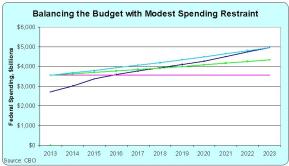 And since revenues are expected to grow by about 6 percent per year, it shouldn’t take advanced knowledge of mathematics to realize that the deficit will fall if spending grows by less than 6 percent annually.
Indeed, we could balance the budget as early as 2018 if spending merely was restrained so that the budget grew at the rate of inflation.
But never forget that the goal of fiscal policy should be shrinking the size and scope of the federal government, not fiscal balance.
Ask yourself the following questions. If $1 trillion floated down from Heaven and into the hands of the IRS, would that alter in any way the argument for getting rid of wasteful and corrupt parts of the federal leviathan, such as theDepartment of Housing and Urban Development?
If the politicians had all that extra money and the budget was balanced, would that mean we could – or should – forget about entitlement reform?
If there was no red ink, would that negate the moral and economic imperative of ending the welfare state?
In other words, the first part of Samuelson’s column is right. We need a debate about “the underlying issues of what the government should do, what programs are unneeded, whether some beneficiaries are undeserving.”
But we’re not going to come up with a good answer if we don’t understand basic fiscal facts.
if it dont fit in my wallet it is too big
We should have that debate, and debate whether we even need certain federal departments. We should evaluate if they are performing their function.
For example, do we have better access to housing since we’ve had a Department of Housing and Urban Development?
Do we have better access to more reliable sources of energy since we’ve had a Depaetment of Energy?
Is the state of public education improved since we’ve had a Department of Education?
Every piece of federal bureaucracy should be looked at, to see if they perform a needed function. If not, terminate these departments.
There are very few Republicans in government who could argue for the correct side, unfortunately
read
We don’t need a debate. We need to downsize government, now. It is too big, too expensive, too corrupt, too controlling, too invasive, too incompetent and too un-American. There has been too much talk and too little action. Wake-up Americans.
 how do you debate people not smart enough to understand the business model of a lemonade stand???

bkmk
I see this locally as well. The budget for the military is on the down trend as far as a percent of Fed spending at any rate, and the Pentagon has proposed base closings. The local Dems, and some R's seem to favor less military spending, buy they all fight like hell to keep all of the local bases open.
It seems they don't see them as military bases, but as local jobs programs.
Frankly, I don't know if the local bases serve a vital or even important interest in our National defense, but if you want bipartisan agreement in this area, try closing down one of those bases. Even the most left wing anti military Dems will fight tooth and nail to stop it.
Not one of them, Rs or Ds, really want to cut Federal spending and cull back the size of government.
the default position for any government action should always be negative, so that its advocates have to justify it:
Is it constitutional?
Is its objective desirable?
Will it actually achieve that objective?
Is there a way to measure its progress, and to define when it has achieved the objective?
Will it end when it achieves its objective?
Will it end when it becomes obvious that it will not achieve its objective?
Is its cost and collateral damage worth it?
Disclaimer: Opinions posted on Free Republic are those of the individual posters and do not necessarily represent the opinion of Free Republic or its management. All materials posted herein are protected by copyright law and the exemption for fair use of copyrighted works.