Skip to comments.
Heating oil futures contract now uses ultra-low sulfur diesel fuel
Energy Information Administration ^
| MAY 10, 2013
| Energy Information Administration
Posted on 05/10/2013 6:06:55 AM PDT by thackney
Historically, standard futures contracts for heating oil allowed for delivery of product with sulfur content up to 2,000 parts per million (0.2%). Beginning with the May 1, 2013 contract, the New York Mercantile Exchange (Nymex) switched its specification for the heating oil futures contract to the ultra-low sulfur diesel specification (ULSD). The ULSD contract is a distillate that contains less than 15 parts per million (ppm) of sulfur, the same specification used for most diesel fuel. Many states in the Northeast require the switch over the next several years (see chart) to lower sulfur heating oil. Switching the contract to reference ULSD lets market participants more easily hedge their distillate investments.
The new contract specifications were announced in April 2012 and took effect with futures contracts for delivery starting in May 2013 that are traded on Nymex and the CME Globex platform. The new specifications reflect the changing regulatory climate for heating oil in northeastern states, which as a region have the highest consumption of heating oil in the United States. The new contract will have a physical effect as well, by changing the nature of the products stored by industry in New York Harbor (NYH) tankage. Because NYH is the delivery point of the Nymex futures contract and because most terminals are expected to store only one commingled product (ULSD), rather than segregating two distillate products (home heating oil and ULSD), physical delivery of higher sulfur home heating oil would become difficult in the near future.
New York was the first state to limit sulfur content in distillate used for heating purposes in July 2012, requiring that heating oil contain less than 15 ppm. Other northeastern states plan to follow suit, with Connecticut, Maine, Massachusetts, New Jersey, and Vermont all scheduled to require ULSD for heating purposes by 2018.
This change is likely to result in a slightly higher heating oil futures price when compared to historical prices. Since ULSD contains lower amounts of sulfur and requires more refining steps to make, it typically has a premium to distillate fuels with higher levels of sulfur. In February and March, the difference between the April heating oil contract and the May heating oil contract averaged nearly $0.08 per gallon.
TOPICS: News/Current Events
KEYWORDS: diesel; energy; heatfuel; ulsd
Navigation: use the links below to view more comments.
first 1-20, 21 next last
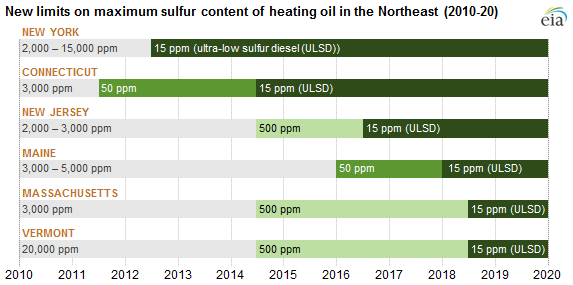
Source: U.S. Energy Information Administration.
Note: Connecticut has passed legislation with the above requirements. However, the law requires New York, Massachusetts, and Rhode Island to have similar restrictions in place to trigger compliance, and as a result, no sulfur restrictions are yet enforced on heating oil. Specifications change on July 1 of the years shown, with the exception of Maine's requirements, which change on January 1.
Note: ppm denotes parts per million
1
posted on
05/10/2013 6:06:55 AM PDT
by
thackney
To: thackney
So ... my summer heating oil discount ... isn’t ?
2
posted on
05/10/2013 6:12:49 AM PDT
by
knarf
(I say things that are true ... I have no proof ... but they're true)
To: thackney
I wonder if this will help create a market for bio-diesel.
To: thackney
This will cause more oil-fired condensing equipment to be developed. The sulphuric acid issues with earlier condensing equipment should be mitigated considerably with the ULSD.
4
posted on
05/10/2013 6:14:47 AM PDT
by
headstamp 2
(What would Scooby do?)
To: headstamp 2
I would expect newer equipment to be based on much cheaper fuels like Natural Gas.
5
posted on
05/10/2013 6:16:39 AM PDT
by
thackney
(life is fragile, handle with prayer)
To: taxcontrol
The price of Sulfur may drop.
6
posted on
05/10/2013 6:17:46 AM PDT
by
Paladin2
To: thackney
NG and propane companies are grinning at this I bet.
I can’t believe more people haven’t converted over from oil by now, I know in some rural areas it is difficult, but the savings is substantial.
7
posted on
05/10/2013 6:23:40 AM PDT
by
Abathar
(Proudly posting without reading the article carefully since 2004)
To: Abathar
I live in upstate NY and have an oil furnace and hot water heater. I use about 100 gal of oil a year. Main heat is from a wood stove (12 face cords per year). Switching to gas would cost $10,000 or more for installation. I’ll stay as I am.
8
posted on
05/10/2013 6:37:02 AM PDT
by
AMiller
(Frank Zappa)
To: thackney
“I would expect newer equipment to be based on much cheaper fuels like Natural Gas.”
In many areas now you will have the option to switch to more efficient oil condensing equipment with ULSD. There are many areas up here in the NE that don’t have access to Natural gas and won’t anytime soon. Propane is a more expensive option than oil but you can get the ability to use condensing equipment with it.
Higher sulphur fuel oil presented bad corrosion problems with the first attempt at oil condensing equipment. You could get efficiencies now to rival Nat Gas with ULSD.
Oil has more firepower than Nat gas also.
9
posted on
05/10/2013 6:41:18 AM PDT
by
headstamp 2
(What would Scooby do?)
To: headstamp 2
Propane is a more expensive option than oil When it is on par with ULSD I don't think that is going to be the case anymore.
10
posted on
05/10/2013 6:46:48 AM PDT
by
thackney
(life is fragile, handle with prayer)
To: Abathar
I can’t believe more people haven’t converted over from oil by now, I know in some rural areas it is difficult, but the savings is substantial.If the NG pipe doesn't go to your house it's not difficult, it's impossible. Around here propane is more expensive than oil so that's a non-starter. I am finally going to be able to switch to NG this year but it's going to cost me a bunch for a new furnace. I think I can see ROI in about 6 years though.
11
posted on
05/10/2013 7:04:50 AM PDT
by
Straight Vermonter
(Posting from deep behind the Maple Curtain)
To: Abathar
The issue with converting over from oil is to what alternative. I live in southern NH in a 40 year old house. I have forced hot water oil heat. I could convert to propane, but that is even more expensive. There I no NG pipeline in front of my house. It is unlikely there will ever be one in the future. Therefore, I put in a wood stove. The other alternative is a pellet stove or wood furnace.
All of these alternative heating sources require more than turning up the thermostat. The better wood stoves and pellet stoves cost $3000-4500 installed. I went with a woodstove because I have 12 acres of woods I own. I still have to cut, split, stack and haul wood. Then once a year I need to clean the chimney.
To: Abathar
Also, I am 50. I am not sure how much wood I will want to cut, split, stack and haul when I am 70.
I also mentioned outdoor wood furnaces as an alternative. The original models of these were very inefficient(50%). I have two buddies that own them. One owns a small sawmill. He states that he would never have one unless he had free wood.
There are more efficient models on the market now that have secondary combustion chambers. These outdoor furnaces can be $7500-$12000 installed.
Another alternative are pellet furnaces that have come on the market in the last few years. These are being installed with silo type storage units. This enables a direct feed into the furnace. You can then buy pellets in bulk cheaper than by the bag.
Lastly, the other alternative is anthracite coal. This comes washed in a bag to reduce the dust. These furnaces are actually just as efficient as oil burners(85-90%). They also have a hopper system that needs to be loaded every 3-4 days. There are also many different coal stoves on the market with automatic and manual shaker systems.
As you can tell, I have been researching the oil alternatives for quite a while.
To: Straight Vermonter
I was in the same boat when I built my house so I chose geothermal. The highest electric bill for a 3300 sq ft home has been $275, and that includes a family of five with three teenagers who love hot water. Initial cost is high, but the payback combining both heat and air was 6 years, and now I’m as happy as can be.
14
posted on
05/10/2013 7:55:30 AM PDT
by
Abathar
(Proudly posting without reading the article carefully since 2004)
To: thackney
LOL!
Das Goobermint finds ANOTHER way to screw the oldsters!!!
I guess ZIRP wasn't forcing them onto a dogfood diet fast enough...
15
posted on
05/10/2013 7:57:21 AM PDT
by
kiryandil
(turning Americans into felons, one obnoxious drunk at a time (Zero Tolerance!!!))
To: woodbutcher1963
See my post below, geothermal if you have any property at all can be kind of pricey to start, but once you get past the payback it’s great without the hassle of loading hoppers and stacking wood. I grew up on baseboard hot water oil heat and loved it, but here in Indiana we have some really hot days too, so having both cheap heat and air from a single unit has been a lifesaver when money got tight.
16
posted on
05/10/2013 8:00:27 AM PDT
by
Abathar
(Proudly posting without reading the article carefully since 2004)
To: Abathar
How has your maintenance/repair cost been?
My boss put one in about 10 yrs ago and large repair bills overwhelmed the operating savings.
Pumps, valves, expensive plumbers, etc
My next door neighbor has one that was open loop and last yr in the Indiana drought the well dried up and he had to go to a closed loop, another big expense.
17
posted on
05/10/2013 8:05:48 AM PDT
by
nascarnation
(Baraq's economic policy: trickle up poverty)
To: Straight Vermonter
If the NG pipe doesn't go to your house it's not difficult, it's impossible. Not quite; you can use storage tanks and have it delivered; but that raised the price you're paying.
Around here propane is more expensive than oil so that's a non-starter.
That's probably the biggest reason.
18
posted on
05/10/2013 8:18:29 AM PDT
by
OneWingedShark
(Q: Why am I here? A: To do Justly, to love mercy, and to walk humbly with my God.)
To: Abathar
We have some of the highest electricity rates in the country. Even after deregulation our rates are $.06895-.093/kilowatt.
To: nascarnation
I put mine in back in ‘99-’00 when I built my home and it was the best decision I ever made. I went with a Water Furnace 4 ton system with a 5 ton loop and it can handle my house with no problems at all.
I’ve had a couple of minor repairs, nothing major but I do have it serviced twice a year on a maintenance agreement with Dial One also. I absolutely love it, I own a 12 acre lake that I put the loop in and the thing just keeps on chugging along, I leave my thermostat at 70 year around and don’t touch it.
My largest bill was in the winter this year when the power company jacked my rates up a little (thank you Duke Energy) and it was still just under $300, normally I’m around $180/month but that covers the entire house with three teenagers who don’t yet grasp that 20 minute hot showers aren’t really necessary in the morning to wake them up.
My neighbor here in our industrial park has 6 big units that he heats and cools his machine shop with. He ran two kinds of loops, horizontal ground loops around his property, and he has 12 8” x 200 ft deep wells that he runs vertical as well. He had the same problem with his ground loops as your boss last summer, he ended up in August drilling a big water well (we have a really high water table here fortunately) and running a sprinkler system 24/7 on his loop which after a week or so did what mother nature wouldn’t.
I know there are a lot of different manufactures of these things, but Water Furnace has been great. Another thing I really like is I have a 25Kva generator I can put on my tractor in an emergency and completely run the house. (aside from delicate electronics, I don’t push my luck there) All in all depending on your situation getting a quote on one and getting an honest opinion on whether or not its right for you is worth your time. It’s not for everyone but if you have some property you could see some decent paybacks and also rate reductions and incentives to do it.
20
posted on
05/10/2013 10:12:23 AM PDT
by
Abathar
(Proudly posting without reading the article carefully since 2004)
Navigation: use the links below to view more comments.
first 1-20, 21 next last
Disclaimer:
Opinions posted on Free Republic are those of the individual
posters and do not necessarily represent the opinion of Free Republic or its
management. All materials posted herein are protected by copyright law and the
exemption for fair use of copyrighted works.
FreeRepublic.com is powered by software copyright 2000-2008 John Robinson