Skip to comments.
Japanese Manufacturing Output Falls for First Time in 2012
Townhall.com ^
| July 1, 2012
| Mike Shedlock
Posted on 07/01/2012 7:52:52 AM PDT by Kaslin
The short term effect of Japanese stimulus following the earthquake and tsunami has now worn off. All Japan has to show for that stimulus is a bigger pile of debt, proving once again the Broken Window Fallacy.
In the real world, Japan has a debt-to GDP ratio of 225% and rising. Japan's export machine has stalled. So has Japanese manufacturing in general.
Markit reports Japanese manufacturing output falls for first time in 2012 to date
June data pointed to the first month-on-month reduction in manufacturing output since December 2011, as both new business and new export orders fell. Backlogs of work decreased as a result, while employment growth eased to only a marginal rate. On the price front, factory gate charges fell further in June, in response to a first reduction of average costs in 20 months.
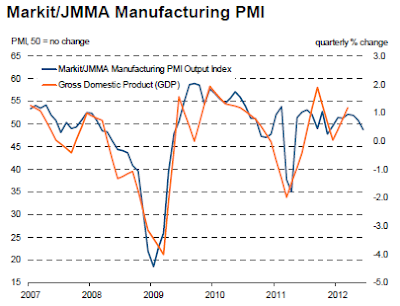
After adjusting for seasonal factors, the headline Markit/JMMA Purchasing Managers’ Index™ (PMI™) dipped fractionally below the neutral 50.0 threshold in June, to post its lowest reading in seven months.
Commenting on the Japanese Manufacturing PMI survey data, Alex Hamilton, economist at Markit and author of the report said:
“June data suggest that Japan’s manufacturing sector upturn is fading into mid-year, with output and new business falling simultaneously for the first time since December 2011.
Growth in the year to date has been supported by earthquake-related reconstruction projects. The latest survey findings indicate that the boost from these efforts is starting to ebb, however, with investment goods producers noting a particularly sharp fall in output during June. This bodes ill for growth heading into the second half of the year, especially given the fragility of demand in external markets – highlighted by an accelerated fall in new export business during June.”
Japan Doubles Sales Tax
The AP reports Lawmakers in Japan OK hike in sales tax
Japan's lower house voted Tuesday to double the country's sales tax to 10 percent over three years in a bid to rein in a bulging national debt as an aging population burdens the country's social security system.
The vote, however, shook Prime Minister Yoshihiko Noda's grip on power because of strong opposition from a group within the ruling party led by power broker Ichiro Ozawa that believes the tax hike will weaken the economy. Ozawa and his supporters have threatened to bolt the Democratic Party over the tax issue.
The bill passed easily by a vote of 363-96, with support coming from the two biggest opposition parties. The bill must still pass the less powerful upper house to become law, which is expected.
It calls for raising the sales tax from 5 percent to 8 percent in 2014, and then to 10 percent in 2015.
Even Noda's government projects the tax hike will take only a modest bite out of Japan's deficit. The Cabinet Office forecasts that doubling the sales tax will boost revenues by ¥13.5 trillion ($170 billion) annually by 2015. Japan currently runs a deficit of about ¥45 trillion ($563 billion) a year.
Ruling party veteran Ozawa, who has often criticized Noda and controls a bloc in the ruling party, has suggested he may leave the party and take as many lawmakers as he can with him to form a new one. If 54 or more lawmakers join Ozawa, Noda's party would lose its majority in the key lower house.
Japan is in a very tight situation. The US will find itself in a similar situation down the road if it listens to misguided economists hell-bent on getting government to waste more money.
TOPICS: Business/Economy; Editorial; Foreign Affairs; Japan
KEYWORDS:
1
posted on
07/01/2012 7:52:58 AM PDT
by
Kaslin
To: Kaslin
I heard that following the earthquake and tsunami, the quality of Japanese cars is in the tank, maybe not all makes, but if you buy Japanese this year, I would stick with 2010 and prior.
2
posted on
07/01/2012 8:04:50 AM PDT
by
WhatNot
To: Kaslin
The beginning of the end for Japan,INC. Since they scrapped nuclear power, they simply don’t have the energy to maintain a modern industrial culture. Their genetic losses in WW II were catastrophic and the demographics are hopeless. As their productivity declines they will be tempted to borrow heavily to maintain consumption aka Europe and the US. However they had better be careful going into unsustainable debt to the Chinese. The Chinese would not tolerate a default. The People’s Liberation Army would collect that debt with relish. It would be ironic to see Chinese troops in Japan about one hundred years after the Japanese atrocities in China.
3
posted on
07/01/2012 8:06:59 AM PDT
by
allendale
To: Kaslin
The tsunami and nuclear fallout happened where all three capacitor manufacturing plants are located.
Japan produced the world’s highest quality capacitors that are used in nearly every electronics device.
Chinese capacitors have been as good, but China lacks the quality control to weed out the bad ones.
With no other choice, the Chinese capacitors had to be used en masse but the poor QC required everyone of them to be tested instead of just sampling.
That greatly slowed production but forced up Chinese manufacturing of capacitors and QC.
Now the Chinese have the market and Foxcomm, whom produces 40% of the world’s communication electronics uses those capacitors.....in China with their 1.2 million workers.
Through accident of nature, Japan has permanently lost a manufacturing base for capacitor electronics.
4
posted on
07/01/2012 8:24:06 AM PDT
by
gandalftb
(The art of diplomacy says "nice doggie", until you find a bigger rock.)
Disclaimer:
Opinions posted on Free Republic are those of the individual
posters and do not necessarily represent the opinion of Free Republic or its
management. All materials posted herein are protected by copyright law and the
exemption for fair use of copyrighted works.
FreeRepublic.com is powered by software copyright 2000-2008 John Robinson