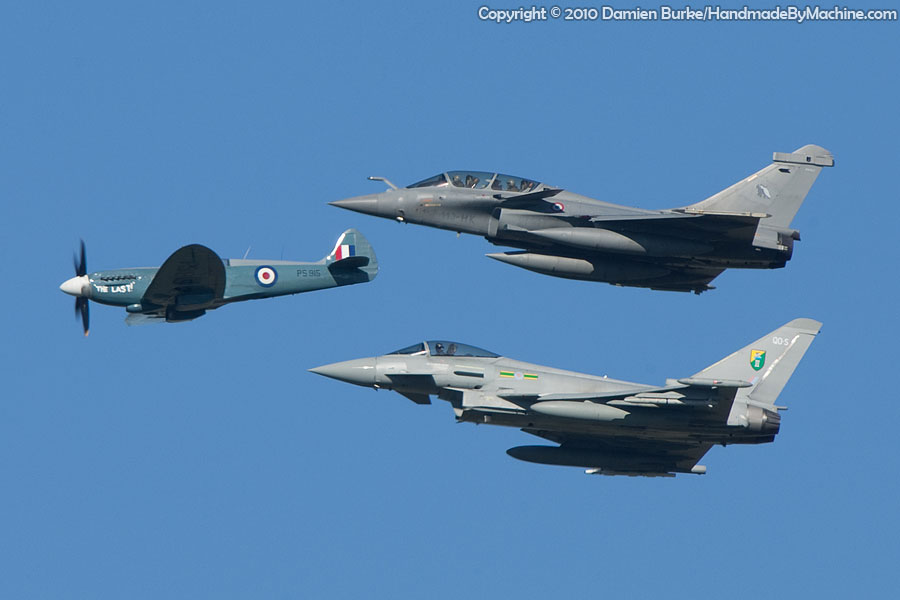
The contenders:-French Rafale (top), Eurofighter (below)
Posted on 05/01/2011 10:02:19 AM PDT by sukhoi-30mki
Sanjaya Baru: On a wing and a prayer
The decision to make India’s choice of fighter jet a purely technical one was, in fact, political.
Sanjaya Baru / New Delhi May 02, 2011, 0:28 IST
Major and strategically important defence purchases have rarely, if ever, been purely technical decisions. In the 1950s, Jawaharlal Nehru made political choices in opting to seal deals with the British, the Americans and the French. Nehru’s and Indira Gandhi’s switch to the Soviet Union in the early 1960s was a political and strategic decision. In her second stint in the 1980s, she turned westwards to Europe and Rajiv Gandhi followed suit. Narasimha Rao allowed Israel to open shop and Atal Bihari Vajpayee took the first step towards a strategic partnership with the United States. In each case, geo-political considerations took precedence over techno-economic evaluations.
No government decision to spend upwards of $11 billion on defence equipment could have been devoid of political and strategic calculations. Few will, therefore, readily accept the explanation that the decision to disqualify bids from the US, Russia and Sweden for a medium multi-role combat aircraft (MMRCA), and shortlist European jets, was purely technical. Even if that was the case, the decision to allow only technical considerations to dictate the choice was a political one.
Technical considerations must get priority. Also, one should not jump to the conclusion that it will mark an irreversible turning point in India’s relations with the US, which is visibly upset, more “angry” than “disappointed”. The least important part of the disappointment for the US would be the money lost because not only has the US done well in the past couple of years selling defence equipment to India, but it is also likely to get other big orders, like the $4-billion purchase order for Boeing’s C-17 transport aircraft, which according to US Ambassador to India Timothy Roemer would benefit “30,000 American workers and 650 American suppliers located in 44 states”.
However, international relations experts and strategic analysts have already commented that the very “de-politicisation” of this decision could well be a manifestation of a downslide in the India-US bilateral political relationship, compared to the heyday of the second Bush administration and the first Manmohan Singh government. Such a perception will have its own political and geo-political consequences.
What exactly is the deal about? The best analysis of the MMRCA tender has been offered by an Indian-American scholar of defence studies, Ashley Tellis, who also served as a policy advisor to the US State Department and the White House. In his lucid and, obviously, partisan analysis, Dogfight: India’s Medium Multi-Role Combat Aircraft Decision (available at: http://www.carnegieendowment.org/files/dogfight.pdf), Dr Tellis sums up: “The MMRCA bid has been one of the hottest recent aviation procurements not just in India, but internationally, too. Eight countries and six companies eagerly await the outcome of this contest. This has turned into such a sizzling affair not only because of the size of the contract. Indeed, there are bigger procurement battles raging internationally. Rather, this procurement bid has been incandescent because it involves geopolitics, the economic fortunes of major aerospace companies, complex transitions in combat aviation technology, and the evolving character of the IAF itself.”
Over several months in 2009-10, the Indian Air Force (IAF) conducted trials along India-Pakistan and India-China borders to test six different aircraft: Boeing F/A-18E/F Super Hornet and Lockheed Martin F-16IN Super Viper (US), Dassault Aviation’s Rafale (France), MiG-35 (Russia), the Eurofighter Consortium’s Typhoon (Germany, Italy, Spain and UK) and Saab’s Gripen (Sweden). By all accounts, the tests were extensive and exhausting. (This newspaper’s defence analyst Ajai Shukla has written extensively on the subject.)
Of the five jets which were rated on around 450 specs, Rafale and Typhoon were shortlisted based on technical parameters. Interestingly, neither the weightage or evaluation methodologies of the vital technical specifications nor the costs of aircraft have so far been considered a variable. Another “technical” consideration that seems to have been ignored so far is the extent to which the indigenisation of production, technology transfer and financial support would be offered by different suppliers. After all, the deal is not just to procure 126 or more jets, but to help modernise India’s aerospace industry.
Were the technical factors favouring the two European jets so overwhelming that they prevailed over any political considerations weighing in favour of either the US or Russia? Or, put differently, were political considerations so weak that they could not override technical factors? Was the MMRCA verdict an assertion of an “independent foreign policy”, as some gratuitous commentators suggest, or a manifestation of either political weakness or changing strategic preferences?
The decision to favour Europe in this deal could also have been prompted by concerns about European economies falling like ninepins and being bailed out by cash-rich China. Building partnerships in Europe is important, even if less so than building one with the US. Moreover, while promoting Europe as a partner of the IAF, the US can still emerge as the key partner for India’s increasingly important Navy.
Few will believe that politics played no role in the MMRCA decision. Instead, most will assume that the political factor in India’s strategic relations with the US has weakened since the days of the historic civil nuclear energy cooperation agreement. Has President Barack Obama’s “successful visit” to India not helped repair the damage done to the bilateral relationship in his first year in office? Are issues of strategic importance to India getting short shrift from US? Equally, and importantly, is the drift in India beginning to take its toll in terms of our long-term strategic planning?
The domestic political preoccupation of the leaders of the world’s largest democracies seems to have weakened the political foundation of an as yet evolving strategic partnership. That alone would explain the politics of a technical decision.
The contenders:-French Rafale (top), Eurofighter (below)
They probably made the decision to drop the US planes after seeing Obama when he went out to India. The guy is kryptonite.
Is there some consensus among military aviation experts on how the F/A-18 compares with the two European planes? Disregarding tech transfer, cost, and support in times of war, are the two European planes really considered technically better for India’s purposes?
The Super Hornet is a less costly and more mature aircraft with operational AESA radar and full integrated strike capability. Which translates into you having a higher possibility of getting it on time with all the promised capabilities. The two Euro-contenders are only getting gradual upgrades.
Where the Super Hornet lags is it’s performance-it’s more of a bomb truck than an agile fighter. A lot has been written about its deficiencies in turn rates and transonic acceleration on FR alone. A lot of reports/blogs in recent days claim that it performed poorly in the trials, esp the high altitude tests in Leh. The fact that it was offered with a brand new engine which is not in service points to concerns over its performance in the current configuration.
You can add ground attack capability to a fighter (F-15E, SU-30 and lots of other aircraft), but can you improve the aerial performance of a predominantly strike oriented aircraft to the same level??? I guess that’s the question the IAF would have asked. And that’s a legitimate one when you have the world’s second largest air force breathing down your neck.
Could be that the Indians believe that BO would favor China in the event of conflict with India.
Interesting, thanks for this info.
Disclaimer: Opinions posted on Free Republic are those of the individual posters and do not necessarily represent the opinion of Free Republic or its management. All materials posted herein are protected by copyright law and the exemption for fair use of copyrighted works.