Posted on 04/04/2011 10:48:53 AM PDT by sukhoi-30mki
How the Royal Navy changed US naval aviation
By Stephen Trimble
Americans may have invented it, but the British made naval aviation work. Jet-powered flight introduced a new set of challenges for aircraft carriers nearly 40 years after Eugene Ely's famous plunge off the foredeck of the USS Birmingham in November 1910.
Adapting the aircraft carrier's floating runway for the jet age meant reconsidering almost everything about carrier-deck design and operations that was known and proven during the crucible of the Second World War.
Making that transition would occupy the US Navy and the Royal Navy most of the decade following Japan's surrender, but many key ideas came from the British side of the Atlantic. "If you want to balance it out it's not a fair trade," says Bob Dunn, a retired US Navy vice admiral and aviator. "We took more from them than they got from us." The model for the modern aircraft carrier was set over nine months in 1955 when first the HMS Ark Royal and then the USS Forrestal entered service. Each represented that service's first aircraft carrier designed from the keel up to support jet-powered fighters, bombers and patrollers.
© US Navy
Catapults, angled decks and mirror landing aids eased the transition from propeller-driven aircraft to heavier, jet-powered types
While the Forrestal was a US-flagged ship, its most innovative design features all resembled the Ark Royal's in almost every detail. Both ships were the brainchild of a small group of thinkers embedded in the Royal Aircraft Establishment (RAE) at Farnborough.
In the winter of 1944-45, with the Battle of the Bulge still raging, the Royal Navy had already decided the future of naval aviation belonged to jets. "These officers took a look and said, 'We've got to figure out how to put jets on the carrier'," says Thomas Hone, a professor at the US Naval Warfare College and co-author of American and British Aircraft Carrier Development, 1919-1941.
Led by senior engineer Lewis Boddington, the RAE embarked on a series of experiments, starting inauspiciously with a short-lived concept for recovery fighter jets on carrier decks. That was the unlikely concept of the undercarriage-less aircraft and the rubber mattress deck. To increase the fuel-thirsty jet's range, aircraft designers removed the landing gear. Instead of landing on wheels, the concept required the jets to land by flaring to a stall slightly above the carrier deck and crashing on to a rubber mat. The results were predictable.
RUBBER-MAT APPROACH
"That didn't work for a number of reasons," Hone says. The rubber-mat approach seemed feasible when a master pilot such as the RAE's legendary Eric "Winkle" Brown flew the manoeuvre, but concerns persisted about the ability of more average pilots to pull it off. More generally, the rubber-mat solution was fine for the first wave of lightweight jet designs that emerged immediately after the Second World War. The USN quickly adopted a long-range strike strategy for its carrier-based fleets, which required ever-larger and heavier aircraft. The rubber mat was not so scalable. Ultimately, the companion idea of extending the range of jets by eliminating retractable landing gear faded for similarly practical reasons. It was never clear how crews would manhandle the wheel-less aircraft around the deck.
A long-term solution to the problem of landing jets on aircraft carriers lingered through the middle of 1951. The problem was not just about stopping aircraft with higher landing speeds, the goal was also to maintain the efficiency of flight operations at sea despite the transition to jets. Before the Second World War, US carriers, which emphasised the strike role of naval aviation, had found the answer in the "deck park", Hone says. This involved erecting large net barriers across the carrier's straight deck, allowing aircraft to continue landing in front of the barrier while other fighters were being re-armed and refuelled behind the barrier. It was a simple and efficient solution but only worked as long as propeller-driven aircraft required no more than half a typical carrier deck to take off or land.
INDUSTRIAL SPIRIT
With the transition to jets, the aircraft would need the entire length of existing straight-decks to come to a stop. The Americans' approach to this problem was typical of the nation's industrial spirit at the time, and new carriers sported ever-longer straight decks as the 1950s approached. The British, however, had a different idea. In August, Boddington for the first time heard a proposal from a British carrier pilot, then-Royal Navy Capt Dennis Cambell. "Together, they came up with this idea of angling the deck," Hone says. In one stroke, the problem was solved. Aircraft could be recovered in one section of the deck and not interfere with take-off and landing operations in another. It was a major, far-reaching innovation that changed the history of naval aviation forever. "In the past, they built the ship and then accommodated the ship to the airplanes," Hone says. The key idea of the angled deck was finally to design the ship from the start with the goal of making them suitable for handling take-off and landing operations for fast jets. The appeal of the angled deck was immediately recognised by the USN, which took the concept farther than the RAE's engineers had considered. While the British concept called for canting the deck by 4-5°, the USN adopted a more radical design with a deck angled by 8-10°, Hone says.
© US Navy
USS Forrestal's design features resembled the Ark Royal's
After experimenting with the USS Midway, the navy modified the USS Antietam with a slightly angled deck to conduct a full-scale demonstration. Both navies then took the next step and designed the Ark Royal and Forrestal from scratch as angled-deck carriers. Once the problem of deck layout was solved, the RAE focused its efforts on other needs demanded by the transition to jets. With aircraft designs introduced after the Second World War, carriers needed to provide more of a boost aligning the bow with the direction of the wind.
The steam catapult originated in the 1930s with both navies, but the idea was not developed further until after the war was over.
The British again revived the concept, generating steam pressure of 24.2bar (350lb/in2) off the boilers feeding the carrier's engines, Hone says. Americans initially worried about whether the concept could be scaled up to on larger US carriers, with boilers that produced steam at 41.4bar, but "it worked fine", Hone says.
Angled decks and catapults, however, were not enough to complete the transition from light, propeller-driven aircraft to heavier and mostly jet-powered types.
Guiding aircraft to a stop on the carrier deck became more of a challenge as aircraft landing speeds got faster. The previous system relying on landing system officers using flags to signal the glideslope to the pilot proved inadequate.
Royal Navy Rear Adm Nicholas Goodhart is credited with inventing the solution to this problem. It was called the mirror landing aid, and it uses a system of lights that are only visible to the pilot on a correct glideslope.
"This is way to coach the pilot onto the carrier," Hone says. "Jets came in fast, so they change position fast. It was better to have lights reflected in the mirror. The pilot has to react to it."
Is this system still in use or is it all done with radar now ?
“CALL THE BALL...”
ping
 Here is a picture of it.
In the early 50's, about the time that the Forrestal was in planning/design, the US Navy's focus was on developing a long-range, carrier based, SUPERSONIC nuclear bomber. This was before the Navy concentrated on sub-launched missiles as its primary offensive strike weapon.
The Navy came up with the Vigilante, a beautiful airplane (and much of the later FB-111 can be seen in the planes design.) I am no expert on this topic, by any means, but it would seem that the design of the Forrestal was mandated, to a great extent, by the size and take off/landing needs of the Vigilante.
Don’t know about carriers, but a similar concept is employed at civialian airports. The most popular is PAPI, which consists of a row of four lights. Two white and two red indicates the correct slope, more white than red means too high, and more red than white means too low.
Hone is wrong. The first British trials on HMS Triumph in 1952 used 10°. Having proved the concept, carriers completed/converted 1953-56 (HMS Centaur, Albion, Bulwark, Warrior Ark Royal, Eagle, HMAS Melbourne)used an 'interim' 5½°, which didn't call for major ship modifications (On Centaur, like the trials Triumph, the flight deck was "installed" with paint bushes)
Post 1956 Brit carriers used 8°.
The only people to use 4° were the French Navy on Arromanches
Does the system compensate for the pitch and roll of the ship ?
I don't think it does. If you think about it, you wouldn't want it to. If the ship's stern pitched up then the system would indicate the aircraft is 'low' relative to the flightdeck threshold. Seems to me that the aviator would want to know that.
I don’t know that the “Forrestal” was specifically designed around the A-5 Vigilantee, but it was designed around the concept of a nuclear-armed supersonic jet bomber. There was also a “USS United States” that was cancelled that was just a little bit ahead of it’s time.
Not really. It goes back earlier; 1946-49 when the plan was for a 100,000lb subsonic bomber and a ship (the first of a projected 4) to carry it, the USS United States
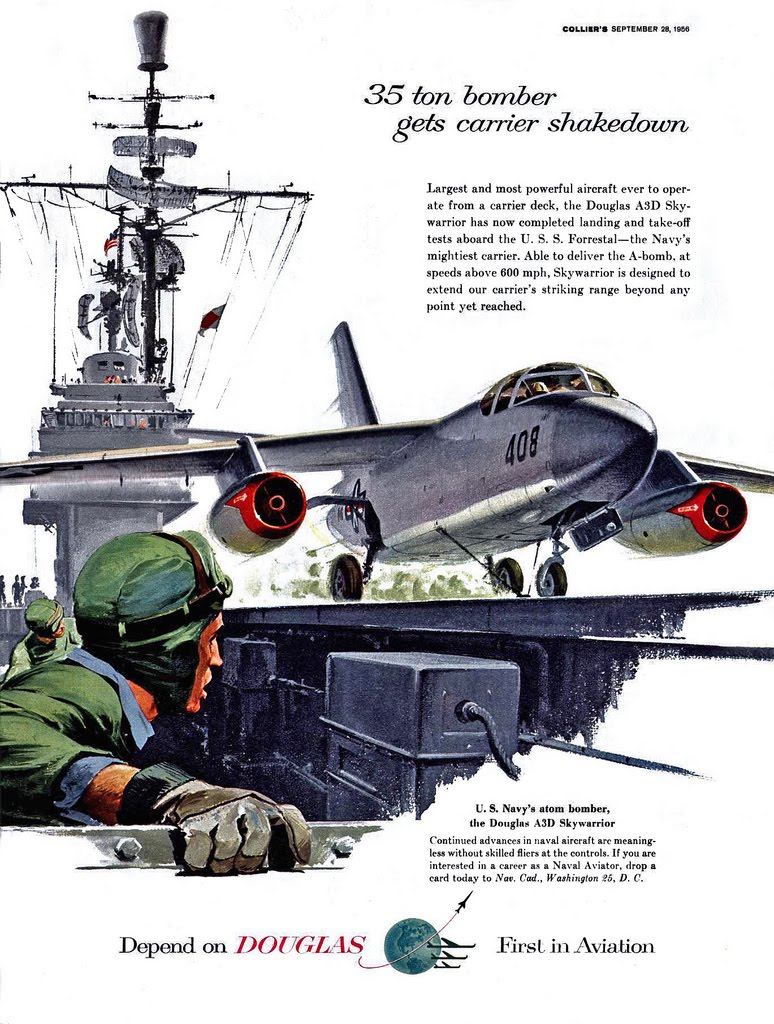
Douglas's Ed Heinemann realized this ship would likely be cacelled and designed a smaller aircraft, capable of doing the same job, that could operate off the existing Midway class carriers.
The Forrestals were sized to this aircraft (the A3D Skywarrior)
The Vigilante was then sized to the Forrestals
The Brits also pioneered armored flight decks..WW-II American carriers were still using wood flight decks.
I'm not sure. Following Trueblackmans info came across this Wikipedia entry which seems to indicate that they are gyroscopically controlled. See the section on Mirror Landing aids. http://en.wikipedia.org/wiki/Optical_Landing_System

Click on pic for past Navair pings.
Post or FReepmail me if you wish to be enlisted in or discharged from the Navair Pinglist.
The only requirement for inclusion in the Navair Pinglist is an interest in Naval Aviation.
This is a medium to low volume pinglist.
Curious that the idea of a flat deck/retractable bridge never got tried again..

French Navy Arromanches 4° 
Australian Melbourne 5½° 
Dutch Karel Doorman 8° 
Consider the relationship of the starboard edge of the landing deck to the forward lift. (actual landing deck, not the outer wingtip clearance line)
On full angle 8° it misses entirely, on interim 5½° it cuts a shallow triangle, on 4° it's a rectangle of more than half the lift area.
From what I understand and saw yes, I just hope they worked out all the bugs after all these yes as the mobile ball was always set up, but I think that might have been for the older pilots in the Wing.
Pluses and minuses to that concept
Disclaimer: Opinions posted on Free Republic are those of the individual posters and do not necessarily represent the opinion of Free Republic or its management. All materials posted herein are protected by copyright law and the exemption for fair use of copyrighted works.