
Posted on 03/08/2011 2:34:53 PM PST by TaraP
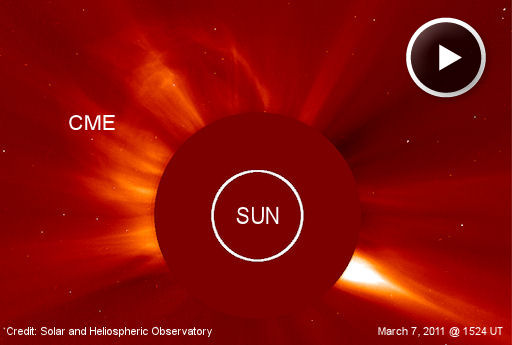
FAST CORONAL MASS EJECTION: A coronal mass ejection (CME) exploded from the vicinity of sunspot 1164 during the late hours of March 7th.
It lept away from the sun traveling some 2200 km/s, making it the fastest CME since Sept. 2005.
A movie of the cloud prepared by Karl Battams of the Naval Research Lab seems to show a small but non-negligible Earth-directed component. This CME and at least one other could brush against Earth's magnetic field on March 9th or 10th. High-latitude sky watchers should be alert for auroras.
Great pics!
Burp.
Cool, a solar flare or CME often makes for lots of fun for myself and other amateur radio operators.
When people start writing strings of numbers that correspond to future mass casualty rates, let me know.
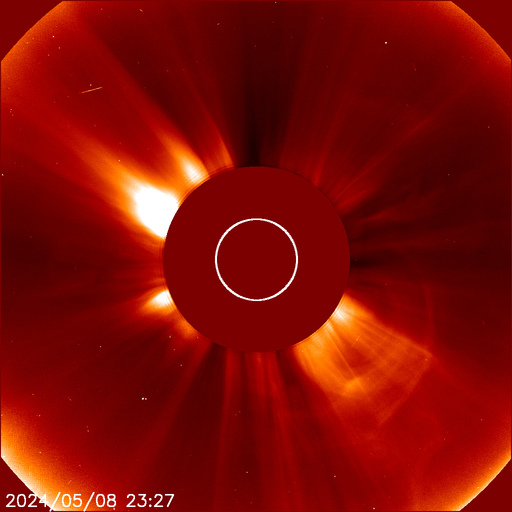
http://sohowww.nascom.nasa.gov/data/realtime/c2/512/
http://www.swpc.noaa.gov/alerts/warnings_timeline.html
Looks like AlGore after a 3-cheese burrito.
 http://www.foxnews.com/story/0,2933,478024,00.html
Solar storms have had significant effects in modern time:
— In 1989, the sun unleashed a tempest that knocked out power to all of Quebec, Canada.
— A remarkable 2003 rampage included 10 major solar flares over a two-week period, knocking out two Earth-orbiting satellites and crippling an instrument aboard a Mars orbiter.
“Obviously, the sun is Earth’s life blood,” said Richard Fisher, director of the Heliophysics division at NASA. “To mitigate possible public safety issues, it is vital that we better understand extreme space weather events caused by the sun’s activity.”
“Space weather can produce solar storm electromagnetic fields that induce extreme currents in wires, disrupting power lines, causing wide-spread blackouts and affecting communication cables that support the Internet,” the report states. “Severe space weather also produces solar energetic particles and the dislocation of the Earth’s radiation belts, which can damage satellites used for commercial communications, global positioning and weather forecasting.”
That sounds hot.
Ping!!
In post #3, there is a mention of the date of March 13th. Hmmm.

Just sent this to several hams to keep their eyes (ears) open!
March 19th is also Moonageddon...Actually
SUPERMOON...The closest the Moon can approach the earth...
What I find interesting, is thelast time the Moon came this close to the earth was in March of 1993..
March 12 to March 15th 1993
Was *THE STORM OF THE CENTURY*
The Great Blizzard.....
Can you tell me what bands and/or specific frequencies might be good for listening in the next day or so? Thanx. Degen 1103 here.
Usually propagation improves just before stuff hits the earth. Then Aurora comes in, bands go dead, then start slowly recovering, with high frequencies coming to life 28, 50 MHz.
—... ...—
Disclaimer: Opinions posted on Free Republic are those of the individual posters and do not necessarily represent the opinion of Free Republic or its management. All materials posted herein are protected by copyright law and the exemption for fair use of copyrighted works.