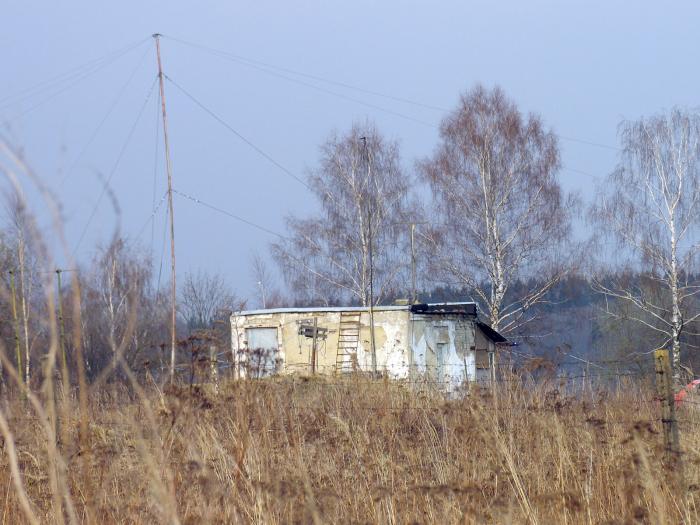
 Radio Beacon on Approach to Smolensk Air Base
Posted on 04/19/2010 2:12:27 AM PDT by theanchoragedailyruse
Type E/F-band (3 GHz spot frequency) 3-D early warning, Ground-Controlled Interception (GCI) and Air Traffic Control (ATC) radar.
Description The ground-mobile 1L117 3D early warning, GCI and ATC radar is an upgraded version of the P-37 early warning and GCI system that is 'almost entirely' solid-state (with the exception of its coaxial magnetrons and cathode ray tubes).
(Excerpt) Read more at janes.com ...
http://www.bdmilitary.com/index.php?option=com_content&view=article&id=305&Itemid=144
1L117M 3D Radar
The 1L117M mobile 3D radar is a long range radar system developed by Russia.
Mission
The 1L117M mobile 3D radar is designed to detect, identify and measure three coordinates (azimuth, slant range and altitude) of various aerial targets, as well as to provide radar data for external users.
The radar can be used as part of air defence and air force automated and non-automated air defence and air traffic control systems.
The 1L117M radar differs from its predecessor 1L117 radar by having the transmitter’s klystron-based power amplifier, which enhances stability of emitted signals, increases passive noise suppression characteristics and improves the radar’s ability to detect low-flying targets. In addition, frequency agility improves the radar’s jamming resistance when operating in heavy ECM environment.
System Composition:
The radar equipment is mounted on five vehicles:
Vehicle No. 1 – transceiver;
Vehicle No. 2 – control and datalink equipment and operators’ workstations;
Vehicle No. 3 – diesel-electric power plant with two diesel generators;
Vehicles Nos 4 and 5 – trailers to carry antenna systems and an SPTA set.
The radar has an all-weather capability and can operate in various climates at ambient temperatures between –40°C and +50°C, in relative humidity 98% and at an altitude above sea level amounting to 3,000 m.
The radar can be transported by automobile, railway and sea transport.
Radio Beacon on Approach to Smolensk Air Base
http://www.lemz.ru/eng/goods/rls/vip117/
The remote indicator post VIP-117 is developed on the basis of the application of computer aids, new technologies and software, and it can be used as an automated system for antiaircraft defence (AAD) and air traffic control (ATC) systems.
The VIP-117 system performs: primary (plot extraction) and secondary (tracking) processing of radar data with identification of data received from primary surveillance radar (PSR), secondary surveillance radar (SSR) and identification “friend-or-foe” (IFF) radar; displaying of air situation with labels “fastened” to target symbols; extrapolation of targets’ positions and prediction of conflict situations; input and display of graphic information; control of IFF modes; solving of guidance (interception) tasks; analysis and display of meteo information; statistical estimation of radar operation; formation of codified messages and their transmission to command posts and working positions; recording of radar and additional data with possibility of further replay at any time.
The VIP-117 system consists of the radar data extractor (central processor) and operators’ workstations (up to 8) which may be guidance navigating officers or ATC controllers. The radar data extractor (RDE) and workstations are furnished with 21-inch colour monitors with high resolution of up to 1280 _ 1024.
RDE can receive information from PSR, SSR and IFF radars either from digital or analog outputs.
As a result of processing air situation with target symbols and labels “fixed” to these symbols is shown on the displays of RDE and operators’ workstations (OWS). Additionally, on the RDE display there is a possibility to show pseudo-analog information, i.e. coordinate marks of targets with persistence traces within some periods of the antenna scanning.
The system, while calculating velocity vector, performs extrapolation of targets positions for a time period predetermined by an operator. At that extrapolation vector is shown on the display screen and such extrapolation vector indicates future position of a target. This also allows to predict possible conflict situations, i.e. dangerous distance between targets either in range or in altitude.
The operator is able to input into the system and to display any graphic information, e.g.: maps of air routes (air corridors) and restricted zones (areas prohibited for flights); terrain maps with indication of populated areas, roads, rivers and other ground features; positions of aerodromes, radio beacons and other navigation aids etc.
From the desk of the RDE control panel an operator can perform the control of identification modes and, if necessary, manual interrogation of a target.
To solve navigation tasks, the system provides an opportunity of measuring distance and heading between any two targets or points predetermined by an operator by means of a marker. At that, on the vector, which connects two targets (for example, an enemy aircraft and a fighter-interceptor), the current distance between these targets, current azimuth of the vector and time interval from the current moment to a moment of future interception are displayed. While switching on interception vectors for some aeroplanes, the operator is able to control the air fighting by choosing those fighters that have the best chances for attacking. If an operator simultaneously switches on the displaying of terrain map, he will be able to coordinate efforts aimed at destroying the enemy aircraft together with ground AAD systems.
The VIP-117 system is capable to carry out independently statistic analysis and to display meteo information in the presence of data from the radar amplitude channel at the RDE input. RDE forms coded messages and sends out radar data through a modem along standard telephone communication line without any distance limitations.
The VIP-117 system has a possibility to record radar situation with its further playback at any time. Recording is made on a hard disk. At the maximum load of the system (200 targets) the duration of an uninterrupted recording is 72 hours. Hard disk information may be rewritten onto floppy disks and stored during long periods.
The control system has a number of service capabilities, namely: selection of display scale; switching on and off of the graticule: large - with marks of 50 km, 30° or small - with marks of 10 km, 5°; off-centring the display screen, changing of displayed symbols colour; any additional data switching on and off and some other servicing functions. All control functions are carried out by means of a keyboard and a mouse manipulator using window menu.
The automated system VIP-117 is offered for interfacing with radars P-37, 1L117, P-18 and other radars of both Russian and foreign manufacturers.
http://www.lemz.ru/eng/goods/rls/1l117/
Additionally, these radars are provided with a built-in identification “friend-or-foe” (IFF) interrogator, with built-in equipment for primary (data extraction) and secondary (targets tracking) processing of radar data, with an attached set of remote display equipment, from whence these radars can be used in automated and non-automated systems of antiaircraft defence (AAD) and air traffic control (ATC).
(...)
New radars, due to high radar performance figure, detect and track both small sporting aeroplanes of Yak-52 type at low altitudes (50 m) and fighters of MiG-25 type up to altitudes of 25 000 m, at that the 3D radar provides measurement of altitude for aircraft flying from 50 m to 17,000 m of altitude.
(...)
Placing radar equipment in carriage bodies and trailers makes it easily transportable, if necessary, from one radar site to another. A time required for deployment or dismantlement of the radar on its site is 8 hours.
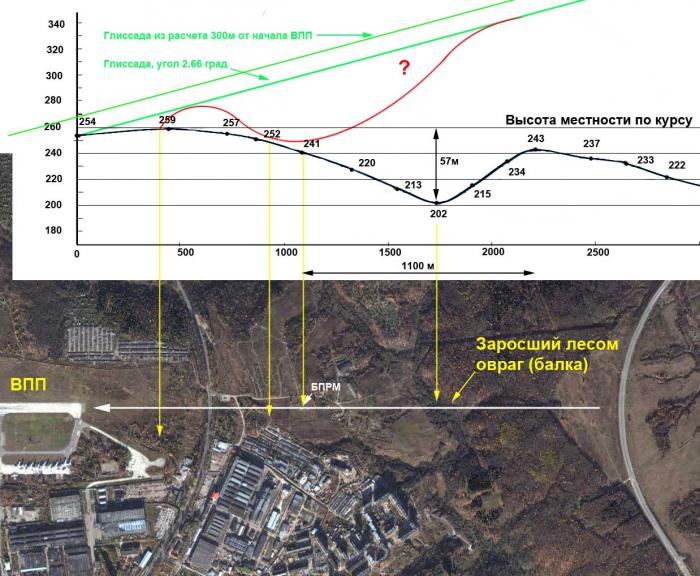 Glideslope At 1500 meters from runway, ATC notifies pilot that plane is off glide slope.
Third yellow line from runway (approx 1200 meters) is location of radio beacon.
Disclaimer: Opinions posted on Free Republic are those of the individual posters and do not necessarily represent the opinion of Free Republic or its management. All materials posted herein are protected by copyright law and the exemption for fair use of copyrighted works.