Skip to comments.
Free Trade Smackdown: Cato vs. USBIC, Griswold vs. Fletcher
WorldTradeLaw.Net ^
| March 1, 2010
| Ian Fletcher
Posted on 03/03/2010 4:32:58 AM PST by ianfletcher
Free Trade Smackdown: Cato vs. USBIC, Griswold vs. Fletcher
http://www.freetradedoesntwork.com/griswold_fletcher_debate.htm
Main Street America Benefits from Global Engagement
By Daniel Griswold
Americans are better off today because of our greater freedom to trade and work with people around the world. Our growing engagement in the world economy has delivered real benefits to Main Street Americans.
Competition from trade has blessed American families with lower prices, more choice, and better quality when we spend our paychecks. Because of trade, consumers pay lower prices for food, clothing, shoes, electronics, and cars, which translate directly into higher real incomes. The cars we drive today are safer and more fuel efficient because of import competition. The bargains that trade has delivered have done more to help struggling families make ends meet than any “stimulus” bill from Washington.
Trade has created better jobs for millions of Americans. Jobs connected to trade and foreign investment typically pay 15 to 30 percent more than average. Two-thirds of the net new jobs created in the past two decades have been in predominantly service sectors where average wages are higher than in manufacturing. Despite the recent recession, real median household income is still $4,000 higher than it was in 1993, and real compensation per hour (wages and benefits) is 23 percent higher.
Trade has allowed U.S. manufacturers to move up the “value ladder” by specializing in higher-end products that play to our strengths. Real output at U.S. factories is 37 percent higher than it was in 1993, the year before NAFTA was enacted. In 2007, American workers on American soil produced 5,000 civilian aircraft, 15,000 aircraft engines, 10 million motor vehicles, 25 million computers, 44 million heavy appliances, millions of tons of chemicals, and billions of semiconductors. American producers lead the world in such advanced products as medical equipment and pharmaceuticals.
America remains the world’s top manufacturing nation based on total value-added (domestic output less imports). We are producing more manufactured products with fewer workers because Americans have become so much more productive per hour worked. Rising productivity is the essence of competitiveness and the foundation for higher living standards.
America’s trade deficit is not a scorecard of trade policy. It reflects a continuing net inflow of foreign investment to the United States. That investment keeps long-term interest rates down, saving a typical homeowner $1,000 a year in mortgage payments. Foreign-owned affiliates in the United States employ more than 5 million American workers in well-paying jobs, including one out of eight manufacturing workers.
We cannot hope to prosper behind tariff walls. Three-quarters of the world’s spending power lies beyond our borders. U.S. companies and their workers cannot prosper in the long run without tapping into global markets. High trade barriers raise the cost of production for U.S. companies that need to import raw materials, supplies, and machinery. They also invite other countries to keep their barriers high to U.S. exports.
We tried protectionism in the 1930s and it was a colossal failure. It only deepened and prolonged the Great Depression and did nothing to reduce high unemployment. After World War II, Democrats and Republicans worked together to create a more open U.S. and world economy. Our more open era has seen the global poverty rate cut in half since 1981. A rising global middle class and deeper economic ties among nations have promoted not only more demand for U.S.-branded products but also the spread of democracy, human rights, and peace.
American leaders from Franklin Roosevelt to Ronald Reagan and Bill Clinton understood that expanding trade promotes prosperity at home while it enhances American influence abroad. Let us not repeat the mistakes of the past by closing ourselves off from a world of opportunity.
---------------------------------------------------
Free Trade Fails in Both Theory and Practice
By Ian Fletcher
Free trade is gradually bleeding America’s economy to death, and the much-promoted myth that economics vindicates it does not survive serious scrutiny.
To debate this issue without bogging down in semantics, we need to make a few things clear at the outset. For a start, the phrase “free trade” has two meanings, which are often confused:
1) The purely theoretical concept of perfectly free trade as analyzed in economics text-books.
2) The current free trade policy of the U.S. This is about 99%, not 100%, free on America’s part, and much less so on the part of our major trading partners.
Free traders often make arguments that would vindicate 1) if valid and then, assuming these arguments to be true, demand that we practice 2). This obviously does not follow. (Sometimes they say the solution is to make trade genuinely free all around the world, but this is infeasible, because the U.S. does not have sufficient political leverage to force this to happen.)
Some of the problems with free trade concern 2): foreign trade barriers, currency manipulation, and mercantilism generally. These are already fairly well-known.
The deeper problems concern 1) because – unbeknownst to most free traders and indeed many economists – even the theoretical foundations of free trade have been crumbling in recent years. The most recent scholarship on the issue casts huge doubt on traditional theoretical justifications for free trade and makes clear why the mercantilism that is being practiced against us can be such an effective economic strategy. It is gradually realigning theoretical economics with both economic history and the common-sense experience of ordinary Americans.
Free traders often duck the hard economics of whether free trade is best by simply resorting to skepticism about whether the U.S. is capable of honestly and competently implementing an alternative. Because the political problems of implementing a tariff varying by industry are well-known, let me be clear at the outset that the alternative I am arguing for is a flat tariff of, say, 30 percent, on all imports, both goods and services. Because there would be no discretion by Congress or the Executive to vary the tariff, these problems are not relevant to our debate here.
It is also necessary to be clear that when protectionists like myself speak of free trade as job-destroying, this refers to gross, not net, jobs, because workers who lose jobs to imports will generally find other jobs eventually. The national unemployment rate is primarily a function of labor laws and the business cycle, not trade or trade deficits. The problem is that free trade is currently destroying high-value-added and high-wage jobs (particularly in manufacturing) and driving Americans into nontradable sectors. Unfortunately, most nontradable jobs are low-value-added, low-wage jobs like security guards, waitresses and the like. It follows that a low unemployment rate does not, on its own, vindicate free trade.
Finally, we must distinguish between free trade being the optimal policy in the long run and the short run. In the short run, it is indeed true that free trade can maximize our consumption: in economic language, it maximizes satisfaction of consumer preferences. But this analysis takes no account of the long-term effects of imports upon our productive base. This is ultimately the big issue. David Ricardo’s theory of comparative advantage, the intellectual keystone of free trade, is a narrow theory which (although commonly misunderstood and vindicating free trade simpliciter) only speaks about optimizing present consumption. It does not even pretend to say anything about optimizing a nation’s long-term productive base, and thus leads to erroneous con-clusions when misused in this way.
TOPICS: Business/Economy; Foreign Affairs
KEYWORDS: dangriswold; freetrade; ianfletcher; protectionism; republicanroots
To: ianfletcher
There is no such thing as free trade. There never has been.
2
posted on
03/03/2010 4:39:51 AM PST
by
raybbr
To: ianfletcher
What about free trade in labor? It’s not good enough for free traitors to outsource production. For what’s left here, they import the H1-B wage slaves.
3
posted on
03/03/2010 4:49:22 AM PST
by
central_va
( http://www.15thvirginia.org/)
To: ianfletcher
"Pity the nation that wears a cloth it does not weave, eats a bread it does not harvest..."
Khalil Gibran (1883-1931)
4
posted on
03/03/2010 4:49:39 AM PST
by
drpix
To: raybbr
Correct, but there are countries with which we have free trade agreements*:
Australia
Bahrain
Canada
Chile
Costa Rica
Dominican Republic
El Salvador
Guatemala
Honduras
Israel
Jordan
Mexico
Morocco
Nicaragua
Oman
Peru
Singapore
The above is the "free trade policy" of the United States. Mr. Fletcher, in attempting to make things clear, simply muddies the water. If he is having trouble with the Harmonized Tariff Schedule of the United States, he should say so. Maybe he just assumes he has leeway because he's proposing a 30% flat tariff.
Should be an interesting debate, if it continues.
_____
Even some of these agreements are still a decade away from being fully implemented.
5
posted on
03/03/2010 4:53:32 AM PST
by
1rudeboy
To: central_va
H1-B wage slaves. Ha. Next time I meet one I’ll tell them that.
6
posted on
03/03/2010 4:55:14 AM PST
by
1rudeboy
To: 1rudeboy
Correct, but there are countries with which we have free trade agreements*:Define "free trade" in the context of these agreements. The minute a trade is taxed, regulated or subject to any govt. scrutiny it's not free.
7
posted on
03/03/2010 4:56:52 AM PST
by
raybbr
To: raybbr
This is where Mr. Fletcher falls into his own tarpit. “Free trade” means “you tariff my products 0%, and I’ll tariff your products 0%.” That’s all it’s ever meant.
8
posted on
03/03/2010 4:58:54 AM PST
by
1rudeboy
To: 1rudeboy
More likely, they’ll tell you that.
It is well know in SIlly Valley that the H1B holder is screwed on the comp package. Because they’re stuck at the “sponsoring” company, they have no ability (short of hiring an immigration lawyer) to move to another company.
The Silly Valley employers take full advantage of the fact that the employees are bound to the sponsoring company for three years or, if the sponsoring company asks for the H1B to be revoked, the visa holder has to go home.
It wasn’t unusual, in my experience, to see a H1B holder paid about 40% less than a US citizen working the exact same job. And that was before consideration of stock option grants.
9
posted on
03/03/2010 5:13:50 AM PST
by
NVDave
To: ianfletcher
This debate keeps resurfacing here...I guess the high unemployment will keep it on the front burner.
However, the facts of the matter do not support the conclusion that "free trade" has hurt our economy, specifically, the number of people employed in manufacturing.
The loss of mfg jobs has been related far more to technological advances than mfg being replaced by foreign nations. The portion of our gdp dedicated to mfg has remained relatively steady while jobs have decreased as shown here:
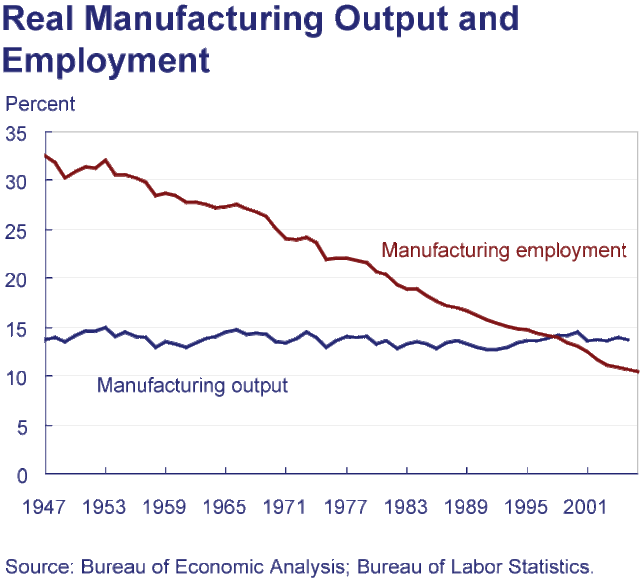
The same trend was seen in agriculture in the 20th century, but no one bemoans all those lost jobs.
Mr. Griswold's arguments are correct. Streamlined trade agreements have been good for the American economy as well as the world's, and protected markets would be a mistake (especially now).
10
posted on
03/03/2010 5:17:06 AM PST
by
A.Hun
(Common sense is no longer common.)
To: NVDave
As long as we're swapping anecdotes, in my experience, it wasn't unusual to be astounded at how much money the H-1B was making, and they were always sniffing-around to make sure they were being paid the market rate.
In any case, we're talking about moving goods over borders . . . let's not hijack this thread.
11
posted on
03/03/2010 5:17:18 AM PST
by
1rudeboy
To: ianfletcher
"Free traders" should deal with reality. Every nation but the US talks "free trade" but practices mercantilism. Their national economic policies are devoted to promoting favorable trade balances, while only the US has accepted the role of indentured colony falling further and further in debt to the new imperial powers.
This version of "free trade", has allowed Main Street Americans to gorge themselves on a bounty of consumer goods - as they become less and less able to produce the goods their lives and lifestyles depend upon.
While being told that the beliefs and practices preached by free-trade economist and politicians will magically keep that bounty of cheap foreign goods flowing - no matter how large our trade debt grows - Americans are transforming themselves into a modern age "Cargo Cult."
12
posted on
03/03/2010 7:40:31 AM PST
by
drpix
To: drpix
Still you can spot the countries that have the most free trade by their citizens higher standard of living. Shut down free trade as was done during the great depression and what results is a dramatic decrease in the overall standard of living. Want another worldwide great depression? Make 30% tariffs on imports. That would do it faster than any other stupid law our stupid politicians could pass.
Free Trade agreements might not be perfectly free, but it's still a hell of a lot better than shutting down economies world wide with high tariffs.
13
posted on
03/03/2010 8:37:25 AM PST
by
monday
To: drpix
only the US has accepted the role of indentured colony falling further and further in debt to the new imperial powersLike everyone who worries over the trade deficit, you miss the point completely. If our government were not running astonishing deficits every year, our trading partners would either have to buy our products or invest in American businesses.
Instead they buy our government debt because it's considered a safe investment.
By insisting on controlled trade to reduce the trade deficit, you are implicitly letting government off the hook for its dangerous fiscal policy.
14
posted on
03/03/2010 9:04:29 AM PST
by
BfloGuy
(It is not from the benevolence of the butcher, the brewer, or the baker, that we can expect . . .)
Disclaimer:
Opinions posted on Free Republic are those of the individual
posters and do not necessarily represent the opinion of Free Republic or its
management. All materials posted herein are protected by copyright law and the
exemption for fair use of copyrighted works.
FreeRepublic.com is powered by software copyright 2000-2008 John Robinson
