


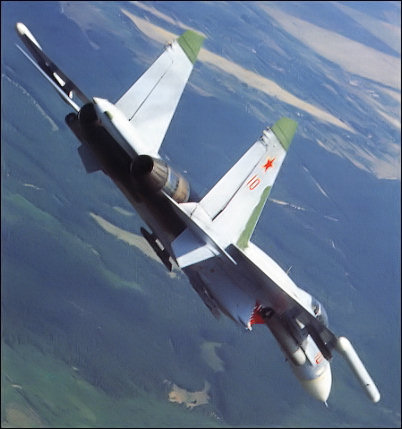
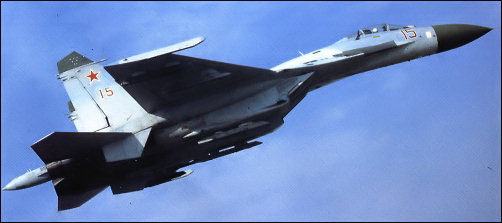
The Russian VVS is facing the common problem with its Flankers as the USAF faced with its Eagles two years earlier.
The Russian equivalent to the U.S. F-15 Eagle is still a top-notch fighter, but the ones in VVS service are showing their age.
Posted on 01/19/2010 5:17:31 AM PST by myknowledge
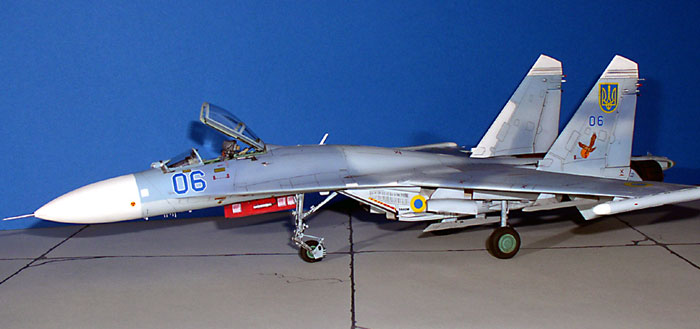
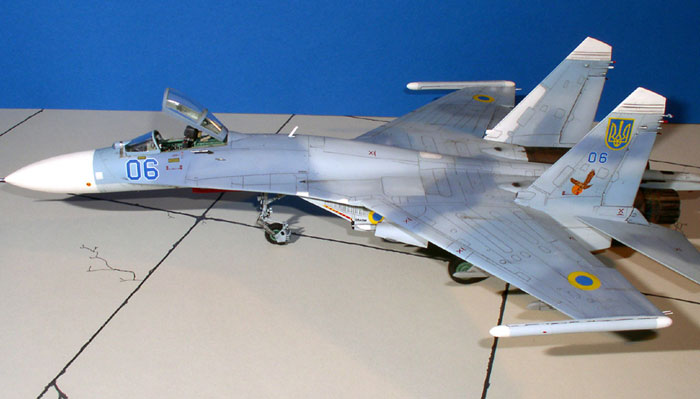
Russia has grounded all of its Su-27 fighters. At least until it can be determined what caused one to crash on January 14th, 30 kilometers from its airbase at Dzemga (in the Far East). The pilot died in the crash, but the flight recorder was recovered. Last year, two Su-27s crashed. The Su-27, which entered service 25 years ago, is showing its age. It's still a first line fighter, but is fading fast. Last year, the U.S. bought two Su-27 fighters from Ukraine, to be used to help train American pilots to cope with the growing number of Su-27 and Su-30 fighters being sold to air forces the world over. The two Su-27s were also used to test the effectiveness of new U.S. radars and electronic warfare equipment. Currently, each of these aircraft are being sold to collectors, for $4.5 million each
Russia's Sukhoi aircraft company has sold over a billion dollars worth of these aircraft (plus components and technical services for them) a year for the last few years. Sukhoi mainly supplies Su-27/30 jet fighters to India, China, Malaysia, Venezuela and Algeria. The 33 ton Su-27 is similar to the U.S. F-15, but costs over a third less.
Developed near the end of the Cold War, the aircraft is one of the best fighters Russia has ever produced. The government helped keep Sukhoi alive during the 1990s, and even supplied money for development of an improved version of the Su-27 (the Su-30). This proved to be an outstanding aircraft, and is the main one Sukhoi produces. There are now several Su-30 variants, and major upgrades. While only about 700 Su-27s were produced (mostly between 1984, when it entered service, and the collapse of the Soviet Union in 1991), adding Su-30 production and you have over 1,000 aircraft (including license built ones in China and India).
The other modern Russian fighter, the MiG-29, is having similar reliability problems, but worse. Malaysia recently admitted that it is getting rid of its MiG-29 fighters because the aircraft are too expensive to maintain. It cost about $5 million a year, per aircraft, to keep them in flying condition. Malaysia has ordered 18 Su-30 fighters, and will apparently order more to replace all of its retired MiG-29s. Russia has offered better prices on maintenance contracts for new Su-30s, in addition to bargain (compared to U.S. planes) prices.
The MiG-29 entered Russian service in 1983. Some 1,600 MiG-29s have been produced so far, with about 900 of them exported. The 22 ton aircraft is roughly comparable to the F-16, but it depends a lot on which version of either aircraft you are talking about. Russia is making a lot of money upgrading MiG-29s. Not just adding new electronics, but also making the airframe more robust. The MiG-29 was originally rated at 2,500 total flight hours. At that time (early 80s), Russia expected MiG-29s to fly about a hundred or so hours a year. India, for example, flew them at nearly twice that rate, as did Malaysia. So now Russia is offering to spiff up the airframe so that the aircraft can fly up to 4,000 hours, with more life extension upgrades promised. This won't be easy, as the MiG-29 has a history of unreliability and premature breakdowns (both mechanical and electronic).
In the last year, Russia grounded has grounded its MiG-29s several times, in order to check for structural flaws. Compared to Western aircraft, like the F-16, the MiG-29 is available for action about two thirds as much. While extending the life of the MiG-29 into the 2030s is theoretically possible, actually doing so will be real breakthrough in Russian aircraft capabilities. The Indians are going to take up the Russians on their upgrade offer. Algeria, and several other nations, have turned down the MiG-29, which has acquired the reputation of being second rate and a loser. Russia, however, wants to preserve MiG as a brand, so it is not solely dependent on Sukhoi for its jet fighters. At this point, it looks like an uphill fight. MiG and Sukhoi are now both divisions of a state owned military aircraft company (United Aircraft). Technically, the MiG division is bankrupt. Sukhoi is profitable.
The Russian VVS is facing the common problem with its Flankers as the USAF faced with its Eagles two years earlier.
The Russian equivalent to the U.S. F-15 Eagle is still a top-notch fighter, but the ones in VVS service are showing their age.
In before the “Russians only build junk” post.
Looks like someone went to the boneyard and threw together the front of an F-16, the midsection of an F-14, then cobbled together a tail end from F-15 and -18 parts.
They probably got the idea from a Johnny Cash song.
OOOH, boy; time to ATTACK! < /sarc >
It’s a testament to Russian aeronautical engineers that they can wring this much performance out of ‘50s technology. Sukhoi and MiG do and have done some interesting things with airplanes. That said, I really wish India would buy their planes from someone else. If they ever get tangled up with China, their pilots are going to have some hard times.
Alas, I forgot to also call the inevitable “Russians only build knockoffs” post. How many different planes does a plane have to look like before it just looks like itself?
Just barely...
You’re right. I think it is a pretty good looking bird. As for any similarities to other fighters... Well, common design elements are common, probably because they are a good idea and work. Physics and aerodynamics are the same all the way around... ;-)
In before I could say it.
Ping
It's probably just a coincidence, though.....like the resemblance of an AK-47 to the StG-44. Just a fluke.
That was a cool flight sim too.
Indeed, and they have made them exportable to Warsaw Pact, Communist and 3rd world clients.
Last time I checked the average Indian pilot flies more hours than his Chinese counterpart and also has greater interaction with Western militaries. Besides the Chicom military is still largely composed of Soviet, Russian era systems including rip-offs of the Mig-21 and SU-27/30.
How exactly is it blatant? I’m assuming you believe it resembles a F-15. If I’m correct, what exactly makes it look like a copy? Is it the twin vertical vertical, or the underslung intakes? Neither of these are exclusive to the Eagle. Your comment reminds me of another FReeper who seems to believe every single delta-wing fighter is a F-106 knockoff (particularly if the plane in question is canardless). While the Ruskies have been know to copy aircraft, the Flanker isn’t an example I’d cite.
F-15 has airframe design inspired from Mig-25
Your assumption is incorrect and incomplete. I was clear as to what it resembled and where.
Disclaimer: Opinions posted on Free Republic are those of the individual posters and do not necessarily represent the opinion of Free Republic or its management. All materials posted herein are protected by copyright law and the exemption for fair use of copyrighted works.