
Posted on 09/30/2009 11:21:14 AM PDT by SwinneySwitch
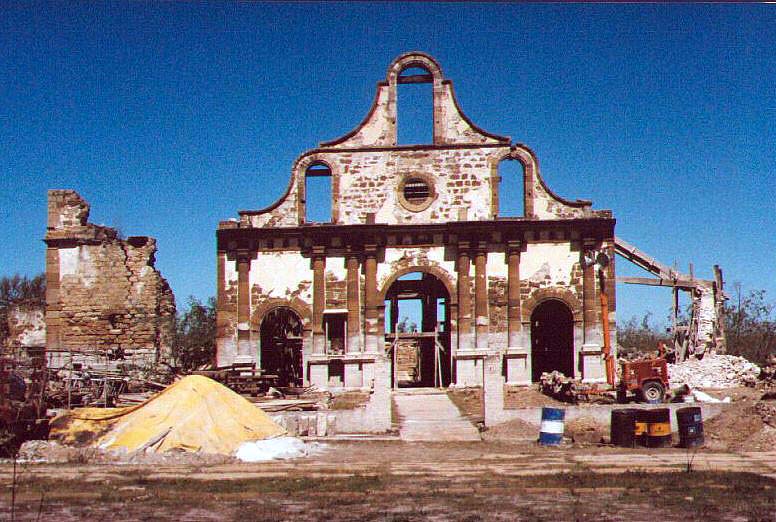
GUERRERO VIEJO, Mexico — As soon as he stepped onto the mud shore below the church ruins, Eric Ellman could visualize the party.
The racers would storm across the Rio Grande, landing their kayaks and canoes to the cheers of fans lining the streets of this 200-year-old, half-sunken and abandoned town now exposed by a drought-lowered lake.
After an awards ceremony in front of the church’s cleaned-up facade, camps would be set up. A band would play. Where cows now stood, couples would dance under a star-studded sky.
The Rio Grande again would be a uniting element, not just a heavily patrolled boundary be tween two impoverished, semi-isolated populations.
Ellman turned to unpack his kayak. He had forgotten his sleeping bag and pad. He didn’t have a tent.
The executive director of the nonprofit Los Caminos del Rio calls himself the “resident dreamer” behind the group’s 20-year-old goal of transforming the river from Laredo to Matamoros into a destination for outdoor recreation and history buffs.
Civic leaders find Ellman’s enthusiasm refreshing, if not necessarily contagious. Some find it trying, because his dreams require others to follow through.
Now 52, he’s lived in the Valley nine years, pushing hard to actually get people on the river, not just its banks. He convinced tourism leaders to organize a 33-mile paddle race set for Oct. 17 that will end in a dual celebration in Laredo and Nuevo Laredo.
Everywhere he goes, he argues the race is a great way to foster a cleaner Rio Grande, to fight the assumption its waters are off-limits to tourism, to encourage exercise in an area plagued by diabetes and obesity and to give news media something to cover besides violence, smuggling and corruption.
The details and challenges don’t faze him. Ellman simply recruits more backers. “It’s so easy, it’s fun,” he said.
With $28,000 in prize money scraped together from small donors and local governments, the race has attracted competitors from New York, Belize, Mexico and across Texas.
But it doesn’t yet have a major corporate sponsor. Many still balk at the idea of getting near the river. Locals are planning to watch, but few are participating.
“It’s not easy,” said Diego Garcia Peña, who founded a canoe club in Monterrey, Mexico, and encourages Ellman. “It takes people like Eric who do not understand impossible things.”
With a shaved head, wraparound sunglasses and a slight twinge remaining of his native New York accent, Ellman looks and sounds like the quintessential gringo. He enjoys surprising people with his fluent Spanish.
It’s not just a canoe race that excites him. Driving along the river, he envisions crumbled buildings restored to interpretive centers, processions of kayakers, canoeists from Michigan coming down for winter races — and the big party at the ghost town of Guerrero Viejo.
Looking for linkage
In South Texas, outsiders are those without multigenerational family roots. Peggy Moffett moved to Zapata when she was 2 and still finds it hard to call herself a local.
As president of Zapata County’s economic development center, she knows what a challenge it is to bring change, she said.
When Moffett gives talks at schools, she finds students who don’t know the original town of Zapata, like Guerrero Viejo, was flooded when Falcon Reservoir was created in the 1950s. The new city grew along U.S. 83 with little connection to the nearby lake, she said.
So when Ellman rolled up to meet her at the Dairy Queen in his Toyota Tacoma pickup with the missing rear fender, she smiled. She knew she didn’t have to sell him on the need to “re-establish that sense of place and connection,” as she puts it.
Like him, Moffett constantly is pitching the river’s potential. The lake is famous for bass fishing, but not many of the speed boats that crisscross it are owned by locals. They don’t even have a public dock there.
“We lost that linkage ... I think that we don’t realize the energy that we have,” Moffett said. “It takes someone else to come in and point that out.”
Ellman could not be more of an outsider. He’s a former New York cabdriver and bike messenger who sold peanuts at Shea Stadium to see baseball games.
He arrived in the Valley after working to treat sewage in Mexico with manmade wetlands, teaching prisoners to make birdhouses out of gourds grown there. The idea seemed obvious to him.
One of the first things he did as director of Los Caminos was offer river kayak tours near McAllen.
“A year and a half ago, we could not get people out on the river for free,” Ellman said. “Now, people are calling and ... they can’t get a hold of us.”
Contacting the nonprofit is difficult. Budget problems forced him to lay off his staff.
Ellman himself has not been paid in six months. He’s thinking of renting out his house so he can pay his mortgage. He’d like some spare time to join a softball league, maybe go on a few dates.
“I don’t have much of a life outside of this,” he said.
The potential
Along the Rio Grande, history literally sits on the surface. Bullet pockmarks from 200 years of wars and revolutions are visible in empty hand-cut stone buildings. Steam-powered irrigation pumps remain standing.
The slow pace of development in the Valley helped preserve it, said Mario Sanchez, a historian for the Texas Department of Transportation and a founder of Los Caminos.
“In a way, (that) gave us the raw materials to work with,” he said. “Because it was there, it was not artificial. You did not need a lot of imagination to see it.”
The Meadows Foundation, the main financial backer of Los Caminos, set up community meetings on both sides of the river to discuss how to tap the area’s potential. A historical corridor was proposed; it would jump-start an economic engine like Civil War battlefield tourism in other states.
“When you made a presentation to the locals, it immediately clicked,” Sanchez recalled.
That was two decades ago. Studies were done, restoration work started, but U.S. historic designation for the corridor was rejected. Under Ellman, Los Caminos is trying again.
“It was always a challenge,” Sanchez said. “So little has been done for the region — anything we were doing was breaking ground.”
Above the flies swarming the cow patties in Guerrero Viejo, Ellman sat atop a crumbling concrete bandstand.
The resident dreamer could not stop smiling. He could see the party. He couldn’t imagine it as anything but a wild success.
It was warm. No need for a sleeping bag. He fell asleep gazing at the stars.
From someone with 16 years in the Army - fat chance. Unless he brought a buddy to spoon with, he woke up 1 hour later freezing and got no sleep that night (especially on the ground with the creepy and crawly things).
Swinney, I am sure you are aware that the zealots who comprises Los Caminos del Rio are and were some of the most outspoken opponents of the border fence, border security and border law enforcement in the Lower RG valley. They don’t want the border to exist at all. Kumbaya.
Viva la water-borne fecal material!
Good fences make good neighbors.
The potential
Along the Rio Grande, history literally sits on the surface. Bullet pockmarks from 200 years of wars and revolutions are visible in empty hand-cut stone buildings.
Great potential for drug smugglers to add some new pockmarks.
And vice versa!
“Budget problems forced him to lay off his staff.”
You’d think the Gulf cartel would be sending him a monthly donation.
Ping!
If you want on, or off this S. Texas/Mexico ping list, please FReepMail me.
Disclaimer: Opinions posted on Free Republic are those of the individual posters and do not necessarily represent the opinion of Free Republic or its management. All materials posted herein are protected by copyright law and the exemption for fair use of copyrighted works.