Posted on 07/11/2009 5:38:19 PM PDT by Jet Jaguar
Secrecy makes contingency planning hard
SEOUL — Little is known about the secretive country considered the most closed society in the world.
Crossing into North Korea, analysts say, you could expect to find crushing poverty, widespread hunger and a massive military that includes nearly one in three of the communist nation’s citizens. Beyond that, it’s anybody’s guess.
"It’s such an isolated society that we only have ... glimpses of what’s going on," said Brig. Gen. Richard Haddad, commander of Special Operations Command Korea.
Should U.S. forces ever be called on for a mission inside North Korea, it is the unknown that presents the biggest challenge, Haddad said.
Special operations forces are trained for unconventional warfare, often executed by teams of guerrilla fighters. Those forces — which include troops who specialize in civil affairs and psychological operations — can also be used after major fighting to track down remnants of the enemy and build up a country’s security forces to restore order, as they are doing in Iraq and Afghanistan.
For them, knowing how the average North Korean views the country’s leaders and the U.S. is critical. So is knowing the landscape, since they could be dropped behind enemy lines in small teams with only the gear on their backs for support, analysts said at a recent special operations forces conference at U.S. Army-Garrison Yongsan, South Korea.
They painted a picture of a country whose population is poor, hungry, weak and increasingly unhappy with the corruption and opulent lifestyles of Kim Jong Il and the elites who run the communist country. And, they said, Kim Jong Il’s regime is weak and unlikely to survive a change in leadership.
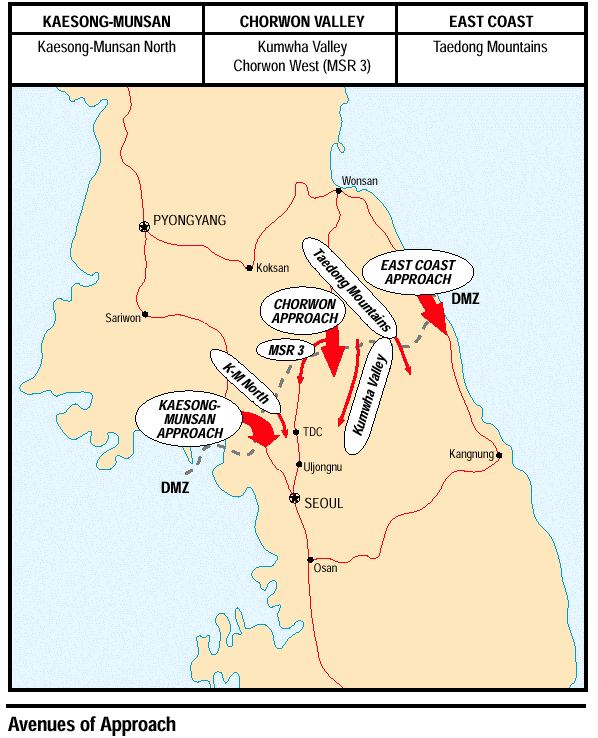
Geographically, the hatchet-shaped country is bordered by seas on two sides, offering plenty of coastline where teams of special operations forces could be inserted. But those teams would operate on difficult, mountainous terrain that North Korea’s 80,000 special operations forces know well, said conference speaker Markus Garlauskas, an intelligence analyst for U.S. Forces Korea who studies possible future challenges with North Korea.
But he said the country’s mountains and poor infrastructure could also help U.S. troops isolate parts of the country from the North Korean military during a war.
U.S. troops would also face a network of underground military facilities that are a double-edged sword — bad if you stumble across them but good if you can capture them and have a hiding spot to operate from, Garlauskas said.
U.S. troops would face a wave of problems in North Korea if the regime collapses, including loose nuclear weapons, pockets of resistance fighters, looting and millions of refugees heading to China and South Korea, said retired Brig. Gen. Russell Howard, a former Special Forces officer and now a senior fellow at the Joint Special Operations University, who spoke at the conference.
In the chaos and anarchy that would follow, some North Korean groups — splintered by political and economic divisions — might be fighting for control of the country.
"There may be organized resistance that may be as afraid of each other as they are of us," he said.
For U.S. special operations forces, their biggest job might be finding weapons of mass destruction in the country before someone else does — a mission that likely would require infiltration and boots on the ground, Howard said in an interview after the conference.
"I just don’t think dropping a 500-pound bomb is going to work in the caves or wherever they have this stuff," he said. "You have to go in and find this stuff."
Special operations forces could also be used in a counterpropaganda campaign to help change the negative perceptions of Americans that North Koreans have. And they could be used to track and help care for the 5 million refugees who are expected to try to go to South Korea and China.
It would take 450,000 to 500,000 military personnel to "achieve success" after the collapse of the regime, Howard said.
Special operations forces would be used differently than they are in Iraq or Afghanistan, where they are tasked with hunting down al-Qaeda and the Taliban and training the fledgling security forces in each country, Howard said. In North Korea, U.S. troops would be working with their South Korean counterparts and might not be needed to work with North Korean forces after the initial "direct action" phase, he said.
But if special operations forces were to train guerrilla forces, a key question is whether a typical North Korean — controlled, obedient, isolated and heavily indoctrinated to hate Americans — can be persuaded to participate in unconventional warfare and fracture the regime’s control.
"He may even believe this is an elaborate sting operation to test his loyalty," Garlauskas said.
U.S. troops could leverage resentment toward the elites who make up 25 percent of North Korea’s population to persuade North Koreans to fight with them, he said. But if they believe the U.S. will win, those same elites might also want to partner with U.S. forces as a way to secure their position in the next government, he said.
Complicating matters for troops on the ground is the question of whether North Korea’s neighbors would decide to enter the fight or try stop the flow of refugees into their countries, something nobody knows.
"It’s not just about what will North Korea do. It’s about what will the Chinese do; what will the Russians do," Garlauskas said.
Finally, experts agreed, preparation is vital.
If a war with North Korea were to come, it could develop quickly "from a certain slow boiling crisis like the one we’re in now," Garlauskas said. "It may not be immediately clear that a crisis is really going anywhere, until it suddenly takes the proverbial turn south."
Howard stressed that planning is critical also in the event of the collapse of the Pyongyang regime.
"Once it gets out of hand, you can’t put it back in the box," he said.
Ping
From the NK side? A bright light followed by a million degrees.
What would it look like? Like Iraq but with more Korean troops giving up. The country and the military is just a shell on the brink of collapse and starvation.
I always figured it would look like blowing up the electrical transmission lines from China and the ports receiving food and fuel deliveries, repelling any attempt to invade the South, and then and waiting for them to die.
Then repeat the process until we're absolutely certain not a single human being is left alive.
Once the chem stuff breaks down and the rad levels drop, the SK's can move in and rebuild.
It could be really confusing for the US military. North Korean special forces operators dressed like RoK soldiers would cause confusion and havoc. South Korean leaders would be assainated, sabotage galore. It could be over before it began.
We need to wage this war on the assumption that the North Koreans are totally, completely sold out to Kim Jong-il and will fight to their last breath, then go from there.
Pyongyang can credibly threaten the prompt destruction of Seoul with conventional arms alone. The North Korean military could also establish a shallow foothold across the DMZ. However, the DPRK’s ability to sustain these offensive operations, or advance its forces further to the south, is questionable. South Korean and American air forces could quickly establish air supremacy and destroy North Korean ground forces. The ensuing buildup of US forces in Korea could reverse any remaining North Korean advances into the South, and unlease offensive operations into the North. North Korea does not require long-range missiles with nuclear, chemical, or biological warheads to devastate Seoul or to make a land grab across the DMZ. Such weapons are needed to deter or defeat an American counteroffensive into North Korea. North Korea has about 500 long-range artillery tubes within range of Seoul, double the levels of a the mid-1990s. Seoul is within range of the 170mm Koksan gun and two hundred 240mm multiple-rocket launchers. The proximity of these long-range systems to the Demilitarized Zone threatens all of Seoul with devastating attacks. Most of the rest of North Korea’s artillery pieces are old and have limited range. North Korea fields an artillery force of over 12,000 self-propelled and towed weapon systems. Without moving any artillery pieces, the North could sustain up to 500,000 rounds an hour against Combined Forces Command defenses for several hours.
If the NK artillery targeting the SK capitol can be countered early enough they can be contained.
What would war w/ N. Korea look like?
With these humpty-dumpties in charge? Lemme see... Plan A: give them a good talking-to; Plan B (top secret): if plan A doesn’t work, give them a time-out; Plan C: try to get China to give them a spanking; Plan D: the unthinkable (threaten them).

It looks like it is, as it is, right now. NORK rescinded the Armistice of 1953 a few weeks ago, so the war with S Korea is on again, and currently takes the form of cyberattacks on S Korea and the US for the last few days, as well as recent missile launchings and planned nuclear tests and whatever else they might have in mind. Further escalations may be expected. As the Korean “War” was a UN Police Action with many nations involved and the US as the main policing contributor, a response from the UN is eventually forthcoming, as will be required by NORK provocations yet to come. The UN has a high threshhold level for response.

The South Koreans can simply blow it up. We blew up our gasoline and ammo dumps when the Germans advanced during the Battle of the Bulge
With Obama in charge, all the NKs would see would be a white flag being waved from the WH. ;-)
Without moving any artillery pieces, the North could sustain up to 500,000 rounds an hour against Combined Forces Command defenses for several hours. How can you contain this?
If there is war with North Korea, the first side to use the bomb will be the winner.
Disclaimer: Opinions posted on Free Republic are those of the individual posters and do not necessarily represent the opinion of Free Republic or its management. All materials posted herein are protected by copyright law and the exemption for fair use of copyrighted works.