Posted on 05/02/2009 10:45:23 AM PDT by Conservative Coulter Fan
Thirty years ago, Britain embarked upon a conservative revolution that not only transformed the country but left an indelible and unmistakable impact on the rest of the world. Only two British Prime Ministers--Winston Churchill and Margaret Thatcher--have by force of personality and power of example done anything like this.
In The Gathering Storm, Winston Churchill wrote of his initial thoughts after his election as Prime Minister in May 1940:
As I went to bed at about 3 a.m., I was conscious of a profound sense of relief. At last I had the authority to give directions over the whole scene. I felt as if I were walking with destiny and that all my past life had been but a preparation for this hour and for this trial.[1]
While it is not recorded whether Mrs. Thatcher felt the same way in the early hours of May 4, 1979, she very well may have.
Britain Before Thatcher: The Sick Man of Europe
Britain, when Margaret Thatcher took office, was, as the phrase had it, the "sick man of Europe" and the sickness, also known as the British disease, looked incurable. Indeed, the consensus, which most of the Conservative Party (like the rest of the political class) shared, was that cure was not the issue. Rather, and to change to another contemporary expression, what was required of any British government was the "orderly management of decline."
The last period of the Labour government had, of course, been disorderly. Militant trade unionists that winter brought the country to a halt, while the dead lay unburied and the rubbish piled up in Trafalgar Square. Hardly anyone believed that a fresh leader could reverse decline, recreate the conditions for prosperity, rebuild capitalism, and restore the country's international standing. So the question most frequently asked--not least within the cynical, defeatist ranks of the Conservative Party, which Mrs. Thatcher had just dragged to electoral success--was how long before this "tiresome" woman and her ideological cronies could be ditched.
At times it was a close-run thing. She needed luck, and in this case fortune did favor the brave. So on through strikes, a war, recession, attempted assassination, simmering dissension, and outright political revolts, she ploughed until the job (or most of it, at least) was done.
The Thatcher Revolution
The pace and scale of this revolution justifies the description, even though the chief revolutionary herself was someone of very traditional instincts who always considered that she was restoring what had been lost, not imposing a utopian plan. In any case, by the time Mrs. Thatcher left office, eleven and a half years on from setting foot in Downing Street, Britain had changed profoundly and overwhelmingly. And for the better. Just to list the achievements is, yet again, to feel astonished at them.
A completely new approach to the management of the economy had been applied--one that, until the recent crash, had not been seriously challenged. All the old assumptions were reversed. Inflation was defeated without a prices and incomes policy. The currency was strong without resort to exchange controls, which were abolished for the first time since the Second World War. Days lost in strikes plummeted and productivity soared without concessions to the trade unions, which were tamed and reformed. Private enterprise was brought in to run what had always been considered "public" utilities. Cutting-edge industries and skills-based services took the place of slimmed down or euthanized industrial dinosaurs.
Public spending was subjected to an iron grip, public borrowing turned around to begin repaying debt, and tax rates--once at Scandinavian levels--were brought down to attract and motivate, not penalize and drive out, talent. Real, lasting jobs, as opposed to state subsidised make-work, were providing higher incomes. Working class families, trapped for successive generations in rented social housing, now bought their homes and started building up capital--even acquiring shares.
The Restoration of Britain as a World Power
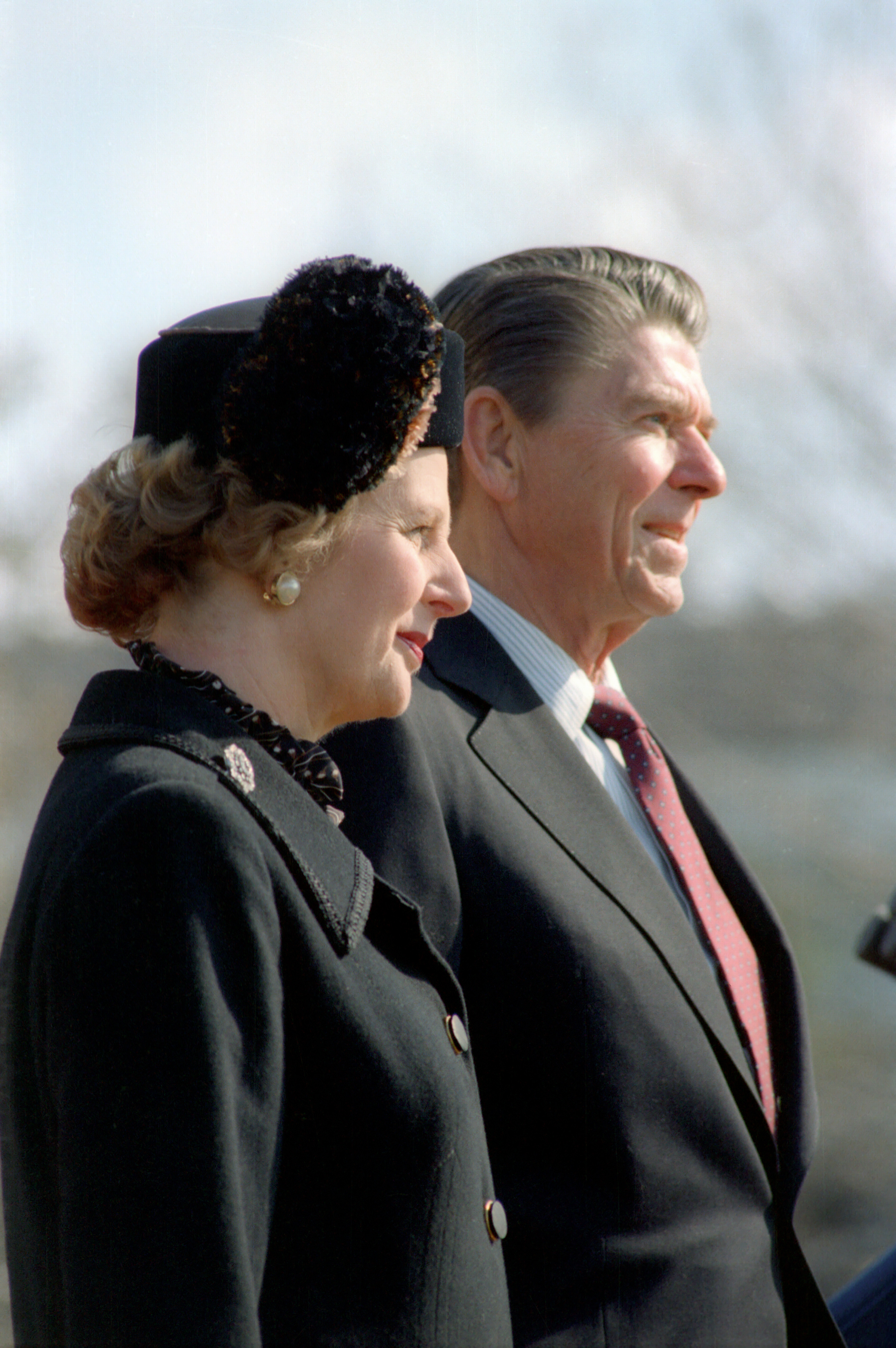
And when British people went abroad--as so many more were doing for the first time in their lives--they found, to their delight, that Britain itself was taken seriously again. Why? Because eight thousand miles away, in the treacherous and implacable South Atlantic, Britain had fought what seemed a Quixotic conflict and discovered, perhaps with surprise, that victory is worth striving for and national glory is good for the soul. And all the while there was a larger, nobler purpose still: the finally triumphant campaign against global Communism, which had murdered, stunted, and impoverished millions with impunity. The friendship between Britain and America was turned by Margaret Thatcher and Ronald Reagan into a mighty bulwark against the Evil Empire, which by 1990 was already tottering.
The Right Leader at a Time of Crisis
Of course, like President Reagan, Margaret Thatcher had her failures and her disappointments. But much of the later criticism fails to hit the mark. It is true that British society now gives conservatives, among others, cause for concern with its crime, disorder, dysfunctional families, and dependency. But it is much less obviously true that there is anything that Mrs. Thatcher's economic reforms did to make it so--cultural, religious and moral trends are stronger than even the strongest politicians.
Mrs. Thatcher left office deeply uneasy about Britain's unsorted entanglements with the fledgling super-state that is the European Union. But the time was not yet politically right for fundamental reshaping, or at least that is what her cabinet colleagues decided. A more substantial criticism is that not much was done to reform the country's hopelessly inefficient health service and welfare system. But not even someone of Margaret Thatcher's tireless constitution can do everything, and democratic electorates have a limited appetite for restless change: They need a crisis, or even crises, to bring out their best.
Mrs. Thatcher was, indeed, always and pre-eminently the woman for crises. She did not seek them, but at a certain level, like all natural leaders, she relished them, and she towered over others during them. Now, with Britain mired in another economic crisis--in which much criticism has been leveled against the free enterprise capitalism Mrs. Thatcher extolled--many, it seems, would like her back, as she was in her heyday, to boss and bully them into shape.
An opinion poll for Prospect magazine rated Mrs. Thatcher better equipped to steer Britain through the economic maelstrom than Gordon Brown (47 percent to 34 percent) and better by a still wider margin than David Cameron (49 percent to 24 percent).[2] In that light, it is encouraging that a recent survey by the Times of Conservative parliamentary candidates found that the likely new intake are "to a large extent followers of Margaret Thatcher and her revolution."[3]
The Thatcher Legacy Must Be Defended
That continuing inspiration is, indeed, a crucially important element of the Thatcher legacy. In Britain, much of what she did is being, or has already been, reversed by the Labour government's financial profligacy, class-hate-driven tax policy, and sweeping centralization. The eventual outcome will depend on a new generation of conservatives able and willing to fight the same battles she did. At least they have something she (of necessity) lacked, because--to adapt the words of her eulogy to Ronald Reagan--they have her example.
Robin Harris, D.Phil., is Senior Visiting Fellow at the Margaret Thatcher Center for Freedom at the Heritage Foundation.
[1] Winston S. Churchill, The Second World War, Volume I: The Gathering Storm (London: 1948), p. 601 (May 1, 2009).
[2]'What We Think of Her', Prospect, issue 158, May 2009, at http://www.prospect-magazine.co.uk/article_details.php?id=10744 (May 1, 2009).
[3]Tim Montgomerie, 'Margaret Thatcher Revolution Inspires This Generation', The Times, April 30, 2009, at http://www.timesonline.co.uk/
tol/news/politics/article6195108.ece (May 1, 2009)
Probably my favorite couple of the later half of the 20th century.
Those two and Pope John Paul II, made a heck of a team.
“Those two and Pope John Paul II, made a heck of a team.”
Indeed. As I say that as a Protestant. However, I was(and still) always with the Pontiff when it came to opposing abortions, communism, and sexual immorality.
The current pope seems to be holding John Paul II’s line when it come to sticking up for the correct values. Wish I could say the same for the current U.S. President and U.K. PM but sadly, I cannot.

Please excuse the looser in the upper right corner.
This is Time magizine after all. Every rose has its thorn.
Well the one good thing Teddy did his whole life was to damage Carter to the point where he ensured his defeat to Reagan.
Those two make the current ones in office look like a couple of teenagers partying and tearing up the house while the parents are away.
If shehad gotten even one more term instead of being ambushed by that pussy willow John Major, Britain would be in much better shape today.
Thirty years ago, Britain embarked upon a conservative revolution that not only transformed the country but left an indelible and unmistakable impact on the rest of the world. Only two British Prime Ministers -- Winston Churchill and Margaret Thatcher -- have by force of personality and power of example done anything like this.The best way to defend her legacy is to purge the ranks of the currently wicked Conservative Party. But nothing like that will happen until the Muzzies start to run wild and burn down everything in the country. That will probably happen within ten years or so, it's a demographics thing.
The democrats seem intent on depleting our strength and resolve as fast as possible.
Yes the Democrats seem intent on destroying our culture with multiculturalism and destroying our world standing with international tolerance.
They think they can gain world respect through displaying a willingness to negotiate everything and surrendering our national interest to petty dictators.
These despots laugh at them and make them appear to be the fools that they are.
As example I give you how the Castros humiliated Obama recently.
If Obama gets his way the US will be a second rate power and China will be Hegemon by the end of his first term.
Disclaimer: Opinions posted on Free Republic are those of the individual posters and do not necessarily represent the opinion of Free Republic or its management. All materials posted herein are protected by copyright law and the exemption for fair use of copyrighted works.