
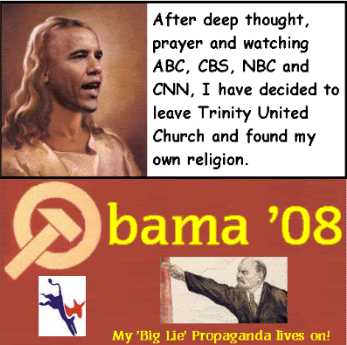
This is my church, the one I never quit.
Posted on 06/02/2008 10:08:37 AM PDT by pissant
Having now left Trinity United Church of Christ, can Barack Obama escape responsibility for his decades-long ties to Michael Pfleger and Jeremiah Wright? No, he cannot. Obama’s connections to the radical-left politics espoused by Pfleger and Wright are broad and deep. The real reason Obama bound himself to Wright and Pfleger in the first place is that he largely approved of their political-theological outlooks.
Obama shared Wright’s rejection of black “assimilation.” Obama also shared Wright’s suspicion of the traditional American ethos of individual self-improvement and the pursuit of “middle-classness.” In common with Wright, Obama had deep misgivings about America’s criminal justice system. And with the exception of their direct attacks on whites, Obama largely approved of his preacher-friends’ fiery rhetoric. Obama’s goal was not to repudiate religious radicalism but to channel its fervor into an effective and permanent activist organization. How do we know all this? We know it because Obama himself has told us.
A Revealing Profile Although it’s been discussed before (because it confirms that Obama attended Louis Farrakhan’s Million Man March), a 1995 background piece on Obama from the Chicago Reader has received far too little attention. Careful consideration of this important profile makes it clear that Obama’s long-standing ties to Chicago’s most rabidly radical preachers call into question far more than Obama’s judgment and character (although they certainly do that, as well). Obama’s two-decades at Trinity open a critically important window onto his radical-left political leanings. No mere change of church membership can erase that truth.
By providing us with an in-depth picture of Obama’s political worldview on the eve of his elective career, Hank De Zutter’s, “What Makes Obama Run?” lives up to its title. The first thing to note here is that Obama presents his political hopes for the black community as a third way between two inadequate alternatives. First, Obama rejects, “the unrealistic politics of integrationist assimilation — which helps a few upwardly mobile blacks to ‘move up, get rich, and move out. . . . ’ ” This statement might surprise many Obama supporters, who seem to think of him as the epitome of integrationism. Yet Obama’s repudiation of integrationist upward mobility is fully consistent with his career as a community organizer, his general sympathy for leftist critics of the American “system,” and of course his membership at Trinity. Obama, we are told, “quickly learned that integration was a one-way street, with blacks expected to assimilate into a white world that never gave ground.” Compare these statements by Obama with some of the remarks in Jeremiah Wright’s Trumpet, and the resemblance is clear.
Having disposed of assimilation, Obama goes on to criticize “the politics of black rage and black nationalism” — although less on substance than on tactics. Obama upbraids the politics of black power for lacking a practical strategy. Instead of diffusing black rage by diverting it to the traditional American path of assimilation and middle-class achievement, Obama wants to capture the intensity of black anger and use it to power an effective political organization. Obama says, “he’s tired of seeing the moral fervor of black folks whipped up — at the speaker’s rostrum and from the pulpit — and then allowed to dissipate because there’s no agenda, no concrete program for change.” The problem is not fiery rhetoric from the pulpit, but merely the wasted anger it so usefully stirs.
Obama’s Network De Zutter gives us a clear glimpse of Obama’s radicalism. Obama is called “progressive,” of course, and is said to yearn for “massive economic change.” That could simply mean an end to widespread poverty, rather than social restructuring. Yet Obama is also described as holding “a worldview well beyond” his mother’s “New Deal, Peace Corps, position-paper liberalism.” De Zutter lays out Obama’s ties to radical groups like Chicago Acorn, as Acorn’s lead organizer, Madeleine Talbott, is quoted affirming that: “Barack has proven himself among our members . . . we accept and respect him as a kindred spirit, a fellow organizer.” In “Inside Obama’s Acorn,” I explore Obama’s links to this radical group, and to Talbott, who practices the sort of intimidating and often illegal “direct action” Acorn is famous for. (For more on Talbott’s affinity for “direct action,” see “Where Do We Begin?”)
De Zutter also touches on some other key elements of Obama’s network. Obama’s early organizing work for the Developing Communities Project was “funded by south-side Catholic churches.” Clearly, this early work cemented Obama’s close ties to Father Pfleger, whose support formed a critical component of Obama’s grassroots network. Precisely because of this early link, Pfleger threw his considerable support behind Obama’s failed 2000 bid for Congress. By the way, Pfleger’s political influence in Chicago is such that Mayor Richard Daley actually declared his 2002 candidacy for a fourth full term as mayor at Pfleger’s St. Sabina church. In “Inside Obama’s Acorn,” I explore the possibility that Obama’s seat on the boards of a couple liberal Chicago foundations may have allowed him to direct funds to groups that served as his de facto political base. De Zutter quotes Woods Fund executive director, Jean Rudd, praising Obama for “being among the most hard-nosed board members in wanting to see results. He wants to see our grants make change happen — not just pay salaries.” No doubt, Obama was sincerely supportive of the sort of leftist organizations favored by the Woods Fund. However, if Obama was in fact looking to some of the groups supported by the Woods Fund as a personal political base, his unusually active board service would make all the more sense.
The threads of this political network are pulled tighter as Obama turns to a “favorite topic,” “the lack of collective action among black churches.” Obama is sharply critical of churches that try to help their communities merely through “food pantries and community service programs.” Today, Obama rationalizes his ties to Wright’s Trinity Church by citing its community service programs. Yet in 1995, Obama was highly critical of churches that focused exclusively on such services, while neglecting the sort of politically visionary sermons, local king-making, and political alliance-building favored by Pfleger and Wright. Obama rejects the strictly community-service approach of apolitical churches as part of America’s unfortunate “bias” toward “individual action.” Obama believes that what he derogates as “John Wayne” thinking and the old, “right wing...individualistic bootstrap myth” needs to be replaced: “We must unite in collective action, build collective institutions and organizations.”
Obama sees the black church as the key to his plan for collective social and political action: “Obama . . . spoke of the need to mobilize and organize the economic power and moral fervor of black churches. He also argued that as a state senator he might help bring this about faster than as a community organizer or civil rights lawyer.” Says Obama, “We have some wonderful preachers in town — preachers who continue to inspire me — preachers who are magnificent at articulating a vision of the world as it should be.” Obama continues, “But as soon as church lets out, the energy dissipates. We must find ways to channel all this energy into community building.” Obama seems to be holding up people like Wright, Pfleger, and James Meeks (who he has listed as his key religious allies) as positive models for the wider black church — in both their rhetoric, and in their willingness to play a direct political role. If anything, Obama would like to see the political visions of Wright and Pfleger given greater weight and substance by connecting them to secular leftist political networks like Acorn.
End Run By the end of De Zutter’s piece, Obama’s distinctive vision comes clear. While in his years as a Chicago organizer and attorney, Obama took care to maintain friendly ties to the Daley administration, in Obama’s campaign for state senate, he specifically avoided asking the mayor or the mayor’s closest allies for support. Obama’s plan was to make an end-run around Chicago’s governing Democratic political network, by building a coalition of left-leaning black churches and radical secular organizations like Acorn (perhaps with de facto help from liberal foundation money as well). This coalition would provide Obama with the flexibility to play out a political career some distance to the left of conventional Illinois democratic politics. And sure enough, Obama’s extremely liberal record in Illinois vindicated his strategy.
The De Zutter story sheds considerable light on the debate over the significance of Obama’s ties to Pfleger and Wright. For the most part, that debate plays out with a relatively apolitical notion of church membership in mind. Obama’s defenders say that he should not be held responsible for the occasional political excesses of his preacher. Critics point out that the extremism of Wright and Pfleger is long-standing and well known. At some point, this line of thinking goes, the radicalism of such preachers ought to become intolerable. And what does it say about Obama’s judgement that he actually built his own national reputation by pointing to his appreciation of Wright’s sermons? Obama’s critics also see his decision to join Wright’s church as an opportunistic move by a politically ambitious secular humanist in search of a respectable religious home.
I agree with all of these criticisms of Obama. Yet De Zutter’s article shows us that the full story of Obama’s ties to Pfleger and Wright is both more disturbing and more politically relevant than we’ve realized up to now. On Obama’s own account, the rhetoric and vision of Chicago’s most politically radical black churches are exactly what he wants to see more of. True, when discussing Louis Farrakhan with De Zutter, Obama makes a point of repudiating anti-white, anti-Semitic, and anti-Asian sermons. Yet having laid down that proviso, Obama seems to relish the radicalism of preachers like Pfleger and Wright. In 1995, Obama didn’t want Trinity’s political show to stop. His plan was to spread it to other black churches, and harness its power to an alliance of leftist groups and sympathetic elected officials.
So Obama’s political interest in Trinity went far beyond merely gaining a respectable public Christian identity. On his own account, Obama hoped to use the untapped power of the black church to supercharge hard-left politics in Chicago, creating a personal and institutional political base that would be free to part with conventional Democratic politics. By his own testimony, Obama would seem to have allied himself with Wright and Pfleger, not in spite of, but precisely because of their radical left-wing politics. It follows that Obama’s ties to Trinity reflect on far more than his judgment and character (although they certainly implicate that). Contrary to common wisdom, then, Obama’s religious history has everything to do with his political values and policy positions, since it confirms his affinity for leftist radicalism.
Sense of Mission It could be argued that the new and supposedly moderate, “bipartisan” Obama of 2008 is the real Obama. Unfortunately, that argument is unconvincing. Again and again, De Zutter reports that Obama’s true passion, deepest calling, and most authentic sense of mission is to be found in his early community organizing work. Obama’s own vision for himself as a legislator is as a kind of super-organizer/activist, extending the “progressive” quest for “social justice” to society as a whole.
I see no reason to doubt Obama’s self-account, and many reasons to accept it. As De Zutter notes, Obama gave up a near-certain Supreme Court clerkship to come to Chicago and do community organizing. It’s also easy to imagine Obama joining one of the many other less radical black churches on the south side of Chicago, if that was all he needed to launch a political career. Clearly, given his good relations with the Daley administration, Obama could have asked for its support in his bid for the Illinois State Senate. Yet at every turn, Obama took a riskier path. That suggests he was operating from conviction. Trouble is, the conviction in question was apparently Obama’s belief in the sort of radical social and economic views held by groups like Acorn and preachers like Wright and Pfleger.
Obama was certainly more rhetorically smooth, and no doubt less personally embittered than some of his mentors. Yet what stands out after a consideration of Obama’s larger personal and political history is the general convergence of political orientation between Wright, Pfleger, Acorn, Chicago’s “progressive” foundations, and Obama himself. Obama in Chicago was a man of the Left, doing his level-best to assemble a coalition free from the constraints of conventional, middle-ground Democratic politics.
Obama Speaks If there is any doubt about the accuracy of De Zutter’s detailed account, we get the same message from this too-little discussed but revealing and important piece by Obama himself. This chapter from a 1990 book called After Alinsky: Community Organizing in Illinois was originally published in 1988, just after Obama joined Trinity. The piece is called, “Why Organize? Problems and Promise in the Inner City,” and it shows exactly what Obama hoped to make of his association with Pfleger and Wright.
Obama begins by rejecting the false dichotomy between radicalism and moderation:
The debate as to how black and other dispossessed people can forward their lot in America is not new. From W.E.B. DuBois to Booker T. Washington to Marcus Garvey to Malcolm X to Martin Luther King, this internal debate has raged between integration and nationalism, between accommodation and militancy, between sit-down strikes and boardroom negotiations. The lines between these strategies have never been simply drawn, and the most successful black leadership has recognized the need to bridge these seemingly divergent approaches.
Of course, even James Cone, the radical founder of black-liberation theology, sees himself as synthesizing the moderation of Martin Luther King Jr. with the radicalism of Malcolm X. Obama here seems to be calling for an inside/outside strategy like the one he would have learned working with Chicago Acorn. Note Obama’s reference to the controversial tradition of “direct action” favored by Acorn (and earlier by Saul Alinsky, whose tradition of radicalism the book is meant to carry on). Obama offers radicalism with a moderate face.
Obama sketches out a vision in which a politically awakened black church would ally with “community organizers” (like Obama and his friends from Acorn), thereby radicalizing the politics of America’s cities:
Nowhere is the promise of organizing more apparent than in the traditional black churches. Possessing tremendous financial resources, membership and — most importantly — values and biblical traditions that call for empowerment and liberation, the black church is clearly a slumbering giant in the political and economic landscape of cities like Chicago.
After expressing disappointment with apolitical black churches focused only on traditional community services, Obama goes on to point in a more activist direction:
Over the past few years, however, more and more young and forward-thinking pastors have begun to look at community organizations such as the Developing Communities Project in the far south side [where Obama himself worked, and first encountered Pfleger, SK]...as a powerful tool for living the social gospel, one which can educate and empower entire congregations and not just serve as a platform for a few prophetic leaders. Should a mere 50 prominent black churches, out of thousands that exist in cities like Chicago, decide to collaborate with a trained and organized staff, enormous positive changes could be wrought....
Give me 50 Pflegers or 50 Wrights, Obama is saying, tie them to a network of grassroots activists like my companions from Acorn, and we can revolutionize urban politics.
Mystery Solved So it would appear that Obama’s own writings solve the mystery of why he stayed at Trinity for 20 years. Obama’s long-held and decidedly audacious hope has been to spread Wright’s radical spirit by linking it to a viable, left-leaning political program, with Obama himself at the center. The revolutionizing power of a politically awakened black church is not some side issue, or merely a personal matter, but has been the signature theme of Obama’s grand political strategy.
Lucky for Obama, this political background is unfamiliar to most Americans. There are others who share Obama’s approach, however. Take a look at this piece by Manhattan Institute scholar Steven Malanga on “The Rise of the Religious Left,” and you will see exactly where Obama is coming from. Malanga ends his account by noting that religious-left activists often partner with groups like MoveOn.org and attend gatherings featuring speakers like Michael Moore. After the 2004 election, there was some talk of the Democratic party “purging” MoveOn and Moore. Far from purging its radical Left, however, the Democratic party is now just inches away from placing it in the driver’s seat. That is the real meaning of the fiasco at Trinity Church.
A racist, socialist, Muslim.
You gotta love the way the US keeps spawning these hard to label people.
his greed for office is getting such that he jettisons anything, anything that gets in his way.
shelley better keep quiet - she may be next:-)
Sadly, the number of the unchurched grows daily here in America.....
“Obama shared Wright’s rejection of black ‘assimilation.’”
DIDN’T he though? Take a look at his thoughts on the white race:
From Dreams of My Father, “ I FOUND A SOLACE IN NURSING A PERVASIVE SENSE OF GRIEVANCE AND ANIMOSITY AGAINST MY MOTHER’S RACE”.
From ‘Dreams of my Father’, “THE EMOTION BETWEEN THE RACES COULD NEVER BE PURE...THE OTHER RACE WOULD ALWAYS REMAIN JUST THAT; MENACING, ALIEN AND APART.”
From ‘Dreams of My Father’,
“I CEASED TO ADVERTISE MY MOTHER’S RACE AT THE AGE OF 12 OR 13, WHEN I BEGAN TO SUSPECT THAT BY DOING SO I WAS INGRATIATING MYSELF TO WHITES.”
From Dreams Of My Father, “NEVER EMULATE THE WHITE MEN and brown men whose fates didn’t speak to my own. IT WAS INTO MY FATHER’S IMAGE, THE BLACK MAN, SON OF AFRICA, THAT I’D PACKED ALL THE ATTRIBUTES I SOUGHT IN MYSELF”.
From Dreams Of My Father:
“THAT HATE HADN’T GONE AWAY,” he wrote, BLAMING “WHITE PEOPLE— some cruel, some IGNORANT, sometimes a single face, sometimes just a faceless image of a system claiming power over our lives.”
From Dreams Of My Father;
“There were enough of us on campus to constitute a tribe, and when it came to hanging out many of us chose to function like a tribe, staying close together, traveling in packs,” he wrote. “IT REMAINED NECESSARY TO PROVE WHICH SIDE YOU WERE ON, TO SHOW YOUR LOYALTY TO THE BLACK MASSES, TO STRIKE OUT, AND NAME NAMES. “
From Dreams Of My Father, “I HAD GROWN ACCUSTOMED , everywhere, TO SUSPICIONS BETWEEN THE RACES.”
What really bothers me about this empty suited, shallow, anti-American, black racist is that he and his nasty wife took their KIDS to church with them to hear that mad-man scream and holler about how bad this country is. I am surprised that no one in the drive-by media has asked him why he took his kids to hear this lunatic.
What an absolute ass! And what a terrible time to have a rip-roaring liberal such as McCain as the Republican candidate!
America looses no matter which of the three liberals wins. How sad. This country is in for the worst 4 years no matter who wins!
mark


We need to call an enemy what an enemy is. Obama is an enemy of America.
Disclaimer: Opinions posted on Free Republic are those of the individual posters and do not necessarily represent the opinion of Free Republic or its management. All materials posted herein are protected by copyright law and the exemption for fair use of copyrighted works.