
Posted on 04/04/2008 6:02:42 PM PDT by blam
Habitat Destruction May Wipe Out Monarch Butterfly Migration
A monarch butterfly gathering nectar from a swamp milkweed flower. (Credit: iStockphoto/Willie Manalo)
ScienceDaily (Apr. 5, 2008) — Intense deforestation in Mexico could ruin one of North America’s most celebrated natural wonders — the mysterious 3,000-mile migration of the monarch butterfly. According to a University of Kansas researcher, the astonishing migration may collapse rapidly without urgent action to end devastation of the butterfly’s vital sources of food and shelter.
“To lose something like this migration is to diminish all of us,” said Chip Taylor, KU professor of ecology and evolutionary biology. “It’s so truly spectacular, one of the awe-inspiring phenomena that nature presents to us. There is no way to describe the sight of 25 million monarchs per acre — or the sensation of standing in a snowstorm of orange as the butterflies cascade off the fir trees.”
Taylor leads Monarch Watch, a program at KU dedicated to research, conservation and education about the butterfly. Since 1992, Monarch Watch has tracked populations at the Monarch Biosphere Reserve, a 217-square-mile area in central Mexico that is the winter home for millions of migrating butterflies from across the continent.
In spite of its protected status, the isolated reserve is suffering from illegal logging driven by soaring prices for lumber in Mexico. This logging, once sporadic, has increased in recent years and now is threatening the very survival of the butterflies. Over the past two winters, millions of monarchs have died from exposure to wind and cold temperatures in clear-cut areas. Monarch Watch estimates half of the reserve needs reforestation.
“It’s a remote area, and it’s difficult to police,” Taylor said. “There are elements that are quite forceful in their logging. They carry guns. They overpower the local residents. They sneak in there at night, sometimes with 100 trucks, and clear out 2 or 3 hectares. And we’ve got the local residents contributing to this as well. Now that they’ve taken out most of the areas where the butterflies don’t occur, they’re going to be starting work on the areas where they do occur. This prospect is very ominous and is a serious threat to the overwintering population.”
A hectare is roughly the size of two and a half football fields.
“Since 2000, we’ve had the three lowest populations we’ve ever seen at these overwintering sites,” said Taylor. “On the surface, it looks like the population is going down. Previously, the population occupied 9 hectares. Now, we’re only averaging about 6 hectares per year. This year the population was 4.61 hectares — the third-lowest population.”
The hazard to migrating monarch butterflies extends beyond Mexico. In the United States, sprawl consumes 9.4 square miles of natural habitat per day (or an area the size of Illinois every 16 years). Furthermore, Taylor says use of “Roundup Ready” soybeans and corn has reduced monarch habitat by at least 100 million acres since 1996.
“We’re developing this country at a very rapid pace with very little attention to wildlife,” Taylor said. “In addition, the widespread use of herbicides along roadsides, transgenic crops and expansion into biofuels is reducing habitats for wildlife. These sorts of losses have to be dealt with if we’re going to sustain this monarch population. We have to create new habitats and we have to protect the habitats we have.”
To ease the deforestation crisis at the Monarch Biosphere Reserve in Mexico, Taylor has called for steps including better interdiction to halt illegal logging, increased planting of trees and employment of area residents as forest managers.
In the United States, the KU researcher has encouraged planting of milkweed plants essential to the survival of monarch butterflies by backyard gardeners, landowners, schools, institutions and departments of transportation.
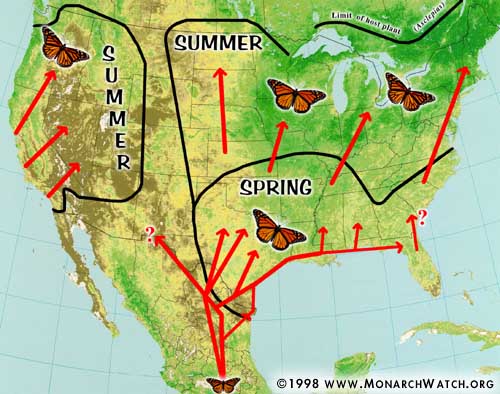
“The monarch migration is truly a wonder,” Taylor said. “Here, you have a fragile insect weighing a half a gram, with a tiny brain, that comes out of Mexico in the spring, migrates up to the breeding areas where it has several generations, then migrates back again to an area that the year’s last generation has never been to. There are lessons for life in this butterfly and we need to protect it. If we don’t, we’re pretty lousy stewards of this planet and it bodes poorly for our future.”
Adapted from materials provided by University of Kansas.
My eyes first saw “Appetite for Destruction”. Having an 80’s flashback. Sorry.
Not to worry.
Ted Turner says we are going to destroy ourselves and become cannibals within 30 to 40 years.
After that the animals will rule again.
It’s not in America. We shouldn’t worry about it, nor should we send in anybody to worry about it.
Great Pic! I have taken pictures like that myself in Pacific Grove and Santa Cruz. They also have some area in Big Sur where they congregate. In Paficif Grove, its one of the Big Attractions. (All Areas are near Bay Area, CA).
It would be sincere loss if this was to come to end. However, I am not optimistic because Mexico in my mind is one of the most screwed up Country in the world and they can’t save or protect anything worth saving or protecting.
Its not just in Mexico.....
Oh well, maybe we ought to grow our own.
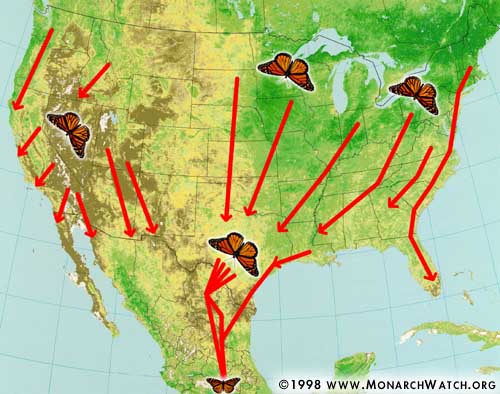
Thanks for the info! The arrow on the far left is the one where I hang around!

They fly right through downtown San Antonio. Not a whole lot of ‘habitat’ there.
I know where you are. I used to live in Scotts Valley in the late '60's when it was a quiet little town.
When will people realize that economic prosperity promotes a healthy environment? In the US, there are more forested acres, cleaner water and cleaner air than 50 years ago, while in the third world, forests are being cut down, the air and water are increasingly polluted.
As I mentioned to the bee people... I have no shortage of bees to pollinate the vegetable plants in my yard because I have a blue bell bush.
Had no shortage of Monarch butterflies last year... most likely due to the daisy bush.
Neighbors have come to pick up the baby bushes each Spring since I've lived here -- 8 years. Clueless as to the actually origin of these perennial... multiplying bushes.
“It’s not in America. We shouldn’t worry about it, nor should we send in anybody to worry about it.”
I hope you’re joking.
And yes, it is in America. Pacific Grove, Pismo Beach, Big Sur, and Morro Bay, California, are all major monarch colony sites. It’s a major source of tourism. And frankly, it would be tragic to lose them. (Pacific Grove might still be the most beautiful little community in the US, but tragic, nonetheless...)
Monarchs also summer in the Great Lakes region and into Canada.
You make light of it, but it’s hard to react that way when you’ve seen their migratory groups. It’s a sight to behold.
However, according to the monarch "expert" at KU, you should be planting milkweed...
“It’s so truly spectacular, one of the awe-inspiring phenomena that nature presents to us. There is no way to describe the sight of 25 million monarchs per acre — or the sensation of standing in a snowstorm of orange as the butterflies cascade off the fir trees.”
I was born in Morgan Hill , lived in the valley , up Hwy 9 to Brookdale for years . I remember these migrations and this guy is correct , it is an awsome thing to see .
I would tell the man to move where they are and sell his ivory tower though .
Disclaimer: Opinions posted on Free Republic are those of the individual posters and do not necessarily represent the opinion of Free Republic or its management. All materials posted herein are protected by copyright law and the exemption for fair use of copyrighted works.

