
Posted on 03/05/2008 8:29:14 PM PST by B-Chan
The Revolution had given the French hope of a fairer society. Its ideals were shared by the immense majority of the people, the nobility and the clergy. But in 1789 there was no question of abolishing the monarchy nor of forbidding the old form of worship. In 1793 the cup was full: the sale of property seized by the state had benefited those who could afford to buy them. The "patriotic" [Republican-sympathising] middle-classes managed to purchase country houses, churches and good farmland. The new masters were no better than the old ones - often far from it. To look down one's nose at the peasant population was characteristic of "enlightened" minds. In short, the rich became richer and the poor remained poor - and, worse still, despised.
And these unfortunates were made even poorer by taxation which, under the new name of "contributions", had more than doubled.The Civil Constitution of the Clergy obliged priests to swear loyalty to the State. Those who refused to do so had to give up the Ministry, to ?e replaced by other priests who had agreed to the new order - sort of "civil servants of the faith".
Of course, the dissenting priests continued to practise their Ministry in secret, but they were tracked down and imprisoned. Resentment grew against the new, official incumbents, called "jureurs" [sworn priests]. The installation of such a new priest often caused local riots in which the National Guard had to intervene.
But what ignited the powder was the conscription of 300,000 men. The Nation had declared war on its European neighbours, and this was the number of troops that the western départements had to provide. Feeling ran particularly high against the National Guard, who were to be allowed to stay on their home ground. In other words, the population would be sent off to lay down their lives for a bunch of haughty middle-class officers, who paraded in fine uniforms and turned houses upside-down in their zeal to dig out illegal priests. Well, there would be war all right, but closer to home rather than on the frontiers of France!
After a few sporadic outbreaks, the general flare-up happened between 10 and 13 March 1793. Two-thirds of the Vendée rose up in arms (the Plain and the south coast areas remaining Republican), and with them the western part of Maine-et-Loire (known as Les Mauges), the south of Loire-Atlantique département and the north of Deux-Sevres. The rebellious region was bounded on the north by the river Loire, from Angers to the sea, and on the east by a line from Angers to Parthenay.The movement's leaders were men of the people. They sought out real military officers from among the local nobility. After all, the privileges of these aristocrats had originally been accorded in return for the promise to provide protection for their underlings. Though, since the Middle Ages, the price that the peasant population paid for this notional service had become exorbitant
However, since the nobility were paid to do it, it was time for them to fulfil their side of the bargain. But the aristocrats - or at least those who had not fled the country - took a good deal of persuading.At the beginning of the insurrection no one realised how big the movement was, and the Vendeans' rising seemed suicidal. Thus Charette - the "knight" who was to enter into legend - had to be pulled by overexcited local peasants from his hiding-place beneath a bed. D'Elbée, Bonchamps, Sapinaud, La Rochejaquelin and Lescure showed little more enthusiasm.
All that the Vendeans had in the way of arms were a few hunting guns and their farm implements, just as they had used in earlier peasant uprisings. Mounted like bayonets, at right-angles to the normal position, scythe blades became deadly weapons. Thus armed, the Vendeans invaded the Republican villages, immediately overpowering the National Guard, who had no military experience whatever. One by one, towns began to fall to the Vendeans: Bressuire on 2 May, Thouars on the 5th, Fontenay on the 25th, Saumur on 9 June, Angers on the 18th. With these victories the Vendeans acquired thousands of guns and dozens of cannon. Their Catholic and Royalist Army numbering 50,000 men was beginning to take form. Jacques Cathelineau, a simple pedlar, was elected General-in-Chief.
In Paris, dismay reigned. Troops sent to overcome these "clog-shod soldiers" were routed. Reinforcements were sent. It was obvious to the Vendeans that they could not carry on alone, but their capture of the city of Nantes brought them the added strength of the "chouans", from Brittany, as well as a large port through which they could have dealings with England.The attack on Nantes took place on 29 June. In spite of problems synchronising the different Vendean armies and of the Republicans' desperate attempts to defend the city, Cathelineau reached the centre of the town.
But in Place Viarme he fell, mortally wounded. In spite of their efforts, the other Vendean leaders could not manage to conceal the General's death from their followers. Though the city was in their hands, the Vendeans pulled back.Soon the Republic had lined up 60,000 men against the Vendée. The numbers may seem fairly even, but the Republican? had the advantage of a permanent force of soldiers, while those of the Vendée never followed up their victories - preferring to hurry home and look after their crops. The "Blues" [Republicans] could wait, but haymaking or harvest couldn't.
Among the new arrivals in the region was General Westermann, whose later exploits would earn him the title of "butcher of the Vendée". In a daring raid, he surprised the royalists and recaptured Bressuire and Mauléon before being beaten. A fresh victory for the Vendeans followed on 14 July, at Vihiers, but August proved a less fortunate month. The Vendeans failed to capture the town of Luéon, which was heroically defended by the garrison and the inhabitants.
Encircled by the garrisons of Niort, Nantes, La Rochelle and Angers, the Vendeans were everywhere. Five days later they beat the best of the Republican troops - the "Mayennais" (so-called because they had kept up a terrible siege in the town of Mainz) - and such illustrious leaders as the talented military commanders Kléber. This army, now sent to the Vendée, had forced the Prussians to leave the city with arms and standards, on condition they never again took up arms in the East. The Convention was confident that soldiers of this calibre would soon put down the unruly département. However, Kléber and his Mayennais were overcome at Torfou on 19 September 1793. Though not routed, the army of Mainz was forced to retreat. The same happened again, twice during the following week.
The turning point came on 17 October, at Cholet. Kléber himself admitted that the Vendeans had been wrong to accept an engagement outside the town. The battle raged until nightfall, with victory seeming certain first for one side and then the other.
Two Vendean chiefs, Bonchamps and d'Elbée, were gravely wounded. As at Nantes, it was the signal for flight. The Catholic and Royalist Army fled towards the river Loire. Men, women and children - 80,000 in all - managed, with only one reported casualty, to cross the wide river in small boats and on rudimentary rafts. Napoleon later admitted to a deep admiration for such a logistical exploit, which implied an unusual level of discipline among civilians.
At St Florent le Vieil, near the river's sandy shores from which the crossing began, the dying Bonchamps ordered the lives of 5,000 Republican prisoners to be spared. Furious at their own defeat and at the losses they had sustained, the Vendeans had been eager to shoot their captives
This is the name of the tragic epic that led the people of the Vendée on the roads of the West. In spite of the mass of stragglers, the Catholic and Royalist Army - reinforced by the Chouans from Brittany and Maine - won a series of victories. Their object was to take the port of Granville, and thus to be in a position to receive help from England. At Laval and Entrammes the royalists swept away Republican defences. But Granville proved impossible to take from the landward side. Without awaiting support from the English navy, the Vendeans attacked the town walls. It was a total failure. The British fleet appeared just as the Vendean army had struck camp. It was time to take the road back - a bloody route, for only 5 per cent of the Vendeans returned to their native parishes. The rest perished; cut down, shot, or worse. Hot on their heels followed the Republican cavalry, with orders to take no prisoners. In spite of this, the Vendeans won victories at Pontorson, Dol and Antrain. They headed south, intending to recross the Loire at Angers. Alas, the town which had rejoiced over the victory of the Catholic and Royalist Army a few months earlier was now strongly defended. Almost within sight of home, the Vendeans were pushed back northwards to Le Mans where, on 12 December 1793, they were defeated. On the 23rd, what remained of the army was massacred at Savenay.
Westermann wrote to the Convention: "...there is no Vendée. It has perished, with its women and children, under our sword of freedom. Following your orders, I have crushed the children under our horses' hooves, and massacred the women - they will bear no more children for those brigands. I have not taken a single prisoner."
bump
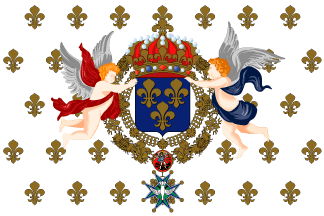
Vive le Roi! Vive la France!
Mes amis, si j’avance, suivez-moi! Si je recule, tuez-moi! Si je meurs, vengez-moi!
Merci. C’est important se rappeler la vraie France, catholique et libère. Vive le Roi!
Ah, Henri du Vergier, comte de la Rochejaquelein! Quelle héros!
That is a cool store! Thanks for the link!
thanks
What is your opinion of the Girondists and Charlotte Corday, and her killing of Marat, did killing him help or hurt things in the big picture (considering the martyr-like status he achieved post-mortem)?
As for Marat: he was a sadist who happened to prefer political sadism to whips and chains. He got what he deserved. Corday was a human cruise missile who took out the target with no collateral damage. She probably saved lives by her act.
Fortunately, Marat's cult was short lived, although the Soviets still held him up as a “people's hero” until the 1980s.
La Rochejaquelin is one of my personal heroes.
I do not live in a time or place that required me to be put to such a test, but I would like to believe that had I lived in that time and place, I would have fought for the Church and the King.
Fortunately, most if not all of my French ancestors were in Quebec by that time.
Disclaimer: Opinions posted on Free Republic are those of the individual posters and do not necessarily represent the opinion of Free Republic or its management. All materials posted herein are protected by copyright law and the exemption for fair use of copyrighted works.