Posted on 12/29/2007 7:01:55 AM PST by Kaslin
Baghdad will mark the first anniversary of Saddam Hussein’s execution on Sunday as a city transformed, largely as a result of thousands of his loyalists forging new alliances with the American military.
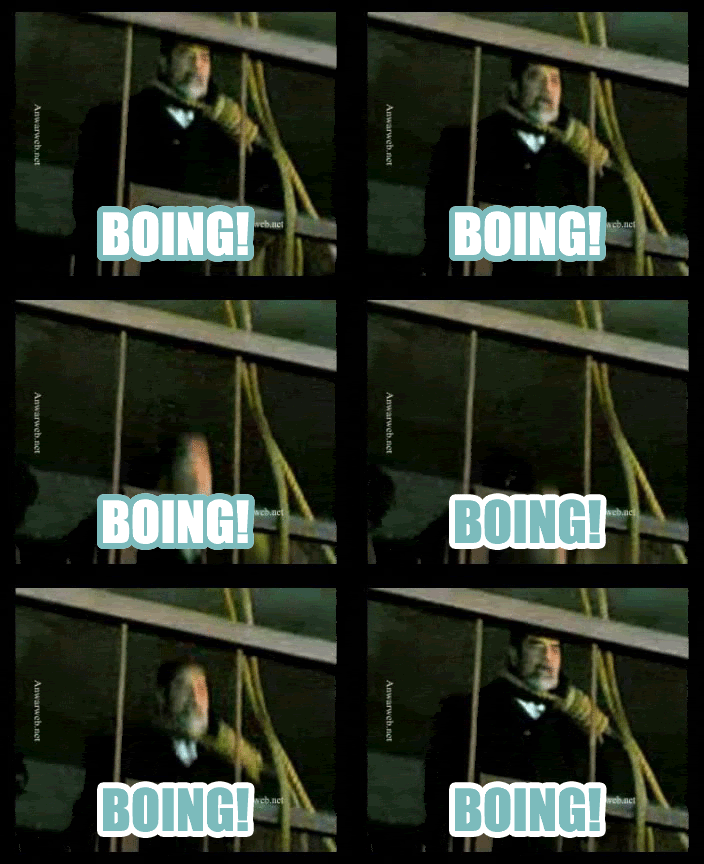
The rushed and chaotic circumstances of Saddam’s final hours - the Iraqi prime minister Nouri al-Maliki personally ordered his hanging on the eve of a major religious feast - illustrated the dramatic rise of Shia Muslim power in Iraq following the US overthrow of the Sunni-dominated regime in 2003.
Mobile telephone cameras caught the executioners taunting Saddam on the gallows with sectarian slogans.
But instead of inflaming the Sunni insurgents, the event provided an opening for US commanders to co-opt fighters to battle extremists linked to al-Qa’eda.
The flagship of the post-Saddam reversal of fortune is Amariyah, a district desolated by the civil war.
It has regained a sense of security unimaginable when President George W Bush ordered a surge of troops in Baghdad a year ago.
Armed American allies patrol triumphant in the streets having driven out al-Qa’eda-linked extremists.
“We fought the terrorists and we won,” said Shami Karim, a 27-year-old fruit stall holder and gun-toting Knight of Mesopotamia, the name given to the £150-a-month guards co-opted to control the district.
“We like to live in peace and are glad that no one in Baghdad can call us terrorists. It has taken a long time but we appreciate the Americans.”
In a report to Congress last week, the Pentagon said US forces had made “significant security progress” in Iraq over the past three months and would end a remarkable year on a high after quelling the worst of the violence in Baghdad and the Sunni heartland.
The Pentagon assessed the impact of the “surge” in troop deployments in the capital and western Anbar province in glowing terms: “There has been significant security progress, momentum in reconciliation at the local and provincial levels and economic progress”.
While the potential for bloodshed remains, many Iraqis would appear to agree with the assessment.
Haji Abdullah Hussein, an elderly baker, is one of the thousands to have taken up the burden of America’s efforts to revive Baghdad as a thriving and peaceful city.
In early December Mr Hussein, 76, opened his shuttered bakery on formerly bustling al-Jamiyat street for the first time this year.
“I’ve been a baker for 22 years,” said Mr Hussein.
“I hung on for as long as I could but I was forced out until now. The Americans proved that ordinary life was possible here again.”
The US praises the bravery of Mr Karim and 60,000 fellow volunteers but the Baghdad government has condemned the alliance as a plot to strengthen its opponents.
The Sunni Muslim bias of the neighbourhood guards, known as Concerned Local Citizens (CLCs), alarmed the Shia-dominated government which has only accepted 5,000 into the police forces.
While furiously lobbying for a compromise, US commanders have pledged to cap the CLCs under 90,000 and encourage fighters to seek re-employment as civil servants.
“It’s not like we are arming these people,” said a senior US official. “They’ve been bold enough to come forward and fight al-Qa’eda.
We’re trying to integrate them into the set-up by providing salaries and a status but to a Shia Islamist government this has become an effort to restore a colonial Sunni regime.”
American largesse is not confined to men with guns.
A scheme that allows businessmen to claim £1,500 grants to reopen shops has “working in a weird, unbelievable way,” the US official said.
The latest breakthrough is the revival of Baghdad’s most prominent computer arcade.
Prominent refugees have returned from exile.
Restaurant owner Hamid Ilsan took his celebrated al-Rabiyah restaurant to Damascus three years ago but is now putting the finishing touches to a re-launch back in Baghdad.
“You can feel it,” he said. “It’s better than it has been for a long time. There’s 12 checkpoints on this street and lots of traffic jams. Customers are piling up out front.”
The influx of exiles is being carefully watched in case attempts to reclaim lost homes and possessions triggers new bouts of inter-community warfare.
Iraq’s Red Crescent reported 28,000 refugees returned from Syria, where more than one million have fled, since September.
The survey found that 110,000 people nationwide had returned to abandoned homes in October, resulting in the first fall in the internally displaced for many months. Even so 2.19 million remain internally exiled.
Haider al-Moussawi, who returned from Syria last month, said improved security was just one factor behind his decision to return home.
“Iraqis in Syria have pushed up prices and are no longer wanted, the new visa regime is tough and homesickness is a reality. We wanted to be back with our own people.”
Sectarian fears created by civil war remain strong. Pacified districts like al-Jamiyat sit next to treacherous zones, forcing residents into a Baghdad equivalent of assessing the perils of crossing from the districts of Holborn to Bloomsbury in London.
Outside Amariyah’s walls lies the suburb of Khadra where locals claim al-Qa’eda loyalists retain a powerful presence.
Even here the jihadists have receded but only as far as the shadows.
Cigarette seller Abdul Salih, who set up his stall on the fly, said the night still belongs to the group.
“I still hear the sound of shooting especially after midnight. I would like us to have the same system as Amariyah. Here al-Qa’eda passes us in ordinary cars not detected by the law.”
The supreme coalition commander, General David Petraeus, has refused to declare victory. He believes the situation is precarious because many al-Qa’eda sympathisers have fled north to the third city Mosul and thus pose a continuing threat.
With the number of American troops in Baghdad is already shrinking after hitting a peak last month, the clock is ticking on how long GIs in combat outposts and security stations across Baghdad can maintain a blanket presence.
Even with its reduced foothold al-Qa’eda remained capable of disruptive acts of violence.
“There isn’t one act that will cause everything to be perfect,” said a US officer in Baghdad.
“It’s not done yet.”
But even those pessimistic about Iraq’s long-term prospects believe insurgents can’t quickly recover from the pummelling meted out in the surge
. Joost Hiltermann, an Iraq analyst at the International Crisis Group said: “Petraeus has accomplished enough militarily for the level of stability we’re seeing to persist beyond the end of the surge in the summer. I think he’s gained enough time for President Bush to leave office claiming Iraq is stable.”
This is old news since it has been all over the MSM. Hasn’t it?
More bad news for those in my tag line.
God Bless President Bush and our brave troops.
Happy New Year.
The success of the surge is the most underreported story of 2007.
Put that in your pipe and smoke it Paultards and Liberals who put partisan interest and gimcrack theory above the brave fighting men and women of America.
I don’t suppose they’re having any piñata parties in honor of the occasion, are they?
Yes, they, with the help of their friends in the media have actually been able to influence events in the war. How they can sleep at night knowing some of the things they have enabled is beyond me.
Despite their efforts, good is winning out and will triumph in the end.
Iraq is a success story. The greatest succes story of this decade and that will become even more pronounced in the coming year.
You’ve been a part of it, my amiga. Thanks for all you do there and here.
Planning on another “reenlistment”? You’ve been going back for a loooong time now.
Well, I'm going back next week at the end of my (short!) vacation here at home. My current mission ends in April and I've got to decide in the next couple of months whether I'll extend or come home. ("Come home" has a nice ring to it.)
I don't know if I want to spend another summer in Iraq. If things have progressed far enough by April, I may dust off my hands and go on to something else. I wanted to stick around to see it work and I'm seeing that now.
The Clash song "Should I Stay or Should I Go" is now my theme song. ;-)
It's my honor and my pleasure. And you've been a part of it, too. :-)
Baghdad’s calm because you’re in Houston right now.
Well, that annoying rooster who hangs out there has certainly been quiet.
I go back to Baghdad next week and well, we'll see.
See, there's this rooster there...
We should have executed him within days of capturing him. Maybe, it would have spead up the “awakening”.
Disclaimer: Opinions posted on Free Republic are those of the individual posters and do not necessarily represent the opinion of Free Republic or its management. All materials posted herein are protected by copyright law and the exemption for fair use of copyrighted works.