
George Washington Bridge
75th ANNIVERSARY
 Interactive: Tour the bridge, see how population grew in North Jersey and test your knowledge of bridge trivia. Special Report: GWB at 75
Posted on 10/25/2006 8:10:19 PM PDT by Coleus
Interactive: Tour the bridge, see how population grew in North Jersey and test your knowledge of bridge trivia.
To fully appreciate the GWB, you have to experience it close up -- as the living, breathing organism it is. Its builders designed the span not to fight natural forces but to accommodate them. Step out onto the span, and you sense the barely perceptible but constant motion, punctuated frequently by heart-stopping vibrations when large trucks barrel past. That's part of the fun, if you're wired that way. The views in every direction are terrific. The Palisades loom in all their Triassic glory. And then, of course, there's the spectacle of the New York City skyline. From the New York side, you can see all the way upriver to the Tappan Zee Bridge. From the Jersey side, downtown Manhattan and the Upper Bay of New York Harbor are clearly visible. Proximity also aids in appreciating the bridge as an engineering marvel and as a monument to the audacity of those who built it. It's hard to fathom its massive scale from a car window at 50 miles an hour.
By foot, you shudder at midspan with the realization of where you are: More than 200 feet above the Hudson, alongside a roadbed that's 30 yards wide, crowded with trucks and buses, 1,750 feet from the towers that hold the whole thing up. And then it comes to you: Somebody looked across this great expanse and said, I'm going to build a bridge here. And then they did it. At a leisurely pace, it'll take 30 minutes to walk the mile or so from the beginning of the walkway on Hudson Terrace in Fort Lee to the Port Authority bus terminal in Manhattan. There are two walkways across the bridge, one on either side. The southern walkway had been closed for construction, but the Port Authority said Friday it is now reopened. Lots of people hoof it across the bridge. There are commuters, power walkers, joggers, bicyclists, tourists and, unfortunately, all-too-frequent jumpers. Getting to both walkways is pretty easy. In both cases, park on Hudson Terrace, at the metered streetside parking just north of the bridge (25 cents an hour, with a three-hour limit).
| George Washington Bridge 75th ANNIVERSARY Interactive: Tour the bridge, see how population grew in North Jersey and test your knowledge of bridge trivia. Special Report: GWB at 75 |
For the south walkway, walk south on Hudson Terrace and go left immediately after you emerge from under the bridge approach roadways. Signs will direct you the rest of the way. For the north walkway, there are concrete steps right next to the parking spots. Follow the signs up the stairs and over the pedestrian bridge over the Palisades Interstate Parkway northbound ramp. From the overpass, the stairs leading down to the walkway are to the right, and fairly well marked.
On the New York side, the northern walkway ends at the bottom of a set of stairs, at 179th Street and Cabrini Boulevard. The Port Authority Bus Terminal is one block to the east, on the far side of Fort Washington Avenue. The terminal has an Off-Track Betting parlor, a bank, and a number of food options. No statement here on the quality of those options. Escalators lead to the A train subway line, which runs the length of Manhattan and beyond.
Some cautions:
On the northern side, the walk involves several sets of steep stairs. The southern walkway is easier.
Walking, post 9/11:
Like much of life in this area, things changed on the bridge in the wake of the Sept. 11, 2001, terror attacks, reflecting the obvious fact that the GWB is an object of immense strategic value to the region. As a result, you're pretty much limited to the walkways. Small observation decks that once extended laterally beyond the towers -- and provided a degree of privacy for the romantically inclined – are long gone. Lovers and any others who may want to dawdle are discouraged from doing so -- red-and-white signs declare that loitering is prohibited. In the old pre-terrorism days, access to the superstructure was relatively easy, though illegal. Local kids were known to dare each other about scaling the structural steelwork of the towers. That's now impossible, or made virtually so, by the sturdy fencing and caging that isolate the walkway areas.
That's probably for the best anyway. In addition, at various points along the walkways, security guards sit in small sheds. Fencing with alarms keeps away anyone who might seek access to the cable anchorages and other sensitive locations. And the bottoms of the metal suspender "ropes" that link the roadway to the four main cables high above are now encased in heavy metal cocoons. Cameras are also prohibited.
A bridge with no name -- During construction, the project was referred to as the Hudson River bridge, but its official name was up for grabs. There was no shortage of suggestions: Gate of Paradise, Bridge of Prosperity, Experiment, Prohibition, Pride of the Nation, Public, Bi-State and Mother's Bridge. It was named for George Washington both because of his Revolutionary War activities in the area and to mark the 200th anniversary of his birth. Before it became the George Washington Bridge, it was called the Washington Memorial Bridge.
Financing -- $60 million was allocated for the project.
• $20 million in Port Authority bonds at 4 percent.
• $30 million in Port Authority bonds at 4.5 percent.
• $5 million each from New York and New Jersey.
The job came in $1 million under budget.
Dining al cielo -- Early designs envisioned restaurants and observation decks at the top of the bridge. None were actually built, but not because it wasn't possible. The maintenance elevators in each tower leg could have been dressed up for tourists. One problem: The New York tower stands on solid ground, but its Jersey counterpart is 76 feet out into the Hudson River. Left on the drawing board -- Both the New York and New Jersey entrances were conceived as ceremonial architectural spaces. The New York approach was envisioned as a great plaza, similar to Grand Army Plaza in Brooklyn, with a spectacular central fountain surrounded by statues. In Fort Lee, a much grander toll plaza was originally envisioned than what was eventually built.
George Washington Bridge 75th ANNIVERSARY Interactive: Tour the bridge, see how population grew in North Jersey and test your knowledge of bridge trivia. Special Report: GWB at 75 |
A safety net -- The wire mesh between the eastbound and westbound lanes of the lower level was designed to catch cars or people that might go over the central rail. In an accident shortly after its construction, a truck went over the rail and was successfully supported by the mesh. The future -- The bridge's suspender ropes will be replaced. Although the suspenders have lost an estimated 10 percent of their strength over the years, the bridge is not in danger of failure, according to the Port Authority, because the ropes are much stronger than they need to be.
Vital statistics and measurements
Span -- Suspension bridges are ranked according to the length of their central span -- the part between the two towers. In 1931, the GWB was the longest in the world, with a central span of 3,500 feet. It retained that distinction until 1937, when it was surpassed by San Francisco's Golden Gate Bridge, at 4,200 feet. In 1964, the title was seized by the Verrazano-Narrows Bridge, at 4,260 feet. Today, the world's longest is the Akashi-Kaikyo Bridge in Japan, which has a span of 6,529 feet. The George Washington Bridge now ranks 14th.
Traffic -- Although the GWB is often called the "busiest bridge in the world," that honor may belong to the Howrah Bridge in Calcutta, India, which gets heavy pedestrian traffic. The GWB is still probably the busiest in vehicular traffic. In 2005, it carried 107,224,000 vehicles -- almost 300,000 per day -- and it definitely has the most traffic lanes -- 14 -- of any bridge in the world.
The towers -- Each of the George Washington Bridge's two giant towers stands 604 feet above the Hudson. Each contains about 20,000 tons of steel and 475,000 rivets (accounting for 325 tons of dead weight). Both towers are made from 12, 50-foot-long sections.
The cables -- Four giant cables, each three feet in diameter, hold the roadway up. Each cable comprises 61 large strands, each containing 434 wires wound together over the river, for a total of 26,474 wires per cable. Four 180-ton saddles atop each of the towers hold the main cables in place. The roadways hang from suspender "ropes" running vertically between the cable and the roadbed superstructure.
The decks -- The total length of the bridge's deck -- the distance between the two anchorages -- is 4,760 feet. The width of the deck is 119 feet, with 90 feet devoted to road surface. The water clearance at mid-span is between 195 and 213 feet.
The anchorage -- Only the New York side required the construction of an external anchorage. On the New Jersey side, the anchorage is the solid rock of the Palisades. The concrete anchorage on the New York side weighs 350,000 tons.
The flag -- The American flag that flies under the upper arch of the New Jersey tower is the world's largest free-flying flag. It is 60 feet wide and drapes vertically for 90 feet. Its stripes are approximately 5 feet wide and the stars measure about 4 feet in diameter. Weather permitting, the flag is flown on the following eight holidays: Martin Luther King Jr. Day, Presidents' Day, Memorial Day, Flag Day, Independence Day, Labor Day, Columbus Day and Veterans Day.
Thanks for posting this. Interesting.
USA Today had an article a week ago about the work needed on so many of our bridges - Upkeep costs rise as USA's bridges age. Coupla good pix of the GW there.
At a leisurely pace, it'll take 30 minutes to walk the mile or so from the beginning of the walkway on Hudson Terrace in Fort Lee to the Port Authority bus terminal in Manhattan.
The author is a fast walker. It's about 10 miles.
/chuckle
I used to work near the GWB on the NJ side. I have never walked across it, though. It sounds like an interesting adventure.
I love bridges.
If I recall correctly, doesn't the Circle Line Boat Cruise take you under all of the bridges? I did this back in the '80's and loved every minute of it.
If I recall correctly, doesn't the Circle Line Boat Cruise take you under all of the bridges? >>
I think it does. Click on the little red light house and read some commentary on that thread.
It's a little more than a mile, and it isn't all that intereting of a walk. The skyline is a long way away. You're much better off on The Empire State Building.
Thanks for posting the article. I really like seeing the GW bridge in
TV/movies, especially when it's lit up at night.
Amazing to think about it would just be a pedestrian "great bridge"
if the lack of funds hadn't left the superstructure exposed.
I didn't become a modest "bridge junky" until reading columns by
Henry Petroski in "American Scientist" magazine.
(sadly, a subscription is needed for internet access)
Some of the stories he tells about the inspiration of, designing, building
and occasional failure of bridges are just great.
I've not read it, but here's a book he's done on bridges:
Engineers of Dreams: Great Bridge Builders and the Spanning of America
by Henry Petroski
http://www.amazon.com/Engineers-Dreams-Builders-Spanning-America/dp/0679760210/sr=1-11/qid=1161836722/ref=sr_1_11/002-7611275-7514441?ie=UTF8&s=books
My mother lives in Ft. Lee.
I've worked in Manhattan on and off for years.
I worked for Tri State Taxi, which was on North Central, during the 1990's. Every so often I walked the bridge just because we were both there.
Delightful! Thank you.
Going to school in Brooklyn, my date and I spent one night walking Manhattan, from the GW Bridge which we walked across and back, to the Battery and the Staten Island Ferry (round trip $.05) 54 years ago. This presentation was nostalgic for me.
Maybe he means the uptown station.
Then I saw the light projector. They had taken pictures of the building, colored them, and placed them in the light projector. Presto, red-and-white building.
It's across the street from the old Morgan residence, which is a fairly impressive brownstone mansion. But whoever built the consulate building (I could look it up) obviously had a keeping-up-with-the-Joneses jones.
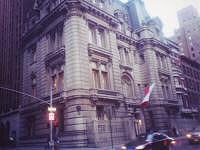
Built by a copper baron. Can't find a picture with the red lights on it.
I think you and Firebrand are right. I just assumed it was the 186th (?) Street station, but you have cleared up the confusion.
Disclaimer: Opinions posted on Free Republic are those of the individual posters and do not necessarily represent the opinion of Free Republic or its management. All materials posted herein are protected by copyright law and the exemption for fair use of copyrighted works.