
Posted on 02/15/2006 3:15:10 PM PST by A.A. Cunningham
TR Traps Last Tomcat from Combat Mission
Story Number: NNS060215-15
Release Date: 2/15/2006 4:42:00 PM
By Journalist 2nd Class Stephen Murphy, USS Theodore Roosevelt Public Affairs
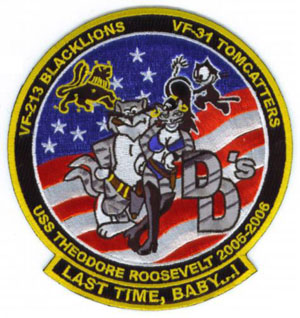
ABOARD USS THEODORE ROOSEVELT (NNS) -- A chapter in naval aviation history drew to a close Feb. 8 aboard USS Theodore Roosevelt (CVN 71) with the last recovery of an F-14 Tomcat from a combat mission.
Piloted by Capt. William G. Sizemore II, commander, Carrier Air Wing (CVW) 8, Fighter Squadron (VF) 213’s aircraft 204 was trapped at 12:35 a.m. and marked one of the final stages of the Navy’s transition from the F-14 to F/A-18 E/F Super Hornet.
“It’s the end of an era and it just kind of worked out that I was the last trap,” said Sizemore. “This is one of the best airplanes ever built, and it’s sad to see it go away. It’s just a beautiful airplane. It’s powerful, it has presence, and it just looks like the ultimate fighter.”
Lt. Bill Frank, a VF-31 pilot, also took part in the last mission, and is credited with being the last pilot to ever drop a bomb from an F-14 Tomcat.
“We were called on to drop, and that’s what we did,” said Frank. “It’s special and it’s something I can say I did, but what’s more important is the work of the Sailors who made it possible. They have worked so hard during this cruise to make every Tomcat operational.”
The decision to incorporate the Super Hornet and decommission the F-14 is mainly due to high amount of maintenance required to keep the Tomcats operational. On average, an F-14 requires nearly 50 maintenance hours for every flight hour, while the Super Hornet requires five to 10 maintenance hours for every flight hour.
“I don’t think there is anything better than a Tomcat, but it’s probably a good time for it to go away,” said Senior Chief Aviation Machinist’s Mate (AW) Gene Casterlin, VF-31. “The Navy is getting smaller and more efficient, and it will only get harder to maintain the Tomcat. But no matter what, the Tomcat is the sexiest airplane in the sky.”
The F-14 entered operational service with Navy fighter squadrons VF-1 Wolfpack and VF-2 Bounty Hunters aboard USS Enterprise (CVN 65) in September 1974. The Tomcat’s purpose was to serve as a fighter interceptor, and it eventually replaced the F-4 Phantom II Fighter, which was phased out in 1986.
During their final deployment with TR, VF-31 and 213 collectively completed 1,163 combat sorties totaling 6,876 flight hours, and dropped 9,500 pounds of ordnance during reconnaissance, surveillance, and close air support missions in support of OIF.
“As we near the end of the Tomcat’s last deployment, we are proud of our legacy and take solace in the fact that the Tomcat is going out at the top of its game, but also regret saying farewell to an old, revered and trusted friend," said Cmdr. Richard LaBranche, VF-31 commanding officer.
In keeping with its history of being adaptable to new challenges, the Tomcat soared to a new level during its last deployment when it became the first Navy aircraft to make use of the Remotely Operated Video Enhanced Receivers (ROVER) system in December of last year. The system allows for ground forces to view video via laptop computers which gives them the ability to view their surroundings from the aircrafts’ point of view in real time, and ultimately provides better reconnaissance and target identification, which are essential to combat air support missions in Iraq.
Previously, ROVER had been used by the Air Force, and with a few modifications from personnel of Naval Air Station Oceana, Va., and members from Naval Air Depot Jacksonville, Fla., it became one of the last great modifications to the Tomcat.
"From its inception, the Tomcat has been the icon of Naval Aviation with its striking appearance, speed, formidable lethality and versatility,” said LaBranche. “It is more capable today than at any other time during its existence because of the innovation, dedication, and tenacity of every maintainer and pilot who has ever been associated with it.”
VF-213 pilots who are making the transition to the Super Hornet will begin F/A-18F (double seat) training in April, and the squadron will be operational, or “safe for flight,” in September. VF-31 pilots who are making the transition will begin F/A-18E (single seat) training in October, and the squadron will be safe for flight in April 2007. This will make VF-31 the last official Tomcat squadron in the Navy.
Maintainers in both squadrons will be begin training to perform their specific maintenance job as it pertains to the Super Hornet, shortly following this deployment. Their training will last anywhere from six weeks up to seven months, depending on the type of maintenance skills involved.
For related news, visit the USS Theodore Roosevelt (CVN 71) Navy NewsStand page at www.news.navy.mil/local/cvn71/.


I wonder if they are selling them for surplus - A Freep F-14 would make a nice mascot.
So, what's the Box Score on the Tomcat?
I know it splashed those two Libyan Migs. Any others Air-to-Air?
the super Tomcat (d) is quite capable even now and is retiring like an undefeated boxer still in the prime.
Also 2 Libyan Sukhois and captured a Boeing 737.
Not bad...
Bump.
“It’s the end of an era and it just kind of worked out that I was the last trap,” said Sizemore. Yeah, right. Hahaha! A coincidence my ass.
Wish I could buy one on surplus.
Placemark.

Monday was a sad day for anyone involved with the best damn pure weapon ever devised. The F-14 could do things no other airplane could, and have enough gas left for an airshow at the boat.
She was powerful, elegant and mean. Just like a beautiful but high maintenance, tempermental woman. I will never forget what the flightline looked like 15 years ago at Miramar with all those beauties on the deck. One can open, one can closed, looking like an ass-kicking waiting to happen.
A fighter should look mean and dangerous. The Tomcat was so damn big, it was hard to believe sometimes how nimble it was. I love you Dick Cheney, but you killed my baby.
God bless the men that fly and fight.
That said. Youse guys are NUTZ! After hydrazine training, and ACES-II certification, and all of the other training required, just to stand around, near a jet fighter.... it dawned on me that they are dangerous. JUST SITTING ON THE FLIGHT LINE! I memorized pins and flags, so that I could look at each one, as I walked to my assignment, and determine whether it was going to fall, fly, or blow up.
God bless the men that fly and fight. I'm glad to be supporting them, able to pat them on the head and tell 'em... "Go get 'em, Tiger!"
I couldn't do it. I'm glad someone can.
/johnny
Just sucks. Congress screwed Grumman.
F14D would make large holes in MIGS.
No. Some carcasses will be used for display and museums but the process of scrapping the Tomcats is closely monitored. Wouldn't want any profiteers to send those parts to the IIAF mullahs.
The Tomcat's final flight
By JACK DORSEY, The Virginian-Pilot
© January 24, 2005
Last updated: 12:55 PM
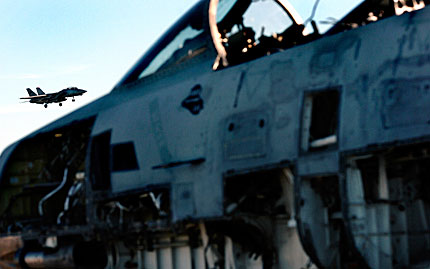
VIRGINIA BEACH — As their 32-year run as the premier Navy fighter begins to wane, the F-14 Tomcats that no one needs are being fed into a junk yard’s shredder, nose first, to become blocks of aluminum for cans, crates, even cars.
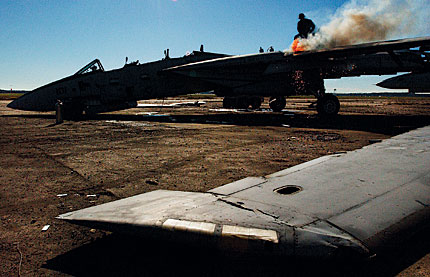
The soft gray carcasses lying on a broken concrete tarmac at the northwest corner of Oceana Naval Air Station – not far from the maintenance hangars where they were once kept pristine – is an ugly sight for the Tomcat air crews still flying overhead.
“I try not to look down,” Cmdr. Rick LaBranche, executive officer of the “Tomcatters” of Fighter Squadron 31, said, referring to whenever he flies over Oceana’s “bone yard.”
Stripped of their engines, ejection seats, radar and guns – everything valuable or reusable – the planes barely resemble the $50 million supersonic jets once capable of firing missiles from 100 miles out, winning any aerial dog fight they picked, and dropping precision-guided munitions within inches of their mark.
The F-14s will cease flying in late 2006, when the last of the 633 that were built for the Navy shuts down at Oceana, ending an era that began in the mid-1970s. They were designed to protect the fleet, built primarily to intercept long-range Soviet strike aircraft, once thought to be the Navy’s biggest threat.
Some have been picked to survive as museum artifacts, or sent to military bases for display. Others are being mothballed for war reserve.
The latter group winds up on the desert floor at Davis-Monthan Air Force Base, Ariz., where another 4,500 antiquated planes are kept.
The slow demise of the F-14 at Oceana is painful for the squadron members manning the 79 Tomcats still in use.
Today, teams of mechanics from Titan Systems Corp., including some former F-14 squadron members , have been hired to gut the fighters before they are loaded onto a flatbed trailer and trucked to a Chesapeake scrap yard.
“Yeah, it makes you cry sometimes,” said Melody Hall, a former Navy aviation mechanic and the only woman on the team taking the fighters apart.
Hall, her forearms smudged with grease, used a tiny angled screwdriver to remove some of the hundreds of fasteners securing an aluminum plate before being able to reach one of the plane’s two engines.
“You have to take them out in a certain way, so they don’t wedge down and get stuck,” she said, switching to an electric drill once she cleared the tight quarters behind a landing gear strut.
Along with a team of two or three others, she will spend up to six weeks stripping the plane before it is towed across the field to Oceana’s bone yard.
About 120 F-14s have been taken out of service since 1999, according to William “Taco” Bell, who heads Titan’s Stricken Aircraft Reclamation and Disposal Program at Oceana.
Of those, about 60 have met their fate inside the junk yard’s shredder, 40 were sent to the desert, 12 to museums and eight are displayed at military bases.
Determining which ones get the welder’s torch, and which continue to fly, is based on age, current condition and historical significance.
“Some are 30 years old and have been repaired so many times it is no longer economic to continue to do so,” Bell said.
Others, recently overhauled, may be just 15 years old, and have more life to give.
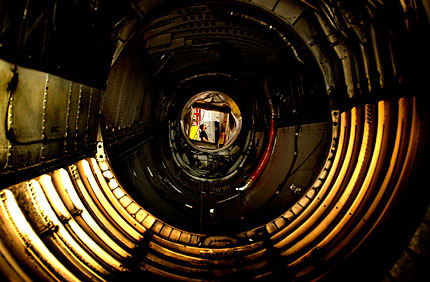
Aircraft log books, painstakingly kept by squadron personnel throughout the history of the plane, let Bell know when an F-14 is coming up for a major overhaul, has sustained a stress fracture, flown too many hours or suffered too many hard landings.
Bell sends those jets to the scrap pile.
A computer-generated list tells Bell the planes’ history . Bureau No. 163894 was an F-14D model, built at Grumman’s plant on Long Island, N.Y. It came off the production line Sept. 30, 1990, flew 3,704 flight hours, made 827 catapult takeoffs and 820 cable-arrested landings aboard carriers.
While it used up just half of its estimated 7,000-hour structural life, it would have had to undergo a $1 million overhaul in November to keep flying.
It was ordered scrapped.
“I worked on Tomcats for 30 years and I have a tear in my eye, too,” said Bell, who retired in 1999 as a maintenance officer at Oceana.
But the businessman in him said it is a fact of life: Some have to go.
However, not all is lost. Titan has reclaimed about 500 items per plane, or 6,000 per year since 1999 that the F-14 squadrons can re-use. That’s about 30,500 parts, Bell said, resulting in $17.5 million worth of material being returned to the Navy for use in F-14s, or other aircraft.
A similar process has been used on other worn-out aircraft, such as E-2 Hawkeye radar planes, H-46 Sea Knight helicopters, even early models of the F/A-18 Hornet .
In addition to the 633 F-14s built for the Navy, Grumman produced 80 for Iran, the only foreign nation to receive them. Iran took possession of 79 Tomcats between 1976 and 1979; the last one was never delivered because of the overthrow of the Iranian government.
While several manufacturing plants produced sub sections of the plane, they were all assembled at Grumman’s Calverton plant on Long Island.
There, said John Vosilla, a spokesman for Northrop Grumman, as the corporation is now named, it would take 18 to 24 months to assemble the planes for flight.
Production rates were between 24 and 36 per year – nothing like the 12,275 F-4F Hellcats that Grumman turned out in one year during World War II.
The F-14s that were produced for the Navy included 493 “A” models, some of which were later converted to “B” and “D” models. There were 85 built as “B” models and 55 built as “D” models . The “A” model initially had a what-was-determined-to- be inferior Pratt & Whitney engines, which were retrofitted with higher trust General Electric engines.
The “B” and “D” series included the new engines, plus additional upgrades. There was no “C” model, normally the designation for a single-seat aircraft.
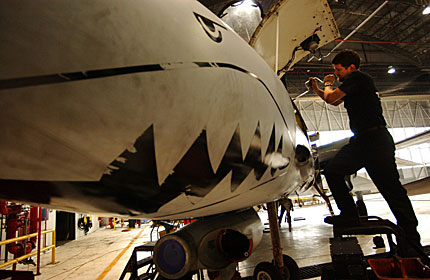
John Griffing, with Northrop Grumman’s field office in Norfolk, recalls his early days with the company serving as a technical representative on the Tomcat for about 12 years. He went to sea aboard the carrier Enterprise for the F-14’s first deployment in 1974.
“The only incident was self-induced,” he said. “Somebody left the safety pin in the tailhook and when the guy came back to land he couldn’t get the hook down.”
The ship erected a barricade across the flight deck to catch the errant jet. “The new Hornets have all the gee-whiz stuff in them.” As Randy Monroe of Ram Metals aimed his Bobcat tractor at the latest hulk resting in Oceana’s bone yard, he said it represented merely another of the 70 or so Tomcats he has cut up.
Monroe powered his tractor across the tarmac, the dull gray nose of the plane screeching on the concrete pad littered with pieces of junk metal, bolts, hoses, clamps and landing gear. Never mind that the plane was an F-14 that once flew in Fighter Squadron 154 aboard the carrier Kitty Hawk, based in Japan. It likely was called upon to provide force protection and reconnaissance for U.S. and allied forces along the Asian coast.
Monroe, of Mineral Wells, Texas, pushed the plane closer to his acetylene torch so he could reach its wings – they are the first to go.
Cuts along a 2-foot beam, a slice here, another there, dropped the right wing in 15 minutes. Same for the left. A bucket of water kept the smouldering wing from erupting into flames.
Next were the air intakes, then the box beam – a thick titanium structure that holds the fuselage to the wings. It is perhaps the most valuable piece of scrap metal on the plane, said Jody G. Goucher, program supervisor for Titan.
It takes Monroe a full day to rip apart each plane.
Monroe works for free. The Navy lets him sell the scrap aluminum, stainless steel and titanium for his profit.
“I make a little off the plane, not a whole lot,” Monroe said when asked what each hulk fetches.
The aluminum is nearly worthless, he said. Like most aircraft aluminum , it has a lot of trash in it, he said.
Monroe has been doing this for six years, including ripping apart 30 worn out E-2 Hawkeyes and a few F/A-18 Hornets.
By the time Monroe gets the planes, they are aircraft in form only. Their guts still hold reams of small-gauge electrical wires, still factory white, still tightly wound.
Pigeon droppings coat the tops of the air crew seats. The canopy jettison handle, marked with yellow paint with black stripes, rests untouched.
Yards of quarter-inch-thick stainless steel pipe, which fed hydraulic fluid to moving parts, remained attached to the fuselage.
“It won’t fly no more,” Monroe said after cutting off another wing and loading the wreck on a flatbed trailer.
His Dodge Ram 3500 truck carries the load out Oceana’s main gate, past the hangars, the galley and officers’ club, and on to a Chesapeake scrap yard for its final shredding.
Nothing is to be left intact.
“That’s one of the reasons I’m here, to make sure it never ends up on e Bay,” he said.
Reach Jack Dorsey at 446-2284 or jack.dorsey@pilotonline.com.
Are those Iranian birds combat ready?
Somehow, I don't think we're going to suddenly start selling them spare parts...
Disclaimer: Opinions posted on Free Republic are those of the individual posters and do not necessarily represent the opinion of Free Republic or its management. All materials posted herein are protected by copyright law and the exemption for fair use of copyrighted works.