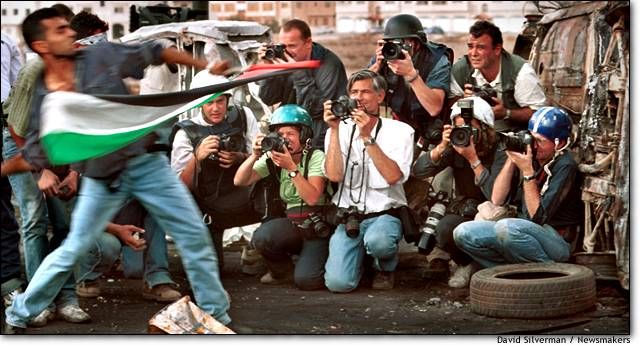
This was earlier at the beginning of the Intifada.
Posted on 10/15/2005 4:15:56 PM PDT by jetbanana
Like the Colossus at Rhodes, Edward R. Murrow was a guardian of epic proportions. Instead of a harbor, he stood at the portal of American television news, protecting its reputation from collapse during a time of tumult and timidity.
That's the image of Murrow presented in George Clooney's new film, "Good Night, and Good Luck," which chronicles the CBS reporter's famous takedown of Sen. Joseph McCarthy and opens today at local theaters.
Suffice to say here that from a vetting standpoint, the film is an exceptionally lucid look through a narrow aperture.
But Murrow's reputation as TV legend (and Washington State University's most famous journalism graduate) is far more complex than 93 minutes can convey. It is worth a second look before hagiography and triumphalism take over.
Murrow enjoyed a latitude that contemporary journalists may envy. Already a star at CBS, thanks to his soaring World War II radio broadcasts, he did the stories he wanted. He reported and he commented. He challenged authority at the highest levels of government and within his own organization.
Yet he also was more of an establishment figure than the movie suggests — a friend of CBS chairman William Paley and a member of CBS's board. Several years before his showdown with McCarthy, he signed a loyalty oath circulated by the company and urged others to do likewise. He chose his big fights carefully.
As with many larger-than-life figures, the shadow of Murrow's work extends to the present, imposing expectations that are a blessing and a burden to today's broadcasters.
The recent coverage of Hurricane Katrina highlights this complicated legacy. TV went to the Gulf "just" to report and wound up becoming a critical part of the story. With evidence of human misery and government ineptitude mounting, the representatives of cable and network news gave voice to outrage and, in some cases, to editorializing.
This transition raises an eternal question about the fine distinction between advocacy and opinion, and to what extent journalists should stay neutral or become activists.
On the one hand, as "CBS Evening News" anchor and "Face the Nation" host Bob Schieffer said in a recent interview, "You cannot be objective about human suffering and people dying. Any person who was not outraged by that, I'm not sure they have business being a reporter."
On the other hand, the blur of coverage, especially on cable, made it harder for audiences to distinguish between the pundit wing of TV news and its objective corps — anchors, reporters, photographers. MSNBC had cameraman Tony Zumbado's unforgettably impassioned reportage of people in despair at the New Orleans Convention Center; it also had Keith Olbermann's acidic opinion pieces.
Murrow's legacy
Both elements descend from Murrow. So do many of the technical components we see on TV. With director Don Hewitt and producer Fred Friendly, Murrow built a show called "See It Now" (1951-58) into a pioneering model of investigative journalism whose mission continues in programs like "60 Minutes."
The show's essence was solid reporting — often in the field, a "See It Now" innovation — accompanied by narration. Sometimes there were several segments, sometimes one long documentary. The program typically closed with a wrap-up of Murrow's observations known as a "tailpiece."
Occasionally, these spilled into outright editorials. That happened at the end of one segment profiled in "Good Night, and Good Luck," a story on the Air Force's decision to dismiss a reservist named Milo Radulovich because of alleged Communist ties.
The piece was methodically and exquisitely reported. It aired on Oct. 20, 1953, and effectively found a complete lack of evidence to support Radulovich's dismissal.
Took a stand
Murrow then took it one step further. As biographer Joseph Persico recounts in "Edward R. Murrow: An American Original," Murrow had signed a CBS contract that included a clause pledging himself to neutrality.
"But in his tailpiece," writes Persico, "he threw his and the network's objectivity rule out the window."
Murrow's statement is too long to recount here. In essence, he said there was no case against Radulovich. Persico signifies the impact by quoting New York Times TV critic Jack Gould the day following the broadcast:
"The program marked perhaps the first time that a major network, the Columbia Broadcasting System, and one of the country's most important industrial sponsors, the Aluminum Company of America (ALCOA), consented to a program taking a vigorous editorial stand in a matter of national importance and controversy."
Nowadays, editorials are nearly vanished from American television news. Some attribute that to a craven desire not to alienate advertisers (though it should be noted that ALCOA stood by Murrow an exceptionally long time, considering the company's biggest client was the Air Force).
Others within journalism believe that not having editorials helps bolster a perception of objectivity.
Against this trend, Schieffer added a commentary to "Face the Nation" right after former President Nixon died. It was so well-received, he continued the editorials — without consulting CBS's standards and practices department. That never became an issue, he says, especially after the commentaries won prizes.
As to the risk of appearing that he has an agenda, Schieffer says he considers the editorials "a form of full disclosure."
Journalistic high point
Murrow's report and commentary on Radulovich set the stage for a collision with McCarthy that reached its apex in a famous March 9, 1954, "See It Now" broadcast in which the senator's various assertions and accusations were methodically dismantled.
It is rightly regarded as a high-water mark in broadcast journalism. In "The Edward R. Murrow Collection," a four-disc DVD set released earlier this year, the third disc consists of five "See It Now" programs that examine the government-investigating committees pursuing allegations of Communist infiltration.
The disc includes Murrow's examination of McCarthy's tactics and the senator's response a month later. Both pieces help form the dramatic core of "Good Night, and Good Luck."
Yet the emphasis is different, which is why moviegoers ardently interested in modern news media should make an effort to watch the original broadcasts, too.
In the film, Murrow's decision to take on McCarthy emerges foremost as an act of courage. And this is not to be underestimated; in 1953 and 1954, one's reputation and livelihood could be ruined by the vengeful backlash of rumored Communist sympathies.
What's overlooked is the extraordinary amount of hard work and painstaking detail that enabled Murrow to take his stand.
A ringing indictment alone would have been powerful, but it would have been one more opinion. It also would have left Murrow open to accusations of political partisanship that are as familiar today as they were 50 years ago.
By systematically proving the senator from Wisconsin had virtually no evidence to back his claims and by inviting him on the show to rebut this conclusion, Edward R. Murrow and "See It Now" provided the ultimate service that investigative journalism can render — giving people information to draw their own conclusions.
Nowadays, editorials are nearly vanished from American television news.
Could have fooled me, I see them as nothing BUT editorials.
I give it 2 weeks.
How about we look at who was in the KGB files, shall we?
Hindsight is 20/20 and we have a lot more information.
But we can continue to pretend that communists in America, like witches, didn't really exist.
And there are no Islamonazis in America meaning us ill will today < /sarcasm >.
And the Academy will probably give it some nominations.
as with the pap that passes for news in th edaily print propaganda. Saw th enetworks pumping the crap about Edward R. taking on Joe McCarthy as if McCarthy was the antiChrist-
the whole Hollyweird defense of Communism and I determined
the movie was just more of Loony Cloony's grandstanding.
The commies and their fellow travelers handed the greatest mass murderer of all time, Joseph Stalin, the atomic bomb on a silver platter. Mc Carthy was right.
Now they embed their editorials in the stories as the report.
Yes, they do.
I got my fill of it, from Walter telling us that Tet was
a defeat to Dannyboy's fake TNG reports.
Speaking of ginned-up, agenda-driven propaganda being passed off as news- did you happen to catch the film online about the Pallies staging Israeli atrocities for the camera? It's very good.
http://www.freerepublic.com/focus/f-news/1502984/posts
Yes, and the rumors they reported and editorialized about caused the National Guard relief column to gather its forces and launch an assault on the convention center to overawe a nonexistent enemy.It was amazing that journalism didn't have anyone embedded with the troops who were struggling past the obstructed roads to bring relief supplies to New Orleans. NOR did they investigate where there might have been supplies local to the Superdome which were not brought to the evacuees.
Frank editorials aren't the problem. The problem is the arrogance of claiming that "straight news" repoprting is objective."Story selection" - what is the lead, what is otherwise reported, and what is not reported at all - is human judgement which cannot be objective.
And that is why "straight news" is even less objective than explicit liberal commentary.
What's amusing about Hollywood's take on all of this is that, based on Soviet documents, McCarthy was right. Whenever I hear a lib referring to McCarthyism I have to laugh, after all there WERE communists in the US Government.
This was earlier at the beginning of the Intifada.
Disclaimer: Opinions posted on Free Republic are those of the individual posters and do not necessarily represent the opinion of Free Republic or its management. All materials posted herein are protected by copyright law and the exemption for fair use of copyrighted works.