

Posted on 08/01/2005 9:13:13 AM PDT by SwinneySwitch
COLUMBUS, N.M.- Kirk Zachek's chili pepper and wheat farm is in the middle of nowhere.
To the north is a winding two-lane, bumpy strip of asphalt known as state Highway 9. To the south is Mexico and the vast expanse of the Chihuahua Desert.
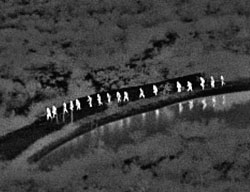
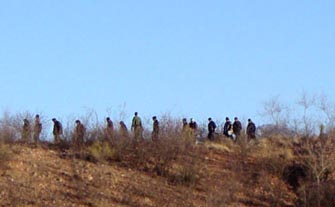
Nearly every day, Zachek spots illegal immigrants crossing his fields on their way north. But calling a law enforcement agency to report them isn't an option, he said. Cell phones don't work in this remote stretch of desert. The nearest land line can be almost an hour away when Zachek is working on his 5,000-acre spread, and even then it might be a long-distance call to reach anyone.
"Sometimes you can get ahold of somebody, and sometimes you can't," Zachek said.
Even when he does get someone, the closest officer is rarely near his property, Zachek said.
Recognizing ranchers' frustration, state and federal officials are now giving two-way, police-style radios to border residents. The direct connection to police dispatchers in three of New Mexico's seven border counties will allow residents to get emergency help or to more easily report illegal activity.
"If you call the ambulance one time the program is a success," said Robert Boatright, a U.S. Border Patrol assistant chief patrol agent in El Paso.
If ranchers and farmers feel comfortable reporting crimes, the radio program could also make volunteer border patrol groups such as the Minutemen unnecessary, Boatright said.
Minuteman volunteers, who plan to patrol parts of the border in New Mexico and Texas starting in October, gained international attention earlier this year when a contingent patrolled a section of the Mexican border in southern Arizona to stop the tide of illegal immigrants.
"If you liken this to a neighborhood watch program, people watch their own neighborhood," Boatright said. "People don't come (from other states) to watch your neighborhood."
The radio program, made possible with $200,000 in federal funds, was born in discussions at the Southwest New Mexico Border Security Task Force three years ago.
"The rationale was that this was an inexpensive way to better use the manpower, the resources we have on the border," said U.S. Sen. Jeff Bingaman, D-N.M. "These private citizens could contact ... law enforcement agencies very rapidly with these radios and keep them informed as to anything going on."
Local law enforcement officials said they don't expect ranchers and farmers to become a direct arm of the law, but any help is welcome.
But Bill Johnson, whose family owns more than 100,000 acres land along the border, said the radio program is an unwanted waste of money, and no one should expect help from his family. It's too dangerous, he says, because human smugglers and drug traffickers would want to know who is talking to law enforcement about their activities.
"They countersurveil us well enough that they know when we go to breakfast," said Johnson's son, James. "All these smugglers have is time and money."
James Johnson, who works alongside his father on the family onion farm, said his family used to use CB radios to call authorities when they saw something suspicious on their land. But then federal authorities told them that criminals in Mexico were watching them.
"I feel kind of guilty that we're not able to do anything about it, but our priority is our family," James Johnson said.
Brenda Mares, a spokeswoman for New Mexico's Homeland Security office, said the radios will be digitally encrypted. Law enforcement officials, including Luna County Undersheriff George Cabos, say that means it will be tough for traffickers to eavesdrop.
"They would have to have very sophisticated equipment," Cabos said.
Scanners are sold publicly for the type of radio New Mexico authorities plan to issue later this year _ according to Internet listings they sell for about $500 _ but Cabos said they will be useless without the proper frequencies, which federal, state and local authorities don't plan to release.
The Johnsons' concerns are understandable, Boatright said, but he points out that they don't have to volunteer.
"This is designed to provide communication to those who don't have it," Boatright said. "If you are not comfortable, then you should consider that."
For his part, Zachek, whose Rancho La Frontera abuts the Johnson property, said the radio program can't come fast enough.
Recently he discovered an older man, wearing a jacket and carrying water, who looked like he needed help. Zachek said he tried several times to reach authorities, even making long-distance calls to Deming, before giving up.
Then there's the more sinister elements, he said.
"About the worst is when you have one of these drug smugglers crossing the farm ... and the police at 50 miles away," Zachek said.
Doubt that it will make them unnecessary, Agent Boatwright.
ping
What a boatload of crap. The neighbors get police raiods that wont reach 20 miles, they call in and the cops either ignore them of they come out and greet the illegals and give them a ride to the highway where they can hitchhike all across America. They cant turn them back and they cant arrest them. Why bother?
Border Ping!
Please FReepmail me if you want on or off this South Texas/Mexico ping list.
Question: What is the slowest thing on this earth?
Answer: Law enforcement when you need them RIGHT NOW!
Because the reality is, they don't want to stop the immivasion.
They just want to toss out symbolic PR gestures, and pretend they care about border security.

Protect our borders and coastlines from all foreign invaders!
Be Ever Vigilant!
Minutemen Patriots ~ Bump!
I recall the Agri-Alert network used in Rhodesia in the 1970s, whose *Patrolphone* backpack radios would also carry only around 25-35 miles- as did the standard US Army Prc-25 of the Vietnam War period. But not only did the police and military monitor the Agric-Alert net for reports of passage by or contact with armed invaders, but when necessary, patrols organized by the farmers themselves, augmented with military personnel on leave and reservists known as *brightlighters* could respond if other forces were unavailable.
Of course, in the end, Rhodesia's people were sold out by their political leadership, another lesson we'd do very well to keep in mind lest we come to think that we can trust them.
I once went on a field trip to Columbus NM. Man, that is some desolate place. I think we went because that is where Pancho Villa crossed the border. Or something. I don't remember. I think I just wanted to go because we crossed to the tiny Mexican town on the other side and had a beer. I was underage in the US at the time, so it seemed like a good thing.
susie
For some reason the only thing both parties seem to agree on is letting ilegals run wild in the US. Some even want to give them Resident tuition in colleges. How can they get resident rates when they are illegal?
The direct connection to police dispatchers in three of New Mexico's seven border counties will allow residents to get emergency help or to more easily report illegal activity.
Yep, It will allow you to contact law enforcement so they can enact their "catch and release" program.
The telephone will sure make the Minutemen unnecessary alright. NOT
"people were sold out by their political leadership, another lesson we'd do very well to keep in mind lest we come to think that we can trust them."
When do they support us?
Disclaimer: Opinions posted on Free Republic are those of the individual posters and do not necessarily represent the opinion of Free Republic or its management. All materials posted herein are protected by copyright law and the exemption for fair use of copyrighted works.