Skip to comments.
Putting a price on free trade
The Charleston Gazette ^
| July 24, 2005
| Paul J. Nyden
Posted on 07/24/2005 10:19:11 AM PDT by hedgetrimmer
Congress is likely to vote on whether to approve the Central American Free Trade Agreement before the end of the month.
On Friday, House Majority Leader Tom DeLay, R-Texas, called CAFTA the “big ticket” item on the House agenda next week, which is strongly backed by President Bush.
Proponents argue CAFTA will promote trade and help some local businesses, especially farmers in West Virginia.
Critics point to the North American Free Trade Agreement, signed by President Clinton in 1993, which eliminated many trade barriers with Mexico and Canada and ended up costing Americans more than a million jobs.
“I just read in the West Virginia Chamber of Commerce’s newsletter that West Virginia workers are the fourth-best in terms of giving productive hours to their employers,” Rep. Nick J. Rahall, D-W.Va., said on Friday.
“CAFTA says to these hard-working folks, ‘It doesn’t matter. We want to open the doors for corporations to throw up tin sweat shops south of the border, and they can take advantage of people less trained, less seasoned, with less health and safety measures and you can undercut American jobs.’
“Call it NAFTA, CAFTA whatever. It’s all about ‘shafta,’” Rahall said.
Rep. Alan Mollohan, D-W.Va., said, “I will oppose CAFTA for the same reason that I have opposed every free-trade agreement to come before the Congress: they are simply not in the best interests of my district.
“Pitting a country with a high standard of living against one with a low standard of living will always hurt the country with the high standard of living. Pursuing free-trade agreements without any appreciation for that reality, or without any sympathy for the workers and communities adversely affected, is a formula for disaster.”
Rep. Shelley Moore Capito, R-W.Va., has not yet made up her mind about the pending legislation.
R.C. Hammond, Capito’s spokesman, said on Friday, “She has not determined how she will vote. She has received letters from her constituents and is considering them now.”
Sens. Robert C. Byrd and Jay Rockefeller, both D-W.Va., voted against CAFTA when the Senate passed the bill, 54-45, on June 30.
The Senate vote was not strictly along party lines. Ten Democrats and one independent voted for the treaty, while 12 Republicans voted against it.
CAFTA will affect trade relations between the United States and Costa Rica, the Dominican Republic, El Salvador, Guatemala, Honduras and Nicaragua.
When NAFTA passed in 1993, the United States had a $20.6 billion export deficit with Mexico and Canada. By 2004, the deficit increased to $110.6 billion (measured in 1996 dollars), a jump of 538 percent, according to a study published last week by the Economic Policy Institute, an economic think tank in Washington.
Authors Robert E. Scott and David Ratner wrote that NAFTA helped investors, but “no protections were contained in the core of the agreement to maintain labor or environmental standards.
“As a result, NAFTA tilted the economic playing field in favor of investors and against workers and the environment, causing a hemispheric ‘race to the bottom’ in wages and environmental quality.”
The EPI study shows all 50 states lost jobs. The 10 hardest-hit states, in percentage of jobs lost, were: Michigan, Indiana, Mississippi, Tennessee, Ohio, Rhode Island, Wisconsin, Arkansas, North Carolina and New Hampshire.
West Virginia ranked 18th, suffering a net job loss of 5,984 between 1993 and 2004. New exports created 5,993 jobs, but new imports displaced 11,918 other jobs.
The U.S. Department of Agriculture, however, believes CAFTA will help boost farm prices and income on West Virginia farms that produce poultry, beef, fruits and dairy products.
The agency’s Web site states, “Exports of farm products help boost West Virginia’s farm prices and income. Such exports help support jobs both on and off the farm in food processing, storage and transportation.
“In 2003, West Virginia’s farm cash receipts were $390 million, and agricultural exports were estimated at $37 million. ... Implementation of the CAFTA will increase West Virginia’s exports of agricultural products.”
CAFTA will eliminate high tariffs and other barriers to importing U.S. farm products into those Central American countries, according to the Agriculture Department.
The American Farm Bureau and 50 other agriculture and farm groups back the treaty.
Ted Boettner, a researcher for the West Virginia Citizen Action Group, said, “The most devastating impact this agreement will have on Americans and the people in West Virginia is a decrease in wages.
“Like NAFTA, this trade agreement will keep wages from growing by increasing competition with workers making 50 cents an hour and by making it easier for employers to threaten to move when workers demand their share of rising productivity.
“To cut wages, it’s important to recognize you don’t have to move manufacturing. You just have to be able to threaten to do it. The threat alone is enough to lower wages and increase temporary employment,” Boettner said.
During a telephone interview, Scott said he has also looked at agricultural trade. “The results we got are very different from what the Bush administration is promising.”
Scott said the agricultural and textile industries will be the major losers in Eastern states.
CAFTA is likely to have little impact on the steel industry, which was hurt by NAFTA by “giving Canada and Mexico a lot of exemptions in anti-dumping and illegal subsidies,” Scott said.
Farmers and workers in Central America also will suffer, according to Andrew de Sousa, an organizer for the Network in Solidarity with the People of Guatemala, based in Washington.
“Groups opposing CAFTA cite the experience of NAFTA and conclude that in their country, where 60 percent of the population survives through agriculture, small farmers will be decimated [and] genetically modified food will wipe out local biodiversity.
“Local medicinal knowledge will be patented and restricted by U.S. pharmaceutical companies, and life-saving generic medicines will be illegal for years, among many other negative impacts,” de Sousa said.
To contact staff writer Paul J. Nyden, use e-mail or call 348-5164.
TOPICS: Business/Economy; Constitution/Conservatism; Culture/Society; Foreign Affairs; Government; News/Current Events; US: South Carolina
KEYWORDS: cafta; freetrade; ftaa; hemispheric; integration; nafta; redistribution; wealth
To: JesseJane; Justanobody; B4Ranch; Nowhere Man; Coleus; neutrino; endthematrix; investigateworld; ...
A discussion of the effects of "free trade" and who benefits.
To: hedgetrimmer
“Call it NAFTA, CAFTA whatever. It’s all about ‘shafta,’” Rahall said.
-----
And anyone who thinks this is REALLY about trade, is fooling themselves. Like NAFTA, CAFTA is just another vehicle for the elitist, NWO crowd.
And our President is pushing this thing HARD, AND HEAVY behind the scenes. The Bush dynasty at work..yes, George, your Dad really let it out of the bag during his term.
3
posted on
07/24/2005 10:28:14 AM PDT
by
EagleUSA
(S)
To: hedgetrimmer
The very words "Free Trade" resonates with a certain type of empty soul.
4
posted on
07/24/2005 10:28:41 AM PDT
by
AEMILIUS PAULUS
(It is a shame that when these people give a riot)
To: hedgetrimmer
Thanks for the ping.
MORE reasons why "free trade" is good/bad/stupid.
5
posted on
07/24/2005 10:36:04 AM PDT
by
Just A Nobody
(I - LOVE - my attitude problem!)
To: AEMILIUS PAULUS
The very words "Free Trade" resonates with a certain type of empty soul.
Agreed, they will bring out their tired arguments about buggywhip makers, sugar subsidies and so on too. In fact, I found the 8-Track endless loop tape they use to play the same pro-free trade arguments over and over again:
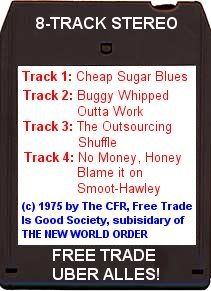
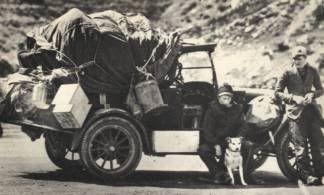
Well, they always felt we need to be a "mobile workforce" so I'll have to pack up my car and live in it. B-P
CAFTA delenda est!
6
posted on
07/24/2005 10:42:18 AM PDT
by
Nowhere Man
(Lutheran, Conservative, Neo-Victorian/Edwardian, Michael Savage in '08! - CAFTA delenda est!)
To: AEMILIUS PAULUS
Some folks seem to think it means conscience free trade.
7
posted on
07/24/2005 11:04:27 AM PDT
by
cripplecreek
(If you must obey your party, may your chains rest lightly upon your shoulders.)
To: EagleUSA
NAFTA, CAFTA,
SHAFTA What a great bumper sticker!
8
posted on
07/24/2005 11:14:16 AM PDT
by
upchuck
("If our nation be destroyed, it would be from the judiciary." ~ Thomas Jefferson)
To: hedgetrimmer
Bounce China out of MFN and I'd be for most of CAFTA.
To: Last Dakotan
No argument about China and MFN. But, CAFTA is bad whether China has MFN or not.
It is a tool to create the FTAA, which uses the EU model for border dissolution and social justice civil governance.
How 'bout unlimited immigration from Venezuela. Peru and Bolivia? Our country needs more poverty stricken communists like we need a hole in the head-- its tantamount to importing a communist revolution. That will happen with the FTAA, because the globalists want to use our wealth to prop up these corrupt governments through remittances. CAFTA is the stepping stone to the FTAA, it says so in its preamble.
To: hedgetrimmer; Toddsterpatriot
North American Free Trade Agreement ... ... ended up costing Americans more than a million jobs....Wow-- just yesterday we were "losing 880,000 jobs to NAFTA" (Posted on 07/23/2005) --this means that we're loosing over 60,000 jobs per day! In about 6-1/2 years, every single job will be gone-- maybe then we'll stop hearing that "giant sucking sound" racket that's been keeping me awake at night.
To: expat_panama
LOL you really are funny.
To: All
Congress is likely to vote on whether to approve the Central American Free Trade Agreement before the end of the month. Do you want to bet?
13
posted on
07/24/2005 7:41:36 PM PDT
by
A. Pole
(Confucius: "In the morning hear the Way; in the evening die content!")
Disclaimer:
Opinions posted on Free Republic are those of the individual
posters and do not necessarily represent the opinion of Free Republic or its
management. All materials posted herein are protected by copyright law and the
exemption for fair use of copyrighted works.
FreeRepublic.com is powered by software copyright 2000-2008 John Robinson