
Major Michael Adams
Posted on 05/06/2004 5:24:50 PM PDT by BenLurkin
The nation's first astronaut to die in the course of a space mission will be remembered with a monument at the remote desert crash site where he perished 37 years ago. Air Force Maj. Michael Adams earned his astronaut wings by piloting the X-15 rocket plane above 262,000 feet, the altitude the Air Force considered the minimum boundary for spaceflight.
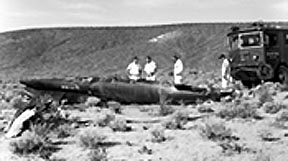
But during a flight in the third X-15 aircraft on Nov. 15, 1967, Adams died in a crash upon returning from the edge of space.
Now, Eagle Scout candidate John Bodylski and aerospace historian Greg Frazier will honor the test pilot and astronaut with a concrete monument at the crash site, about four miles north of Johannesburg. The monument will be dedicated at 11 a.m. Saturday.
"It will be a small yet meaningful dedication," Frazier said, including a military color guard and a few words about the program and the man.
The monument is a two-ton concrete obelisk with a plaque made of Inconel-X, the same high-tech material of which the X-15 was constructed.
Adams is included in the Astronauts Memorial at Kennedy Space Center, dedicated in 1991, and a street is named for him at Edwards Air Force Base. However, there has been no memorial specifically to commemorate the first astronaut fatality, Frazier said.
Because the crash site lies on private property, the monument stands on Bureau of Land Management property about 50 feet north.
Upon returning from an altitude of 266,000 feet on that last flight, Adams found himself in a hypersonic flat spin, a situation never before encountered in manned flight.
When he realized what was happening, he radioed fellow X-15 test pilot William J. "Pete" Knight in the control room.
"They didn't know what to do," aerospace historian Peter Merlin said. However, "Mike Adams was a good pilot. He managed to get out of the spin," he said.
But then the aircraft went into an inverted dive and began pitching rapidly. As it reached the thicker atmosphere closer to earth, the loads on the surfaces became too much for the structure and the plane came apart at about 62,000 feet. Adams was killed on impact.
Merlin and Tony Moore re-discovered the crash site in 1992. "We were probably among the very few people to visit the site since the cleanup crew left," Merlin said.
Among the relics of the crash the pair found were pieces of the aircraft's structure and cockpit, as well as a large portion of the horizontal stabilizer, including the last two digits of the aircraft's tail number, he said. Many of the artifacts are on display at the Air Force Flight Test Museum at the Air Force Flight Test Museum at Edwards Air Force Base.
For directions to the site and details, visit www.xb-70.com/adams.
/john

Boy, would I like to be there for this small memorial. It's great that someone is doing this. Good job scouts.
NASA went a different direction (brute straight up lift) because it was instructed to go to the moon in ten years.
Hope you are right.
Disclaimer: Opinions posted on Free Republic are those of the individual posters and do not necessarily represent the opinion of Free Republic or its management. All materials posted herein are protected by copyright law and the exemption for fair use of copyrighted works.