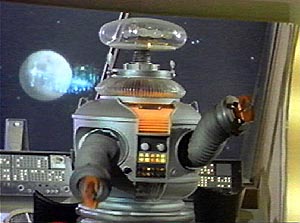
Someone should have entered this guy!
Posted on 03/13/2004 1:01:59 PM PST by AntiGuv
BARSTOW, Calif. - A $1 million race across the Mojave Desert by driverless robots ended Saturday after all 15 entries either broke down or withdrew, a race official said.
Two of the entries covered about seven miles of the roughly 150-mile course while eight failed to make it to the one-mile mark. Others crashed seconds after starting.
The race ended after about four hours when the final competitors were disabled, said Col. Jose Negron, race program manager. Competitors suffered a variety of problems that included stuck brakes, broken axles, rollovers and malfunctioning satellite navigation equipment.
One six-wheeled robot built by a Louisiana team was disqualified after it became entangled in barbed wire.
"It's a tough challenge — it's a grand challenge — you can always bet that it's not doable. But if you don't push the limits, you can't learn," said Ensco Inc. engineer Venkatesh Vasudevan, shortly after his company's entry rolled onto its side several hundred yards from the starting gate.
The Pentagon's research and development agency planned to award $1 million to the first team whose microcircuit-and-sensor-studded vehicle could cover the roughly 150-mile course in less than 10 hours.
The Defense Advanced Research Projects Agency was sponsoring the Grand Challenge to foster development of autonomous vehicles that could be used in combat. Defense officials foresee using the driverless, remote control-free robots to ferry supplies in war zones.
One competitor said the goal wasn't necessarily to complete the course.
"From my opinion, it's always been a question of how far you can get," said Palos Verdes High School sophomore Kevin Webb, 16. His school's entry, a modified Acura SUV, hit a barrier shortly after crossing the starting line.
Of the 21 teams that attempted to qualify over four days of trials earlier this week, just seven completed a flat, 1.36-mile obstacle course at the California Speedway in Fontana, east of Los Angeles.
Race organizers deployed eight to 10 tow trucks along the route in anticipation of breakdowns.
The first of the 15 entries out of the gate was Carnegie Mellon University's converted Humvee, which took off at a fast clip but stalled after half an hour.
"It is out of the race," said Carnegie Mellon senior Nick Miller, 22, a member of the team that had been the early favorite.
Virginia Tech's converted golf cart failed within 100 yards of the starting line when its brakes seized up. It was driven off the course by 23-year-old senior Nick Elder.
"Our vehicle knew where to go, but our brakes were holding us back," said the disappointed Elder.
The defense agency spent $13 million on the race. It estimates competitors laid out four to five times that amount developing their entries, which rely on global positioning satellites as well as a variety of sensors, lasers, radar and cameras to orient themselves and detect and avoid obstacles.
Carnegie Mellon President Jared Cohon said his school's vehicle cost approximately $3 million, which was contributed by dozens of corporate sponsors.
With the on- and off-road race halted Saturday, the agency will host another contest, probably in 2006.
On the Net: http://www.grandchallenge.org/.
In an urelated story, Col. Negron announced his retirement today...
No jokes about running on Windows systems yet? ;o)
Or about 100 years to earn a 100, 000 usd, to fly around the world nonstop without refueling.
Question: Where does a "financially strapped" California school (moronic CA voters just obligated us for another $25,000,000,000 in debt for "needy" schools) get an Acura SUV and all the technology (not to mention school time) necessary to enter this competition?
Comment: This type of project is way beyond the scope of secondary school. This is university-level work--and upper division/graduate-level university work at that! Besides lacking the technical knowledge and analytical skills (not to mention the facilities) needed to successfully complete this task, high school students lack the maturity to take on such a project. The 16-year-old says it was not important to complete the course? Completing the course was the GOAL! To say that the goal was unimportant shows that he wasn't ready for this and was never in a position to win. Of course, primary and secondary schools no longer teach goals, performance, and results; instead it's all about "self-esteem" and "expressing your diversity," so this attitude is not surprising.

A slightly larger gas tank, bada bing bada boom, we're in the money!

Here it apparently is...

It's hard to believe they spent $65 million dollars on this between the Defense department and the competitors and 8 of the 15 didn't even make it a mile. I wonder how far the bests ones made it?
It doesn't seem like it would be that hard. A go-cart, an extra fuel tank, a gps system, a camera with some image recognition software, a little bit of custom navigational software to steer clear of hazards. The barbwire seems like the hardest to detect, might need a special sensor for that. I'd love to know what kind of sensors they employed and how well each fared.
Disclaimer: Opinions posted on Free Republic are those of the individual posters and do not necessarily represent the opinion of Free Republic or its management. All materials posted herein are protected by copyright law and the exemption for fair use of copyrighted works.