Skip to comments.
Reinventing zoning
SunSpot.net (Maryland) ^
| 12 November 2003
Posted on 11/12/2003 1:44:10 PM PST by Lorianne
IF BALTIMORE County Executive James T. Smith Jr. has his way, the region's largest jurisdiction will soon join a small but growing revolt against the straitjacket strictures of traditional zoning. Up to seven communities will be allowed to write their own codes. The goal: cutting red tape and speeding up revitalization of decaying commercial strips. The County Council should support this radical experiment when enabling legislation is introduced in the next few weeks. From Randallstown to the U.S. 40 corridor, the current zoning approach has failed to spur viable redevelopment; it's time to try alternatives.
(Excerpt) Read more at sunspot.net ...
TOPICS: Culture/Society; Government
KEYWORDS: communitycontrol; landuse; propertyrights; urbansprawl; zoning
Navigation: use the links below to view more comments.
first 1-20, 21-40, 41-60, 61-64 next last
1
posted on
11/12/2003 1:44:11 PM PST
by
Lorianne
To: farmfriend
ping
To: Lorianne; AAABEST; Ace2U; Alamo-Girl; Alas; amom; AndreaZingg; Anonymous2; ApesForEvolution; ...
Rights, farms, environment ping.
Let me know if you wish to be added or removed from this list.
I don't get offended if you want to be removed.
For real time political chat - Radio Free Republic chat room
3
posted on
11/12/2003 4:25:00 PM PST
by
farmfriend
( Isaiah 55:10,11)
To: Lorianne
Instead, community groups, developers and planners brainstorm about the best way to quickly revive a commercial strip by rebuilding it and combining retail, office and residential uses.
And what say do the property owners actually have? Zero. And what people actually want to live in a retail/residential combination monstrosity?
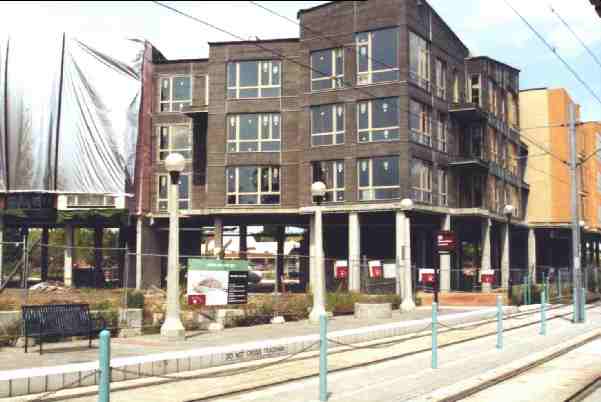
The problem is that people don't want to live in high densities, especially when there are planner-induced parking shortages. A state regulation requires Portland to reduce its parking by 10 percent, so new developments are often built with limited parking. Since developers won't build what they can't sell, planners have to subsidize them to get them to build high-density developments.
This development next to a light-rail station in Beaverton received $10 million in subsidies, yet went broke before it was finished. Since it was to have limited parking, it is doubtful that it could have made any money even with the subsidies.
To: hedgetrimmer
Where are the shear walls to prevent earthquakes from leveling that monstosity ...
5
posted on
11/12/2003 5:29:45 PM PST
by
tubebender
(FReeRepublic...How bad have you got it...)
To: hedgetrimmer
What is that?
There are certainly nicer examples of mixed housing. I used to live in Portland and I know there are some.
Some people like to live in higher densities, some people don't. There are lots of areas within cities that are highly sought after. I owned a home in an older neighborhood in Portland on a 5,000 square foot lot. I had no problem selling it and made a hefty profit. :)
6
posted on
11/12/2003 11:34:07 PM PST
by
Lorianne
To: farmfriend
BTTT!!!!!
7
posted on
11/13/2003 3:07:33 AM PST
by
E.G.C.
To: Lorianne; hedgetrimmer; tubebender
"I used to live in Portland and I know there are some."..........
"I owned a home in an older neighborhood in Portland on a 5,000 square foot lot. I had no problem selling it and made a hefty profit. :)"
Guys, Ah-yup. Due to "new" zoning regulations? "Free" Trade at it's best{?}. Zoning by non-elected "representatives" of the "people". Socialism! Peace and love, George.
To: Lorianne
Ususally people without children will live in high density situations, but once a couple starts a family they almost always want a home with a yard (rightly so because sometimes you just have to turn the little tykes outdoors to blow off steam).
The problem with this whole smart growth thing is they don't give you a choice anymore. One of the more radical planners visiting Santa Cruz county a couple of years back lauded the city's densification plan and told an adoring audience at the conference "prettty soon all of the people will live in cages, and the animals will run free". He was met with wild applause. These are the people who force land out of use by humans creating "green belts" and "wildlife corridors". Because land is taken of the markets, the remaining land becomes dearly expensive and fewer and fewer people can afford to own it. This puts them in a situation where they would have to live as a tenet in one of these buildings, they are not condos, and they would be denied property ownership in that way.
I would also like to remind you that everything they are forcing on America with smart growth is not new. It is exactly how the Soviet Union built housing for its serfs(er workers). It used to be appalling to Americans to see the cement highrise prison tower apartments where 10 people might live in two rooms, and where the electricity might only come on for a couple of hours at night. But they were handy to public transportation, and if you remember, in the Soviet Union, you had to get on a list that took many years to get a car, if you were lucky enough to have the money. In their freedom hating utoptianism, the soviet planners thought this was a fine way to force people to live.
Doesn't it bother you that we have "planners" that tell us down to the tiniest detail what and how to build? We have built beautiful and functional cities because of free rights to property, not because soviet planners told us that the trash receptical had to be 3 feet in front of the store, and that there should be no parking in front and that you must not build enough parking spaces for the cars because that will encourage people to drive.
Finally, as we can observe in some of the very large cities, especially Asia, the more dense the population, the more restrictive laws are placed on a population to control their behavior.
Its totalitarianism in a very ugly way, because it is very indirect, and people don't realize what they are giving up when they allow non-elected people with an anti-freedom agenda to determine how they should use their property.
To: hedgetrimmer
The problem with this whole smart growth thing is they don't give you a choice anymore. That's the exact same criticism as I have with older 1960's era zoning! No choice. I deal with this stuff everyday. Older zoning rules do not allow choices. There are very restrictive about how a property owner can develop his/her land. It's the same thing!
If I own 500 acres I cannot develop a mixed use higher density neighborhood by law! And people aren't given the choice to buy in my development or somewhere else entirely diffefent. How is that choice?
The choice issue is a red herring because developers (and home buyers) haven't had a choice for over 50 years. In the meantime, with smarth growth, there are plenty of choices because there are zillions of older type subdivisions of single family houses on larger areas of land. So people still have a choice whether to live in higher density or in lower density. What is being provided are MORE choices, not fewer, for consumers.
And by the way, Smart Growth is not against single family houses with yards, it advocates a MIX of housing types within a neighborhood and advocates more parks for children to play, schools within the community so children can walk to school, churches and everyday neccessity type businesses right in the neighborhood. This is not a new thing, it is how neighborhoods were designed in the first half of the last century (1900-1940). And guess what? These older neighborhoods are the priciest and most sought after neighborhoods in all cities. Most people cannot afford to live in the older well planned neighborhoods because they are less numerous... so they are priced out of most people's reach.
What Smart Growth is trying to do is reinvent the type of neighborhoods that many people WANT to live in. Not everyone, buy a lot of people. People don't have to all like the same thing.
10
posted on
11/13/2003 9:46:45 AM PST
by
Lorianne
To: hedgetrimmer
Doesn't it bother you that we have "planners" that tell us down to the tiniest detail what and how to build? YES! And that's why I hate the zoning that preceeds "smart growth" for 50 years because it does precisely that!
11
posted on
11/13/2003 9:48:51 AM PST
by
Lorianne
To: George Frm Br00klyn Park
Your only argument is for no zoning. We haven't had "free trade" in housing for eons.
12
posted on
11/13/2003 9:50:09 AM PST
by
Lorianne
To: Lorianne
Your only argument is for no zoning. We haven't had "free trade" in housing for eons.People who don't like zoning laws might change their tune if their next-door neighbor decided to convert his house to Joe's All-Night XXX Peep Show and Rock'n Roll Bar.
13
posted on
11/13/2003 10:08:59 AM PST
by
FlyVet
To: Lorianne
I am not in favor of how zoning controls property rights per se, however, zoning was always done by the local governments and property owners always had the right to petition to change and to remove elected officials in charge of zoning from office by voting them out.
Smart growth brings the soviet council into power. The idea that a "stakeholder" can come into a community and completely control development there is anti-american. Before you had a relationship between the property owner and the elected officials. Now you have non-property owning outsiders influencing the elected officials and taking away your say. Smart growth applies the communist idea of a council that is unelected yet wields a powerful club over the property owner. It is anti-property rights to the extreme.
In the case you cited, as I did in my previous posts, some of the most beautiful cities in the world were built without zoning laws, and some of the most beautiful homes built without building codes.
To: Lorianne
....The entire concept of what is called "Smart Growth" says Americans are not free to live where they choose. They must live inside "urban growth boundaries." They may not live in "green-belt" areas around urban centers. They may not live in designated "wilderness" areas, nor in the "viewshed" of scenic highways, nor in the "buffer zone" of a Heritage River or a designated stream.
If it is wrong to deny an American the freedom to travel to Cuba, it is much more wrong to deny an American the freedom to live where he chooses.
This inconsistency in the application of fundamental freedom is frightening. The federal government has no business, or constitutional authority, to mandate zoning, or land-use restrictions on private land. Neither Congress, nor the agencies of government seem to be aware of this. Both are eager to mandate – perhaps more accurately, to dictate – where people may and may not live.
The so-called Community Character Act (S. 975) goes even further. It appropriates tax dollars for communities that adopt the "Growing Smart: Legislative Guidebook," produced by the American Planning Association, with more than $2 million of our tax dollars. This 2,000-page monstrosity spells out not only zoning restrictions, but specifies the types of building materials that may be used, the size and color of signs that businesses may use, and even the variety of plants that may be planted around private residences.
It provides for another, sinister, erosion of freedom: "amortization of non-conforming uses." This rather bland-sounding euphemism tears away a huge portion of the Fifth Amendment, which says "... nor shall private property be taken for public use without just compensation."
As reported by Wendell Cox, in his "Forfeiting the American Dream," the principle of "amortization of non-conforming use" means that the right to own a non-conforming structure is extinguished over a period of time, which is determined by government. At the end of the amortization period, the property belongs to the government, with no compensation to the owner. Only a warped and twisted mind could possibly conceive of such a grotesque abrogation of the fundamental American right to just compensation for the taking of private property.
Government has gotten pretty good at taking private property – and calling it something else – to avoid paying just compensation. When private property is declared to be a critical habitat, or a wetland or a viewshed, compensation is rarely paid. The property has not been taken from the owner, the government reasons, only the productive use of the property has been taken. The owner still has liability, and the responsibility to pay taxes on the property.
In Florida, land adjacent to a right-of-way may be taken by the government if the property is mowed by the road maintenance crew for a period of time. The owner is not notified, and may only discover the taking by noticing a difference in acreage on the tax bill, or by attempting to sell the property. ...
...It is hypocrisy for a congressman to declare that an American has the right to travel where he chooses, and then deny that American's right to live where he chooses. The "Smart Growth," government-managed-society vision is not a vision of American freedom. It is a preview of what Americans will see when they exercise their freedom to travel to Cuba.
Going to Cuba?
--Henry Lamb, 2002
To: Lorianne
Towns should minimize town center land devoted to parking. Parking lots create “dead spaces” which are detrimental to the cohesion and continuity of a town center, and consume land that otherwise could be put to uses that increase density...
.. Encouraging or requiring transportation demand management (“TDM”). As its name suggests, transportation demand management involves efforts to manage transportation demand, rather than adding new or additional transportation infrastructure.( and what happens to your constitutional right to be able to travel without restriction? It looks here as though smart growth planners like to control you by not providing adequate infrastructure for the growth densities they are promoting)
Somerville, Massachusetts’ zoning bylaws recognize one of the important benefits of public transit—the ability to forgo the use of cars—by reducing its minimum parking requirements by 20% for any building located within 1,000 feet of a transit station. For buildings located within 650 feet of a municipal parking facility, the bylaws reduce the city’s minimum parking standard by 10 %.
Establishing design standards that support public transit. (force the architecture of buildings on private property to force use of public transit-- that sticks up for the Constitution, doesn't it?)Design standards that contribute to the pedestrian friendly nature of the area (such as prohibiting parking between sidewalks and storefronts), and that maximize access to and from nearby transit facilities (such as requiring building entrances to be located as near as possible to transit stations) are important aspects of TOD development. (See Portland, Ore., p.35.) Land uses such as distribution centers, rental car facilities, gas stations, automobile repair shops, car washes, commercial parking lots, and businesses with drive through windows, all encourage the use of automobiles. Prohibiting such uses is essential to maintaining a pedestrian-friendly environment within the “TOD” zone, and to encouraging the use of public
--Community rules for smart growth
More people fewer cars-- isnt' that what they did in the soviet union?
To: Lorianne
Reinventing neighborhoods with smart growth is exactly like Al Gore's reinventing government which solidly locked socialist envrinmental policies into what was once a free system.
Do you belong to one of these stakeholder councils?
To: hedgetrimmer
I am not in favor of how zoning controls property rights per se, however, zoning was always done by the local governments and property owners always had the right to petition to change and to remove elected officials in charge of zoning from office by voting them out. That's not entirely true. The biggest push for growth boundaries and curtailment comes from existing communities who don't want growth to occur near them, or the traffic from growth to affect their community. There are literally hundreds of articles a day on this (google news: smart growth or new urbanism).
I encourage you to read the news on this issue nationwide. It is local communities who want slow or no growth near them and pressure their elected officials to curtail growth.
It is existing communities which put pressure on their elective representative to restrict growth. They are not necessarily for "smart growth" per se as a concept ... just as it affects them.
I deal with this issue all the time and I can assure you that just as many conservative "property rights" people show up at public hearing to stop growth from occuring in their area. The phenonmenon is nationwide.
Politicians would not even worry about this issue if they were not hearing from their constituents day in and day out on issues of ill-managed "growth". Some take a longer view of the issue but most people just don't like new growth in their area. They give the politicians power to stop or redirect growth by creating planning commissions and boards with the power to curtail growth.
18
posted on
11/13/2003 10:32:53 AM PST
by
Lorianne
To: hedgetrimmer
No I'm an architect and I work with developers. I have dealt with many zoning rules in various jurisdictions over 20 years. I've also attended countless public hearings etc where the public is almost always opposed to "growth" (in their area). NIMBY's they are called, but the net result is newer zoning regulations in each locale intent on curbing growth in their area. It's an ad hoc phenomenon that is happening in hundreds of thousands of towns and cities across America. In Portland OR is it was simply more organized.
19
posted on
11/13/2003 10:36:00 AM PST
by
Lorianne
To: hedgetrimmer
In the case you cited, as I did in my previous posts, some of the most beautiful cities in the world were built without zoning laws, and some of the most beautiful homes built without building codes. That is true. And many people advocate getting rid of zoning controls altogether.
But I would wager with you that "propery rights" people who own property are not among those wanting to get rid of zoning. Zoning protects their investment in their property and they're not about to give that up. These people turn up at every public meeting to protect thier own property rights by telling others what they can and cannot build on theirs.
20
posted on
11/13/2003 10:39:58 AM PST
by
Lorianne
Navigation: use the links below to view more comments.
first 1-20, 21-40, 41-60, 61-64 next last
Disclaimer:
Opinions posted on Free Republic are those of the individual
posters and do not necessarily represent the opinion of Free Republic or its
management. All materials posted herein are protected by copyright law and the
exemption for fair use of copyrighted works.
FreeRepublic.com is powered by software copyright 2000-2008 John Robinson