Skip to comments.
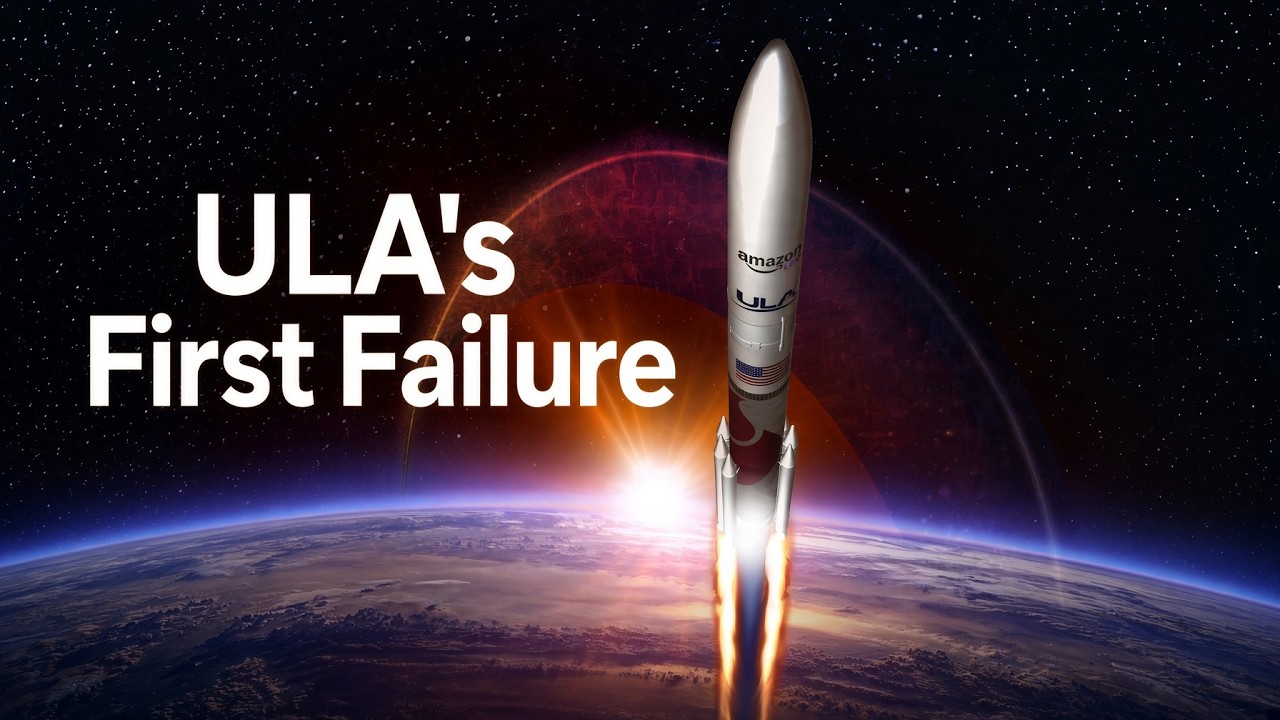
ULA's Vulcan Rocket Fails During Return To Flight [11:59]
YouTube ^
| November 15, 2026
| Scott Manley
Posted on 11/15/2026 8:27:59 PM PST by SunkenCiv
Trying to figure out what we know and what conclusions we can draw, for now we know that ULA's Vulcan failed to reach orbit and the data we have points toa problem with the first stage core which ran long and never gave the second stage the lift it needed to reach orbit. ULA's Vulcan Rocket Fails During Return To Flight | 11:59
Scott Manley | 1.88M subscribers | 163,531 views | November 15, 2026
(Excerpt) Read more at youtube.com ...
TOPICS: Business/Economy; Science; Travel
KEYWORDS: blueorigin; centaur; nasa; newglenn; scottmanley; sls; ula; vulcan
The YouTube transcript was processed with my fine country craftsmanship, and *may* follow.
1
posted on
11/15/2026 8:27:59 PM PST
by
SunkenCiv
To: AdmSmith; AnonymousConservative; Arthur Wildfire! March; Berosus; Bockscar; BraveMan; cardinal4; ...
2
posted on
11/15/2026 8:28:57 PM PST
by
SunkenCiv
(TDS -- it's not just for DNC shills and jihadists anymore -- oh, wait, yeah it is.)
Transcript
Chapter 1: Return of ULA’s Vulcan
Hello, it’s Scott Manley here. Friday the 13th was going to be a big day in rocketry. We had three high-profile launches that were all you had a lot of interest in them. Obviously, we had SpaceX’s Starship and Super Heavy, and that turned into the landing. We also had the 100th launch for Rocket Labs Electron, which is a great milestone, but we also had the return to flight of ULA’s Vulcan. And uh that unfortunately never happened on the 13th. Yeah, bad luck, right? They had ground service equipment issues. It was bumped to the Saturday and then to the Sunday. And on the Sunday, you know, we were all paying attention to this because Vulcan um is a seems it it was thought to be a fine rocket just a bit late and old school. Uh it has had four flights, two of which have had anomalies with the solid rocket motors. Now these anomalies basically it consists of the nozzle which you know obviously creates a more efficient booster. The nozzle just coming off burning through or whatever. And this is unfortunate because this is ULA’s rocket but they buy these solid rocket motors from Northrup Grumman. So they were obviously being unfortunately affected by uh Northrup Grman’s quality control issues. Uh but even with those two booster failures, Vulcan was more than capable of compensating for the lack of thrust and it made it to orbit.
3
posted on
11/15/2026 8:29:33 PM PST
by
SunkenCiv
(TDS -- it's not just for DNC shills and jihadists anymore -- oh, wait, yeah it is.)
Chapter 2: Mission failure and launch
So ULA up until today had never had an actual mission failure. Unfortunately, today was an actual mission failure. It was going to be carrying Amazon LEO and it had 40 satellites on board. I think that’s the biggest payload that Vulcan’s ever carried and it’s actually the biggest single payload of Amazon LEO satellites. It was the first uh Vulcan booster where they had six solid rocket motors indicating that they had a bit more confidence in them at this point. And uh yeah, we were waiting to see them return to flight. And honestly, I was kind of busy, but I had the launch on. And when the thing took off, I saw it going up. I saw the boosters working. I was really happy to see this flying again. It looked like it was flying in the right direction, doing the right thing. See the boosters coming off. And then I sort of faded away. Waited for stage separation. When I heard about stage separation, I thought that’s fine because centaur centaur is one of the most reliable pieces of space hardware. Now centaur is up there. This mission is complete. And I sort of didn’t notice until the stream ended and I wondered, wait a second, I haven’t heard any statement they have made orbit. They’d cut away to a couple of interviews instead of showing us the rocket. Of course, I was even less interested in those interviews. Um, and so I wondered what had happened. I began rewinding and looking through the stream and I noticed that during stage separation, the attitude of the centaur was kind of weird. Like it had did it did some rolls and it did some high angle changes and then it sort of seemed to settle down and get back on course.
4
posted on
11/15/2026 8:29:50 PM PST
by
SunkenCiv
(TDS -- it's not just for DNC shills and jihadists anymore -- oh, wait, yeah it is.)
Chapter 3: Analyzing telemetry
That’s not great. More telling, however, was the fact that according to the timeline, they should have done like main engine cutout and stage separation around the 5minute mark, but in this flight, it actually happened 30 seconds later. And having the engines run for 30 seconds longer implies that they’re using less propellant. And that’s typically what happens if you have, say, an engine problem, right? If the engines aren’t consuming fuel as much, they’re not generating as much thrust. Anyway, it’s not the first time I’ve seen weirdass girrations from Centaur on a ULA rocket. There’s a case that I like to talk about where um a ULA like Atlas 5, the core stage cut off early and the Centaur realized that if it didn’t adjust its attitude, it was not going to be able to get to orbit. So, it took this high like angle of attack to you you give it some extra vertical push so it could stay in space and actually make its way to orbit. and it succeeded. That Centaur won the day and I figured same quality is going to be available to the current Centaur V which is just, you know, used on Vulcan. And so anyway, yeah, I scrubbed through uh to like the next point in the inter after the interview and there’s a few seconds of telemetry we see where we see the centaur working very hard, but instead of showing us the distance down range, the altitude, and the velocity, it just gave us an apogee and a perigee. And that at that apogee, the highest point in the orbit was below the altitude of stage separation. And I knew at that point that Centaur was falling back to Earth and was not going to make orbit, especially since its perigee was deep inside the planet. Um, and so that very clearly showed me that the mission was going to fail in some form. And that was about the 9 and a half minute mark.
5
posted on
11/15/2026 8:30:04 PM PST
by
SunkenCiv
(TDS -- it's not just for DNC shills and jihadists anymore -- oh, wait, yeah it is.)
Chapter 4: Booster performance issues
Now, ULA for their part, they have said that or made the public statement has said that there was an anomaly about 10 minutes into the flight. And I’m going to tell you right now, that anomaly was the centaur burning up in the atmosphere, right? That’s what happened next. It was getting deep inside the atmosphere and it wasn’t going to be able to reach orbit. That anomaly is not what caused the problem. It’s whatever caused the booster to underperform and put this in the wrong trajectory so it couldn’t get into space. So yeah, let’s we look to the booster. It’s powered by two BE4 engines and that of course same engines that are on New Glenn. This failure has some knock-on effects to other missions. So yeah, New Glenn is obviously trying to do its return to flight after a far more spectacular engine anomaly with BE4 engines. So if there is a problem with these engines, that could be bad for them. The Centaur, by the way, if there is a problem with the Centaur, well that Centaur V is going to become the upper stage to SLS. So clearly there’s some incentive from NASA to make sure this thing gets checked out and verifies that the centaur was actually doing its job just fine. Uh but I began trying to investigate this to figure out what happened.
6
posted on
11/15/2026 8:30:13 PM PST
by
SunkenCiv
(TDS -- it's not just for DNC shills and jihadists anymore -- oh, wait, yeah it is.)
Chapter 5: Investigation into trajectory
And the first thing I did obviously is take the telemetry that we get just before stage separation. And you know you can basically plot the velocity versus time and the altitude versus time and compare it to various flights. And the first thing I wanted to see was well the engines had to burn for an extra 30 seconds. Is there some discontinuity in the acceleration that say show a big failure in one engine? And no. It turns out that if you look at the velocity and everything over time, it’s smooth. There’s no very obvious discontinuity. So if it was an issue with an engine, it either happened prior to that or it was really really subtle. Um, obviously the engines were burning at a lower level, but I think it must have been burning at a lower level for much longer and it wasn’t like uh it it could well go back to the very start of the flight. But the other thing that I noticed is that the vertical speed is a lot lower compared to previous flights. So what you can do is just look at the altitude versus time and that gives you your speed, your vertical speed. And if you do it for this flight, it gives you a vertical speed of something like 250 to 300 m/s depending upon where you draw your points. If you look at previous flights, the vertical speed is more like 800. So we’re talking like onethird of that. And that vertical speed is really important for Centaur. Centaur is powered by these RL10 engines. These are very old engines, but they are the most efficient engines the US has. And I believe that they’re most efficient rocket engines in the world. They are hydrogen you know uh expand close cycle expander engines and centaur has used these since its inception. Uh and the problem is that centaur has got very big and these engines are relatively small and there’s actually limits to how much you can scale them up because of like the surface area to volume ratio. So centaur comes off after stage separation. It has relatively low thrust and that means it needs to be given a whole bunch of vertical velocity to basically throw it upwards. So that it takes, you know, a few minutes to slow down and begin falling back. And in that that gives it the time to build up even more speed and stay in orbit. But in this flight, that small amount of vertical speed just doesn’t give Centaur enough time to burn the propellant to be able to actually continue on the way to orbit. So that is a big red flag for me.
7
posted on
11/15/2026 8:30:27 PM PST
by
SunkenCiv
(TDS -- it's not just for DNC shills and jihadists anymore -- oh, wait, yeah it is.)
Chapter 6: Guidance and design concerns
Now it could be that that particular like low vertical velocity is just literally due to underperformance of the engines. Um but I’m not 100% sure that is entirely to blame because if you look at the velocity compared to previous flights, you you’ll actually see that it does actually sort of even although it finishes 30 seconds late, it’s still building up speed all the way through. And if you sum it all up, it actually comes out more or less the same, accounting for the fact that it’s carrying a heavier payload. But the booster just doesn’t seem to actually try to get the vertical speed. It just sort of instead of going up and up like other launches, it just sort of curves over and never really picks up any more vertical speed. So that feels to me like the booster wasn’t doing something right. If the booster had detected an engine wasn’t operating, it should have been like that heroic centaur from the Atlas flight. It should have adjusted its pitch upwards to get more loft speed so that the centaur would have a chance, a fighting chance to make it to orbit. But that doesn’t seem to have happened. So maybe there’s a guidance issue, right? Maybe they get a hardware problem and then that would led to a guidance issue where the hardware just gave up and it realized it couldn’t get to orbit. That seems unusual because you you never know quite how much performance you’re going to get out of a rocket because um you know it’s very hard to tell exactly how much propellant you’re carrying sometimes and how far you can run it before the engine before you actually run out of propellant. Um so yeah, in two decades of ULA, they’ve never had an outright failure.
8
posted on
11/15/2026 8:30:39 PM PST
by
SunkenCiv
(TDS -- it's not just for DNC shills and jihadists anymore -- oh, wait, yeah it is.)
Chapter 7: Knock-on effects and outlook
This is the first one. And as I said, it’s going to have potential knock-on effects to both Blue Origin with New Glenn and NASA with SLS. Uh we don’t know exactly what happened at this point, but if it’s the engines on the first stage are a problem, then obviously New Glenn’s going to have to think about that. Even though there is some, you know, the connection between the engines has sort of uh diverged over time. uh centaur I don’t think is a problem but you know ULA obviously builds the Centaur and has been part of this mission so they’re going to have to investigate and there’s a bigger problem that like ULA is a commercial organization and they’ve just had the second failure of their flagship rocket they have a lot of customers that they’re unable to deliver payloads for and that means that they might start defaulting in some of those contracts which could actually lead to cash flow issues which would then cause problems for other c you know other contracts. Um these are all the things that uh you know get me worried because SLS uh human landing system they are very much dependent on this Centaur V going forwards and that means the only you know that means ULA are are very much heavily involved in Artemis. So yeah uh to everyone at ULA working on this I hope that uh you know the problem is found and solved quickly and you do actually get back to flight. But uh it is unfortunate these things happen. Space is hard. That seems to be a cliche, but hey, you guys have been doing it successfully for a very long time. And uh I’m hoping we get to see a return to flight sooner rather than later. I’m Scott Manley. Fly safe.
9
posted on
11/15/2026 8:30:55 PM PST
by
SunkenCiv
(TDS -- it's not just for DNC shills and jihadists anymore -- oh, wait, yeah it is.)
Disclaimer:
Opinions posted on Free Republic are those of the individual
posters and do not necessarily represent the opinion of Free Republic or its
management. All materials posted herein are protected by copyright law and the
exemption for fair use of copyrighted works.
FreeRepublic.com is powered by software copyright 2000-2008 John Robinson