Transcript [processed from the YT transcript using Chipmunk BASIC]
Chapter 1: The Final Ground Test for Ship 42
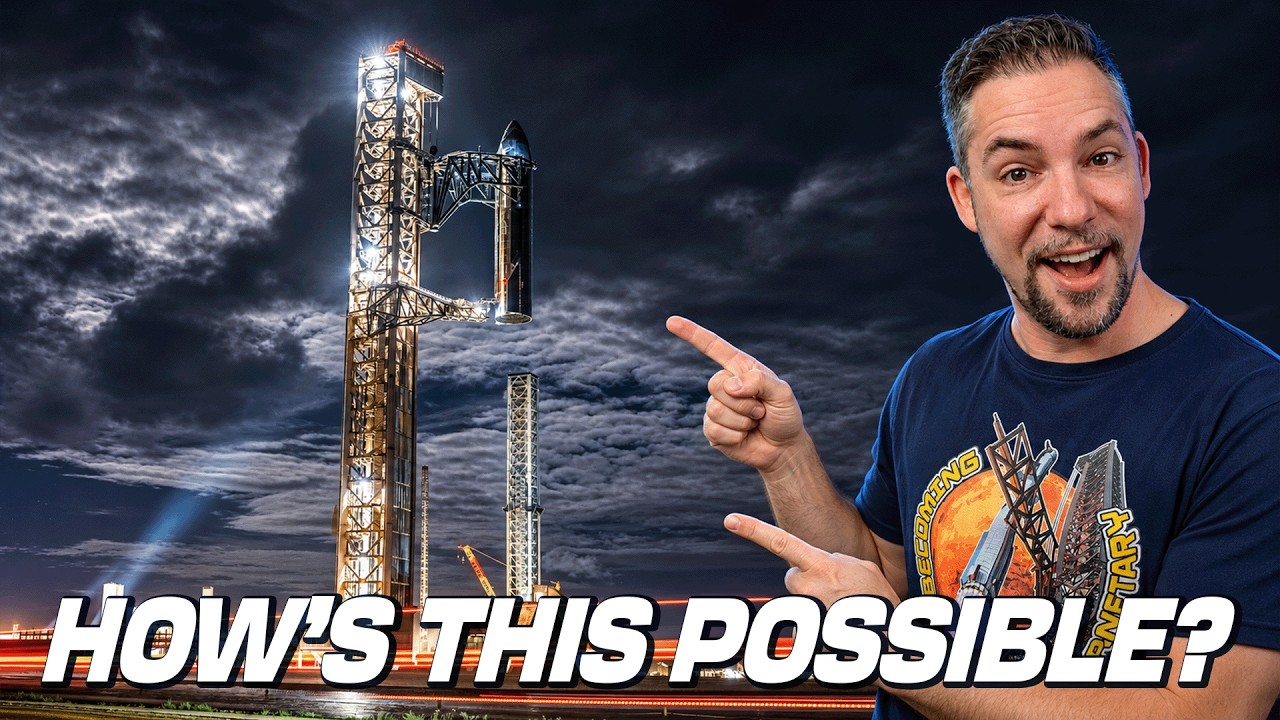
Ship 42 has fired its engines for the last time on the ground, and Elon Musk just made a promise about it that no Starship has ever kept.
The FAA moved Flight 15.
SpaceX hasn’t set a date.
We did last episode, and the new one doesn’t match ours.
Musk also posted a launch number for Louisiana that makes the FAA’s biggest Starbase plan look small.
NASA stacked the Artemis 3 core stage and said, “Who flies first?” and you will ace vulkan rocket has a date you’ll want to hear.
So when does flight 15 fly?
Chapter 2: Analyzing the Flight 15 Timeline
My name is Felix.
Welcome to What About It? Let’s dive right in.
Starship updates.
When does flight 15 fly? Two things decide that.
What is done and what isn’t done first? A week ago Sunday, booster 22 lit all 33 engines on pad 2.
Then it was the ship’s turn.
Ship 42 spent two nights on the stand at Massesis.
Last Monday, it fired a single Raptor the way it will in space to come home.
Last Tuesday, it fired all six 60 seconds and our camera was there.
On Wednesday, SpaceX called it ship 42 static fires complete.
So that single engine burn is very important, especially for flight 15.
A de-orbit burn is one engine lighting on its own in orbit after hours in the cold.
SpaceX calls it a flight startup, and from the outside, it looks like they let the propellant sit and warm up in the tanks before lighting the engine.
NASA said two weeks ago that Flight 15 flies an improved Raptor.
A ship that wants to come home to the tower has to pass that test on the ground first.
It did.
Both stages are tested.
nothing left to fire.
And then Musk chimed in.
That same night, he quoted the post with one line.
As the prophecy foretold, Starship 42 will be the first tower catch.
42, the answer to everything.
The answer to life, the universe, everything.
Have you ever read The Hitchhiker’s Guide to the Galaxy? Good books.
So SpaceX has called boosters three times.
a ship never every starship that ever flew except for the high altitude tests ended up in the ocean.
If this one ends up in the chopsticks, it is the first time an orbital rocket comes back in one piece, both stages.
And SpaceX is already planning past it.
On the earnings call, Win Shotwell said that they want to refly a second stage and do onorbit refueling early next year.
Catch, refly, refuel.
That is the whole 2027 plan and it starts with this flight.
SpaceX trusts two steel arms to keep a Starship safe.
At home, I trust something smaller.
With the holidays coming up, many of us will be away wondering if everything is safe at home.
[ad text redacted]
Chapter 3: The FAA and the Future of Starbase
Back to Starbase.
The flight itself.
Up from pad 2, booster 22 back into the arms.
A load of Starlink V3 satellites into orbit.
And then ship 42 comes around the planet and does what the animation showed us two weeks ago.
Flip, light, slide into the arms.
The only question left is when.
And on Thursday, the FAA moved the date.
The planning slide for high-profile missions now lists flight 15 for November 12th.
The version before said November 8th.
That is an airspace planning date, not a SpaceX date.
SpaceX has said one thing.
On the earnings call, Musk said Flight 15 flies next month, November.
Not a day.
What SpaceX did say is what it expects from the license.
They expect the flight 15 license to include return to the launch site and tower catch for both stages.
So far so good.
And there is no license.
As of recording this episode, the FAA’s Starship page lists no flight 15 license.
The environmental homework is done.
The assessment for bringing a Starship back to Starbase is listed as complete, and so is the one that adds a contingency landing zone in the North Pacific.
What’s missing is the piece of paper that says flight 15 may do it.
Hardware done, paperwork, not.
So when up, uh, I mean flight.
Last episode, we worked out our own window from the last two flights.
The flight 13 ship flew 23 days after its six engine static fire.
The flight 14 ship took 39.
Ship 42 fired all six last Tuesday.
November 12th would be 16 days later, faster than either.
So, our window stays where it was, November 19th to December 5th, most likely the last week of November.
I so hope that SpaceX proves me wrong.
Here is what still has to happen in order.
The license booster 22 out of Mega Bay 1 and onto the mount at pad 2.
ship 42 stacked on top.
Then the closure order from the city of Starbase and the hazard notices usually a few days out and SpaceX’s flight page.
A wet dress rehearsal hasn’t been a fixed step on recent flights, so it may or may not happen.
For November 12th, the license would have to land by about the 9th.
I’d treat November 12th as the earliest possible day, not a target.
By the time you’re watching this, one of those boxes may already be ticked.
And the question that matters more, does ship 42 get caught on the first try? Yes or no? Let me know it in the comments.
Meanwhile, ship 42 is back in the bay.
Chapter 4: A Full House
It rolled at the Mega Bay back into Mega Bay 2 in the early hours of Thursday.
Final inspections, the flight termination charges, that is the system that ends a flight on purpose if something goes badly wrong, and then the Starling satellites.
And it walked into a full house.
As of Friday, Mega Bay 2 held five ships at once, a first.
Ship 40, the one they pulled out of the ocean for inspections.
Ship 42 for flight 15, ship 43 for flight 16, ship 44 on the center stand, fully stacked two weeks ago, and ship 45 on the turntable, which got its common dome on Saturday.
The factory is now building faster than the pads can fly.
And if ship 42 and ship 43 both come back in one piece, SpaceX has a new problem nobody has ever had.
Where to park flown starships? Remember that in a minute when we get to the FAA? Ship 43 had a big week, too.
Last Tuesday, Amy and Jordan, our photographer action team at Starbase, caught ship 43 hanging in the pad two chopsticks.
Postcatch practice.
The arms lifted the ship without the stabilizers and the pushers on the landing rails nudged it into line before the stabilizers hooked it.
That is exactly what happens to a booster in the seconds after a catch.
Three boosters have had it done for real.
No ship has.
So they practice with one that hasn’t flown.
Then back into the bay.
Engines next and a static fire after that.
And it goes on over in Mega Bay 1.
Two boosters.
Booster 23 came back from Massy’s on Friday after two days out there.
We didn’t see a test and SpaceX hasn’t said a word.
Strange.
Maybe GSE fit checks.
And on Saturday, booster 24 was fully stacked.
Two boosters in the bay, one of them waiting for pad 2.
And Masses is growing, too.
You see the pattern? Three new larger liquid nitrogen tanks have replaced some of the old ones.
A second Super Crusher is under construction next to the first.
And Massey’s two, the plot east of the site is approved.
It more than doubles the test area.
At pad one, one flame trench ramp is poured and the new draw works housing behind the tower is going up.
Until the new draw works go in, the pad one chopsticks stay still.
And over at Sanchez, the new pad one launch mount got its top deck plates last Tuesday and Friday.
In Florida, NASA posted a photo on Thursday of you’ll thank me later, the Starship transport barge tied up next to NASA’s Pegasus in the turn basin at Kennedy.
Two rocket barges, one dock.
The Gigabay at Robert’s Road is down to its last bay door.
It is now almost done from the outside.
Now, the numbers.
Chapter 5: The Vision for Starbase Louisiana
Last Wednesday, Musk posted this about Starbase Louisiana.
10K Starship launches per year is just from the Starbase Louisiana.
10,000.
That is about 27 launches every single day from one site.
For scale, the FAA is right now studying the biggest Starbase plan ever put on paper.
Up to 100 launches and 200 landings a year in a first phase and up to 456 launches in 912 landings in a second.
That is for Starbase Texas.
Even the biggest one is less than 5% of what Musk wants from Louisiana alone.
10,000.
I had to read that twice.
Remember the earnings call? Musk said Starship flies weekly in the first half of next year and twice a week by the end of it.
A weekly flight is 26 launches in half a year.
The current Starbase license allows 25 in a whole year.
So 10,000 is a goal.
456 is the application.
25 is the law today.
And that gap is what the FAA review is about.
And now Starship to the moon.
The NASA rocket for Artemis 3 is coming together.
Last Wednesday, NASA said the core stage is officially stacked between its two boosters.
This is a major step in SLS construction.
But that is not the only rocket they need.
NASA’s plan for Artemis 3 in 2027, three launches.
Blue Origins Blue Moon test article goes first and it can wait up in orbit for up to 30 days.
Orion on SLS follows days later.
Once the lander is up and healthy, Starship’s test article launches last from Florida because Starship’s on orbit life is shorter for now.
Orion docks with Blue Moon for 2 days and the crew works inside it.
Orion docks with Starship for up to 2 hours and the crew stays in Orion and the entire mission lasts for about 14 days.
On Friday, Jared Isikman put it in his own words.
We’re not going to launch without Blue Origin in it.
That is why they’re going to launch first.
They need to be up there, do some checkouts, and then we commit SLS.
And on what follows, Blue has to go in order to trigger SLS, and then from there, we’ll get Starship.
No Blue Moon in orbit, no SLS launch.
That is the rule.
And the schedule driver, in his words, for sure the lander.
He also pushed back on the idea that the landers are the only reason this mission exists.
The landers could be ready right now.
And NASA would still insist on an Apollo 9 mission in low Earth orbit.
Undock, move away, come back, dock again.
Practice before anyone goes near the moon.
Makes sense to me.
And the Starship side, NASA’s lead systems engineer for SpaceX’s lander, Reed Rugles, explained it in a podcast NASA posted on Friday, recorded in August.
The Aremis 3 ship is a much closer derivative of their current V3 vehicle.
SpaceX will add a docking adapter and a nose cone on the top of it so that we can actually interface with Orion.
Orion is the chaser.
After docking, Starship will then control the stack attitude and refueling the long duration and propellant transfer demos are things we don’t necessarily need for the Aremis 3 mission, but absolutely for our Luna missions, those are going to be critical.
Yay! You’ve reached the middle of the video.
You made it.
Thank you from the bottom of my heart for watching and liking the video.
And if you’re among the 40% who haven’t subscribed yet, and there was at least one video you learned something new from, it would mean the world to me if you did.
It’s free and it genuinely helps more people find my channel.
Want to make my world even easier? There’s only one place you’d rather be.
The Y members club on Patreon and right here on YouTube.
Click the card or the join button under the video.
You are the reason we keep doing this.
Thank you.
You rock.
From the biggest rocket to the busiest of the smaller launch providers, Rocket Lab.
Chapter 6: Rocket Lab and the Neutron Progress
Last Wednesday, Neutron’s second stage and its thrust module arrived at Wallops Island, Virginia, after a barge ride down Chesapeake Bay from the factory in Middle River.
On Friday, both pieces stood at launch complex 3, Neutron’s own pad.
Rocket Lab called it another major step forward.
So, what is a thrust module? It is the business end of the first stage, the section with the engines.
And on Neutron, it is the only part of the rocket that physically connects to the launch mount.
No strong back, no tower arms.
So that is the piece you want on the pad.
First fit checks against the mount, fluids through the plumbing with the second stage on a test stand next to it.
Real hardware on the real pad long before anything flies.
and it is an important and very necessary step.
The launch itself moved.
In mid-occtober, Rocket Lab said Neutron’s first flight is now expected in 2027 after inspections found air pockets between the carbon fiber layers of a first stage tank dope.
So, the hardware at the pad is the start of a long test campaign, not the countdown.
And meanwhile, Electron keeps the lights on.
A new test pad is going up at the propulsion test complex for static fires of whole electron and haste stacks because there are more than 100 launches in the backlog.
In Rocket Lab’s words, High Cadence launch needs high cadence testing.
On Thursday, the 100th Electron left the factory.
100 rockets from a company a lot of people didn’t take seriously at the start.
You rock at lab.
from Virginia down to Mississippi where Blue Origin is getting ready for a big test.
Last Wednesday, Blue Origin CEO Dave Lymph posted that New Glenn’s next second stage GS2 was lifted into the historic B2 test stand at NASA’s Stenis Space Center.
And it took two cranes at once.
The stand’s main Derek crane on the forward end and a mobile crane on the aft end.
The stage was swung vertical, lifted 218 ft above the ground, and lowered into the test position.
And then this line, Blue Origin said, “Final preparations for our first hot fire test are ongoing.
A hot fire is a firing of the stages engines while it’s held down on the stand.
Same idea as a static fire at Massy’s.
Blue Origin just says hot fire instead of static fire.
And there’s even more than one.
A week ago, Saturday, LIMP posted that another GS2 was heading to Stenis on NASA’s Pegasus barge.
Yeah, the same barge that carried the Aremis 3 core stage to Florida in April.
The same day he posted from launch complex 36, the vehicle access tower is fully assembled with every module repaired and back in place.
The day before, the last full-size module had gone up, putting the tower at over 430 ft above sea level.
Next up, the umbilical extensions.
So, stages in the test stand, a tower that stands tall again, and Blue Origin still says this year.
The same FAA slide that moved Flight 15 has a date for New Glenn 2, December 28th.
A planning date like the Starship one, but it is the first date anyone has put on New Glenn’s return since the pad explosion at the end of May.
7 months from a destroyed pad to a date on a slide.
Not bad.
So, doesn’t New Glenn fly in 2026? What do you think? Tell me in the comments.
ULA has a date as well.
Last Wednesday, ULA said its next Vulcan, named Vulcan Leo 1, is planned for Friday, November 13th, pending range approval.
On board, 40 production satellites for Amazon Leo, Amazon’s internet constellation.
That constellation starts with more than 3,000 satellites, and this is the first of 38 Vulcan launches for it after eight missions on Atlas 5.
It is also Vulcan’s first flight since February 12th.
On that launch, USSF87, a nozzle failed on one of the four solid rocket boosters less than 30 seconds after liftoff.
ULA’s Gary Wentz at the time.
Early during flight, the team observed a significant performance anomaly on one of the four solid rocket motors.
The rocket still put its spacecraft directly into geostationary orbit.
Sounds familiar.
It should.
Vulcan’s second flight ever in October 2024 lost a booster nozzle 37 seconds after liftoff and still made orbit.
ULA traced that one to a defect in the nozzle’s insulation, fixed it, test fired a booster in Utah, and flew one.
Then it happened again.
So, one nozzle failure is a defect.
Two is a design question.
That is why Vulcan has not flown since February.
9 months to find what the first fix missed.
ULA now says it has identified several potential contributors and changed both the nozzle design and the way it’s built.
So Vulcan Leo1 flies with the new nozzle and it flies big.
The VC6L version, six solid rocket boosters on the sides, each with about 459,600 lb of thrust and the long 70 ft payload fairing.
The core stage runs on two BE4 engines, each with 550,000 lb of thrust at sea level.
Those engines are built by Blue Origin in Huntsville.
It launches from space launch complex 41 at Cape Canaveral stacked in its own new Amazon integration building south of the pad VFA and then it rides by rail about 2.
mi or 4.
kilometers to the pad.
Yeah, Friday the 13th.
I hope nobody at ULA is superstitious.
And here’s one for the telescope fans.
A week ago, Tuesday, NASA committed to UveX, the ultraviolet explorer.
It passed key decision point C, the review where NASA signs off on a budget and a date $590 million launched by January 2031 led by Fiona Harrison at Caltech.
UX will survey the entire sky in ultraviolet light to show how galaxies and stars evolve and it can swing fast toward the flashes that follow when two neutron stars merge.
What can I say? 6 years to wait.
We’ll be here.
And that’s it for today.
Smash that like button.
Subscribe for more.
This is what fuels the algorithm.
And this is how you can help us for free.
Check out our epic shirts in your favorite space nerd store.
Our all-time favorite Raptor engine design.
And countless others are there for you to explore.
Just click the card or the US worldwide link in the description.
History is being written in real time.
If you want to catch the other historic stories from recent weeks, click the video on screen and continue the journey now.
Thank you for watching and I’ll see you again in the next video.