Skip to comments.
Rocket Lab | Neutron Update [7:05]
YouTube ^
| October 22, 2026
| Rocket Lab
Posted on 10/22/2026 7:20:23 PM PDT by SunkenCiv
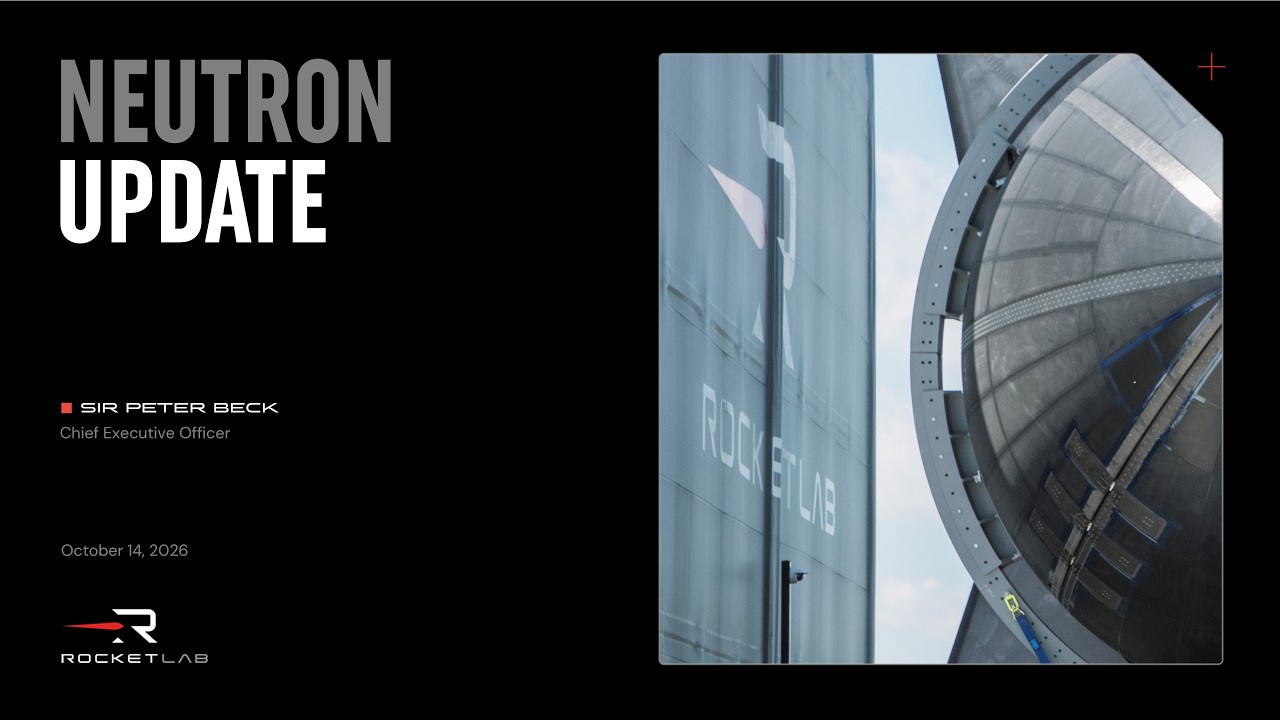
Today we shared an update on Neutron's development, including adjusting the schedule for flight one to 2027.
Sir Peter Beck provides a technical deep dive into Rocket Lab's progress with Neutron. The presentation covers advancements in carbon composite manufacturing, the development of new out-of-autoclave curing processes, and the strategic planning for vehicle production as the team balances long-term reliability with launch readiness. Rocket Lab | Neutron Update | 7:05
Rocket Lab | 221K subscribers | 38,021 views | October 22, 2026
(Excerpt) Read more at youtube.com ...
TOPICS: Business/Economy; Science; Travel
KEYWORDS: rocketlab
Message from Jim Robinson:
Dear FRiends,
We need your continuing support to keep FR funded. Your donations are our sole source of funding. No sugar daddies, no advertisers, no paid memberships, no commercial sales, no gimmicks, no tax subsidies. No spam, no pop-ups, no ad trackers.
If you enjoy using FR and agree it's a worthwhile endeavor, please consider making a contribution today:
Click here: to donate by Credit Card
Or here: to donate by PayPal
Or by mail to: Free Republic, LLC - PO Box 9771 - Fresno, CA 93794
Thank you very much and God bless you,
Jim
1
posted on
10/22/2026 7:20:23 PM PDT
by
SunkenCiv
To: AdmSmith; AnonymousConservative; Arthur Wildfire! March; Berosus; Bockscar; BraveMan; cardinal4; ...
2
posted on
10/22/2026 7:21:03 PM PDT
by
SunkenCiv
(TDS -- it's not just for DNC shills and jihadists anymore -- oh, wait, yeah it is.)
Transcript
Chapter 1: Introduction and Legal
Welcome to today’s Neutron update with Rocket Lab CEO, Sir Peter Beck. Now, before we begin, the presentation today involves our plans and expectations for the future of Neutron and Rocket Lab.
And this slide here highlights key risks and forward-looking statements to keep in mind as you listen. I’ll hand it over now to Sir Peter for further remarks.
Chapter 2: Overview of Neutron Update
Hello, and thanks for tuning in. I’m here to share an update on Neutron, including a change to our first flight schedule. Neutron is on an ambitious timeline, but we’re focused on more than just reaching the launch pad for flight one. We’re building the program’s long-term infrastructure at the same time as we build our first rocket so that we can scale quickly, unlock global launch crunches, and commercial customers, governments, and our own future satellite services are also counting on it. But I’ve said also said that we won’t rush to the pattern with unnecessary risk. And that development programs like Neutron have their challenges. Recently, we hit one of those challenges that has moved Neutron’s first launch into next year. I want to talk you through what happened.
The mitigations were put in place and what it means for Neutron.
Chapter 3: Launch Strategy and Challenges
Earlier this year, the first stage tank we built failed qualification due to a third-party manual handlay process.
Following this, we pivoted to our long-term plan production process using the automated fiber placement machine, which lays down the carbon with speed and accuracy. This change also let us make some design improvements only possible with the AFP machine capabilities like eliminating the insert and thickening the sections for the propellant aft and forward domes on Neutron’s first stage to increase strength. We’ve made some great progress in recent months and successfully produced many parts on the AFP machine, including the first stage barrels, the propellant domes, but recently we identified an issue with the manufacturing process for the propellant dome specifically. And this caused us to delay production and investigate further. Bear with me while I talk through the detail.
Chapter 4: Production Progress
As carbon composite sections are laid up in a mold, they go through a curing process. Curing involves a heat-activated chemical reaction that transforms the epoxy into a solid cross-link polymer that binds the carbon fibers together.
The curing process is typically done in an autoclave where pressure is applied to compact the carbon fiber layers and improve the fiber epoxy bonding. But there’s a size limit to using autoclaves and we’re not dealing with small sections of carbon fiber with this rocket. We are building the largest pressurized structure ever made out of carbon composite made by one of the biggest AFP machines in the world for the largest composite rocket ever.
Because of its scale, we’ve had to develop new out-of-order clave processes to build Neutron. And this includes custom cure cycles for the very large pieces like the Ford and half domes for the propellant tanks on stage one. If this process is not perfect, defects can occur. And one such defect is the formation of voids or tiny air pockets that can form between the layers of the carbon fiber which in turn compromises strength, durability, and reliability of the part. Now during a recent inspection of the newly cured Ford dome, we found some voids that had formed within the carbon composite layers. They don’t necessarily mean that the dome would fail in flight, but our practice is to proceed only when we believe the system has the appropriate margins. Possible success isn’t our standard.
Chapter 5: Technical Challenges with Domes
As soon as we uncovered the voids, we began investigating why they were forming and how to prevent them. Our analysis and testing showed that we were already very close to getting the process right when we built the Ford dome. However, after the stage one qualification earlier this year, we made a design change that deleted joints and increased the thickness of the carbon composite in some areas. Those thicker sections are where the voids formed. We were able to replicate the issue in testing and add mitigations to the manufacturing process to prevent these from appearing in the future. We’ve since run another carbon composite section called the after dome through this new process and I’m pleased to report that it has resulted in the highest quality carbon composite dome to date and we’ve solved the problem. That gives us complete confidence to move forward with the new Ford dome. Also, that process to make a new Ford dome, combining with all the time that it took to investigate, identify, and resolve the issue, has pushed Neutron’s first launch date to next year. We’re balancing speed to first launch with bringing a reliable, high cadence rocket to market for the long term, which means making deliberate choices about timelines to support reliability going long into the future. Along these lines, we’re also using this time to bring forward upgrades to other parts of the vehicle that we plan for future flights.
I know the first question people will be asking is what’s the new target launch date? Before we can provide more granularity on that, here’s what needs to happen next.
Chapter 6: Path to First Launch
Step one, build the Ford dome on the AFP machine that’s already underway. Step two, cure it, then analyze it with ultrasonic testing and other inspection methods to confirm there are no voids or further issues. Step three, assemble the Ford dome and the components together to create the entire first stage. Then run the hydrostatic test campaign followed by the cryo test campaign. All going well, we expect the first two steps to be completed before Q1 with the third wrapped up within that quarter. From there, we expect to be in good shape to share a new target launch date. In the meantime, I’d rather show you real-time progress than give you a date that I might have to walk back.
We’ll be increasingly transparent about our progress to these milestones, including providing regular updates on our website and social media channels. So, keep an eye out for those.
Chapter 7: Commitment to Long-Term Success
Finally, I want to explain again why we’re taking this path with Neutron’s development and not rushing to the pad with a minimum viable product that may have to go back for re-qualifying time and time again. As the world’s largest carbon composite rocket, we’ve had to invent new techniques for Neutron that take time now but bring massive scaling benefits in the long run. It’s why we built factories and facilities alongside the first rocket and why our second and third rockets are already being built before flight one. It’s a complex but ambitious effort, but once we perfect our new processes, we’ll be a lighter, more efficient rocket that’s faster to build and better for our customers since the mass saved by carbon composite goes straight to payload performance. We’ve done this before with things like Electron being the world’s first carbon composite orbital rocket, Rutherford being the first 3D printed orbital rocket engine, and Launch Complex One being the world’s first private orbital launch site. Every one of these bets required solving problems that no one had solved before. And every one of them is now why Electron is the most frequently launched small rocket in the world. There’s significant demand for what Neutron has to offer, including some new contracts we’ll be able to talk about soon. And we’ll be in the fortunate position of partnering with customers who choose Neutron not just for a single launch, but for multiple missions across long-term partnerships.
Those customers understand that a reliable rocket is far more valuable than an early one, and we’re grateful for their trust.
We believe Neutron is going to be a game-changer and taking the time now to solve these challenges means we’re in a better position to deliver a rocket that’s ready to meet the needs for the industry for years to come. We’re making great progress and we’ll provide more updates in the coming months. Thanks for joining.
3
posted on
10/22/2026 7:21:16 PM PDT
by
SunkenCiv
(TDS -- it's not just for DNC shills and jihadists anymore -- oh, wait, yeah it is.)
To: SunkenCiv
These guys probably know what they’re doing...but pressurized fiberglass vessels brings thoughts of the implosion at the bottom of the ocean, near Titanic.
4
posted on
10/22/2026 7:59:44 PM PDT
by
citizen
(Say it with me.....the UK is now UKistan. Short & to the point.)
To: citizen
The material works better in tension than compression. Carbon fiber is rated to 4500 psi.
The submersible had a ton of issues technically.
To: SunkenCiv
OT:
Along with Falcon 9 being cancelled in 2030 is the Crew Dragon capsule. Leaving the US with no capacity to dock with ISS or any other station.
Note: Related to the slowdown of Starlink over ground speed in Ukraine, was a surprise visit by Cosmos 2312 which maneuvered to with in 26 meters of a Finish-US SAR Ice-Eye X36 imaging satellite in use for Ukraine.
Russia demonstrated it now has the ability to destroy all of the Starlink satellites along with any other satellites they chose, causing the total shut down of various LEO bands and potentially locking up all of LEO, confining human kind to the Earth for centuries - the Kessler Effect.
6
posted on
10/23/2026 5:37:40 AM PDT
by
PIF
(They came for me and mine ... now its your turn)
To: SunkenCiv
7
posted on
10/23/2026 5:42:11 AM PDT
by
PIF
(They came for me and mine ... now its your turn)
To: PIF
Your hatred of Musk is strong today.
ISS access won’t be an issue, because it’s going to be deorbited in 2030.
Yes, Russia is a rogue regime.
8
posted on
10/23/2026 6:23:16 AM PDT
by
SunkenCiv
(TDS -- it's not just for DNC shills and jihadists anymore -- oh, wait, yeah it is.)
To: citizen; Tijeras_Slim
9
posted on
10/23/2026 6:27:00 AM PDT
by
SunkenCiv
(TDS -- it's not just for DNC shills and jihadists anymore -- oh, wait, yeah it is.)
To: SunkenCiv
I do not hate Musk!!!! - not at all - you continue to misinterpret my comments for reasons unknown.
Dismissing Cosmos 2612 so lightly shows to me you seem to have no grasp of its significance.
10
posted on
10/23/2026 6:48:08 AM PDT
by
PIF
(They came for me and mine ... now its your turn)
To: PIF
I’d been ignoring your lame-brained crazy rants, and I’m now back to that mode.
11
posted on
10/23/2026 7:00:35 AM PDT
by
SunkenCiv
(TDS -- it's not just for DNC shills and jihadists anymore -- oh, wait, yeah it is.)
To: SunkenCiv
So its back to name calling for you, eh? Civilized discourse must be too taxing? They are not rants, as you previously discovered and apologies for - my commentary based on known facts as I understand them, whether you care to acknowledge them or not.
12
posted on
10/23/2026 8:25:33 AM PDT
by
PIF
(They came for me and mine ... now its your turn)
Disclaimer:
Opinions posted on Free Republic are those of the individual
posters and do not necessarily represent the opinion of Free Republic or its
management. All materials posted herein are protected by copyright law and the
exemption for fair use of copyrighted works.
FreeRepublic.com is powered by software copyright 2000-2008 John Robinson