Transcript [SpaceX Is Changing How Starship Launches]
My goodness, have we got an absolutely packed one for you this week! Lots of Starship action going on as you can plainly see here in Texas, and loads of views around Florida to go with all that. We have surprising updates again from Blue Origin and the steps toward the next New Glenn flight, and more lunar missions are coming with NASA having all but made a PROMISE on this!
Hey, hey, Marcus House with you here, and wow has it been an action-packed week at Starbase. You may recall I had left you last week just after Ship 40 returned to the build site early after only completing a single engine static fire. We were hoping for the full six to fire after that, but it had instead been rolled home. The cause of the early return is still unknown, but it can’t have been a huge issue because it was already preparing to roll back out just a few days later.
During the time it was being worked on in the bay, though, SpaceX didn’t waste any time. As soon as Ship 40 was moved out of that middle aisle and onto the front left workstation to get looked over, they quickly began to get the next Ship, Ship 41, on the back stand here ready for its cryogenic testing! Yes, we’ve got testing going on in a rotation here right now. The thrust simulator stand rolled into the bay early Sunday morning, where they were kind enough to leave the door open for us to watch them lifting Ship 41 off of its workstand and down onto the test stand.
In no time, there it was rolling down to Massey’s, where we had Shaun eagerly awaiting it to roll by in the daylight this time. This ship we are still expecting to launch with Flight 14, so this may be the first orbital Starship if everything goes to plan with the upcoming Flight 13. Once arriving at Massey’s, it was rolled right into place over the trench, and the actuators for pulling on and testing both the forward and aft flaps were hooked on!
Before long, there was Ship 41’s first cryogenic proof test, and it didn’t stop there. It was detanked, and just hours later, it was filled again! Just as we saw them do with Ship 40. That was all SpaceX needed to do at that point. Yes, here it was on Tuesday already heading back to the production side, keeping Shaun a busy man this week.
So with that initial Ship 41 testing already out of the way, SpaceX could now get back to Ship 40’s static fire campaign! It’s pretty nuts to see all this in such a short period of time. Here is the static fire stand already rolling out, again picking up Ship 40, and rolling right on back down to Massey’s for what we hoped would now be a completely healthy looking six-engine static fire test! Boy, did they deliver! They filled those tanks right up to expected levels and jumped right into it!
Here we had the second-ever version 3 Starship being static fired, and look at the fury! This was a full 60-second test it seemed, and SpaceX confirmed this in a post with some beautiful views under the ship during startup. What we have already noticed is that the startup sequence has changed from the Flight 12 sequence, and that now seems to involve both leeward side vacuum raptor engines starting first alongside one of those sea level engines. If you haven’t watched our deep dive segment last weekend on why this is important, this will give some very useful context.
These three engines firing up first will kick the booster upward toward space in that known optimal flip direction. Then the remaining vacuum and two sea level engines will light to accelerate onward to orbit. We hope this static fire success transfers perfectly to the hot stage separation in flight, of course. That shouldn’t be too far away now given that Ship 40 has already rolled back to Megabay 2. This means Massey’s was clear for more testing with Ship 41.
Well, SpaceX were not done for the week with Ship 41 after that initial cryo test. Yes, they haven’t been playing musical chairs, but musical Starships this week. Here it was rolling back out on the cryo test stand bound for Massey’s again on Friday morning. We can only assume that some more alterations needed to be made and re-tested because it is now there at the test site going through more cryo testing.
Now to tie up the upper stage Starship action, can you believe we’ve just yesterday also watched SpaceX getting a start on Ship 42’s construction with the nosecone, forward section, and pez dispenser passing by!? It’s pretty hard to keep up with everything right now, and the last step coming up for Flight 13, of course, is a static fire from Booster 20. This should be close to finishing up all the preparation needed at this point. With that, Ship 41’s flight partner Booster 21 also finished stacking this week!
Its forward dome rolled out here recently, followed by the remaining two methane tank sections! The biggest sign they were almost done with welding those together was this. The stand typically used for installing the liquid oxygen side tank was sitting in the ringyard behind the Gigabay, as seen from the air thanks to RGV Aerial Photography! This is used to switch the methane section between the bridge cranes! It moved into the bay on Sunday morning and was back out the next morning, not even 24 hours later. The end result is that Booster 21 now should be completely stacked!
Trust SpaceX to not stop there, though. Just an hour after the stand left the bay, here they were kicking off a ring parade! The common dome and first two liquid oxygen tank sections for the next Super Heavy Booster 22 began rolling in to start its own stacking process! It’s absolutely crazy everything going on all at once!
If all goes well for the next two Starship flights from Texas, this could be the very first Super Heavy to launch with Flight 15 from the Cape at Launch Complex 39A. If so, this could also make it the first booster that we ever see being laid down into a horizontal transport position and shipped off to the Cape here in the near future!
Now the hardware required to perform such horizontal Super Heavy action is currently being built over in the Sanchez area of this site right now and continues to evolve before our eyes. Most of it is already pretty much done, actually, and it all just needing to be assembled together! Chameleon Circuit has been working with us to put all this together in 3D for us, and hopefully, this will give you a great sense of how it will all look in the end!
The order of operations is still speculative, of course, until we see them do it for the first time, but the idea is that they will likely install two of these specially designed grid fin attachments into the mounts either side of the Super Heavy. These look to be equipped with leveling systems for 360 degrees of movement, which will allow the booster to be lifted off of a stand, hooked up to the aft rig, and rotated 90 degrees into the horizontal position. This means it will rest on a cradle located near the forward or middle section of the booster with the transporters!
Now with all that action out of the way, what about the launch pad that obviously needs to be ready for Starship Flight 13 coming up? If we take a look at Pad 2 this week, the obvious difference that will stand out is the lack of scaffolding in the center of that launch mount. Thanks to this shot from above, you can clearly see that this was actively being removed during this flight!
After it was gone, this gave way for some full-speed launch clamp and ship quick disconnect retraction tests along with some new spectacular water deluge testing! Looking closer, these tests seemed a little different from any previous test. These seemed to come in pairs, one full pressure test and then another lower pressure test around 8 minutes later. Now that is a pretty good way to simulate the Super Heavy being caught by the tower. A little deluge there to protect the mount at the moment of a catch makes perfect sense to me.
To add more support for this argument, this was even accompanied by the catch rails moving up and down a few times, both arms! Now SpaceX hasn’t mentioned any specific mission that will attempt the first-ever catch of a Version 3 vehicle, but we hope to see it as soon as Flight 14, assuming the next mission goes perfectly to plan for the Super Heavy.
Now the one other intriguing change to note here at Pad 2 would be the excavation of materials alongside the commodities lines that enter the back of the tower. It looks like SpaceX is adding an extra insulated cryogenic pipeline here. We aren’t too sure what this is for just yet, but we are all wondering if they are going to try to reroute the Liquid Oxygen dump vent back down the tower. That’s just pure speculation right now, but it would make sense given this vent gave SpaceX problems before Flight 12. At the time, you may recall they had to install a brand new extension to stop the flow blowing back into the tower.
Now moving over to the old Pad 1 rapidly becoming new again, this has had a bunch of notable changes. If we start with the tower itself, they have removed the actuator from the back of the ship quick disconnect arm and have begun to sever the connections between each section. They’ve laid out two large sections of load spreaders beside the crane here, and we suspect the larger will be for the elbow. The smaller is likely then for the extension that has the quick disconnect itself on the end!
You may also notice that there is now scaffolding surrounding the base of the tower, which then continues all the way to the arm carriage, which is paving the way for a whole bunch of maintenance and upgrades! Align with that, seemingly popping up out of nowhere, you may have noticed the brand new roof behind the tower, which is only a few beams away from being completed!
The new flame trench below is even beginning to reach the final depth, and this is revealing more of the hundreds of steel and concrete piles down here! Perhaps my favorite part is that we can also see a few of the 6 massive piles that supported the previous launch mount. You will recall the iconic 6-legged monster that stood here not so long ago, and the support for those legs will continue to live on and support the new design!
Just to the side, we can see that they’ve started installing the large vacuum jacketed pipes used to fuel the Super Heavy booster, as well as some gas lines along these pipe racks! The concrete foundation here for the commodities bunker has now cured and should be ready to have the bunker framework itself lifted on top. The preassembly of the bunker has been a new process to Pad 1’s order of operations, and they seem to be finding even more ways to work in parallel. You may see here that they’ve already begun to start welding sections of the steel waiting to be lifted in for the trench walls, which will now go in as long sections!
Now with all this, a massive thank you to Greg Scott working along with us here because we also have brilliant insights around the Florida sites.
[ad text redacted]
Okay, so diving into all this Florida action, if we begin with SpaceX’s Roberts Road facilities, you can see the Gigabay here is much further ahead than the one in Texas! Cladding is quickly approaching the top and the 4 tower cranes are gone with the roof now almost completely covered over. In fact, the concrete floor of the penthouse underneath is already in! There are actually some white stands under construction nearby which may be workstands for the bay! Now here we have pieces for the 4th orbital launch mount which will be for the second tower at launch complex 37. You can see the pedestals are all in place for them to begin welding those together! Next door, you can see the pads, tower arms, and carriage which have actually already rolled out! The arms rolled first, then the carriage just days later. They do still seem to be lacking some hardware but nothing that can’t be installed at the launch site!
Speaking of, the stacking for the first tower at launch complex 37 is well underway. During this flight, we had the 2 modules already stacked with the third being prepared, and thanks to this shot from Julia with NSF later indeed, the third and 4th tower module has been stacked out of the nine, so it is already over half the height of the full tower. Thanks to Harry Stranger and Planet Labs, this satellite view from above just a few days ago on Thursday shows those arms and the carriage sitting right there. So cool!
So what about Launch Complex 39A preparing to be the first tower here to launch a Starship from Florida? Those transport stands they shipped here just a few weeks ago from Starbase in Texas are likely being used in the commissioning of the Starship pad! That “Ibeproofin” test rig used to qualify the launch mount clamps has finished its job and has been removed from the mount, and there we have the cladding installation appearing finally on the tower! I just can’t wait to see Starship vehicles rolling into the Gigabay to prepare for the first Florida flight.
Thanks for all those great views there, Greg! If you love what he is doing there, do consider giving him a hand on Patreon. There is more and more going on all the time that we only get to see from above, so yeah, that would be super handy. With that, super grateful that you are subscribed right here too because then we get to help make these events happen.
Now we’ve got some interesting stuff with Falcon 9 flights this week too. On Sunday, we started with your typical Starlink mission with Group 17-40 from Vandenberg Space Force Base. Booster 1088 was landing on the droneship Of Course I Still Love You for its 17th recovery moments later, but that mission was rapidly followed that same day across the country from Florida at Space Launch Complex 40. This was the Sirius SXM-11 Mission and between the fairings was the 12th high-powered satellite for SiriusXM.
Coincidentally, this was also Booster 1085’s 17th mission and after stage separation, we had that view of the satellite up there continuing on its way to orbit. We’ve had a number of these missions before, of course, and you may recall seeing these satellites having this large, mesh reflector that expands out almost 10 meters in diameter. There was the touchdown on the droneship A Shortfall of Gravitas there in the darkness, and nice and clean as always.
Next up was Starlink Group 17-46 back at Vandenberg on Wednesday evening. Booster 1100 was only on its 7th mission here landing shortly after on Of Course I Still Love You, and wrapping up that week of Falcon 9 action, a sweet crystal clear view of the Starlink stack of 24 drifting away at deployment. Always nice when we see that shared. Now another quick launch to mention was the next Amazon LEO mission here launching on Atlas V on Thursday. Now I believe that this is indeed the last ever LEO satellite stack launch for Atlas V. If you recall, that Atlas V is no longer being made, and with just the four Atlas V’s now in existence, they are all allocated to Starliner.
Saying that, after you read through the June 30 Inspector General Report released the other day, and given they talk about Starliner investigations going right through to the end of the year, I can’t imagine there is going to be any Starliner action before mid-2027 at this point. Anyway, no problem with this mission, of course. United Launch Alliance deployed the LEO satellites there as planned, so we will need to wait for Vulcan before we will see ULA send any more to orbit at this point. Remember we are still waiting for that to be given the thumbs up to fly again after the anomaly on its most recent flight with the USSF-87 mission almost five months ago.
[Blue Origin’s New Developments at Launch Complex 36A]
Now it seems like we’ve got something new and interesting to talk about every week with Blue Origin. The reconstruction work at Launch Complex 36A after New Glenn exploded here back at the end of May keeps on providing us with new surprises. CEO Dave Limp shared with us that they are now moving ahead with an entirely new pad configuration, abandoning the original design. This change they hope is going to significantly speed up the rebuild.
Instead of constructing a brand-new transporter erector, Blue Origin is switching to a hybrid horizontal to vertical integration approach. The first and second stage will still be mated inside the Horizontal Integration Facility as before, but the new transporter will then carry the fully assembled vehicle out to the pad, and a massive crane will pull New Glenn up into its vertical launch position. Once upright, that crane will then also be used to install the payload.
This I think is a nice render of what the rebuilt pad is expected to look like, and that’s worth comparing to how it originally looked before the accident. Another noticeable change is that the second lightning tower won’t be returning at all. I mean, at this point, it almost seems like if there were to have been an accident, this may have been the best time for it because Blue Origin had already been developing a very similar concept for the future 36B pad designed for the more powerful 9 x 4 New Glenn.
As a neat added bonus, this new approach should also allow them to support a faster launch turnaround in the future and as you can probably already tell, the support tower has some pretty big modifications. If you compare this to how we’ve watched New Glenn fly in the previous missions, you can see that it will be launching rotated 90 degrees from before. I mean, there’s a bunch of work just to support the new lines, umbilicals, and even a work platform as shown here.
So where are we at right now!? At this point, the team has already assembled an enormous 600-foot crane to begin working on the main tower here. You may recall Dave’s post here soon after the accident saying that it can be repaired in place rather than being torn down. Well, it seems what they’re going to do now is carefully dismantle it section by section so that they can repair or modify the individual segments of the tower before it is reassembled.
Just as a side note, I think what’s interesting here is that this CC 8800-1 crane being used is the exact same one that was being used by SpaceX to build the currently active Tower 2 at Starbase in Texas, and then the Mobile Launcher at KSC. It sure does get around. In this photo by Greg just yesterday, you can see they’ve already removed the top of the tower, so it is going to come down fast.
So with all these huge changes, Blue Origin keeps on hinting that New Glenn should be back here to fly before the end of the year. I’m still pretty skeptical of that timeline, especially with how much they want to do here. I always think the problem with stating these self-imposed deadlines is that the more they keep saying that, the worse it appears if they just can’t make it.
[NASA announcements]
Now we have also just had yet another bunch of neat stuff announced by NASA during this week’s Moon Base Update. They are still betting on New Glenn flying soon in order to have them launch the Blue Moon Mk-1 Endurance vehicle around the middle of next year, and they again talked about Astrobotic’s Griffin lander, which is still on track to launch by the end of this year. But we know even more now. It’s great to see NASA giving us regular updates now on the progress of the Moon Base architecture, and Jared made it clear that we’ll be getting awesome updates every month.
In this update, we learned that Astrobotic now has received two more Commercial Lunar Payload Service missions with their smaller Peregrine Lander design. Intuitive Machines were awarded one using their Nova-C, and Firefly’s Blue Ghost lander was awarded another one. Together, these contracts are worth around $600 million dollars, and if everything goes to plan, we should see all these four new missions head to the Moon in late 2028. That is going to be a very fun year.
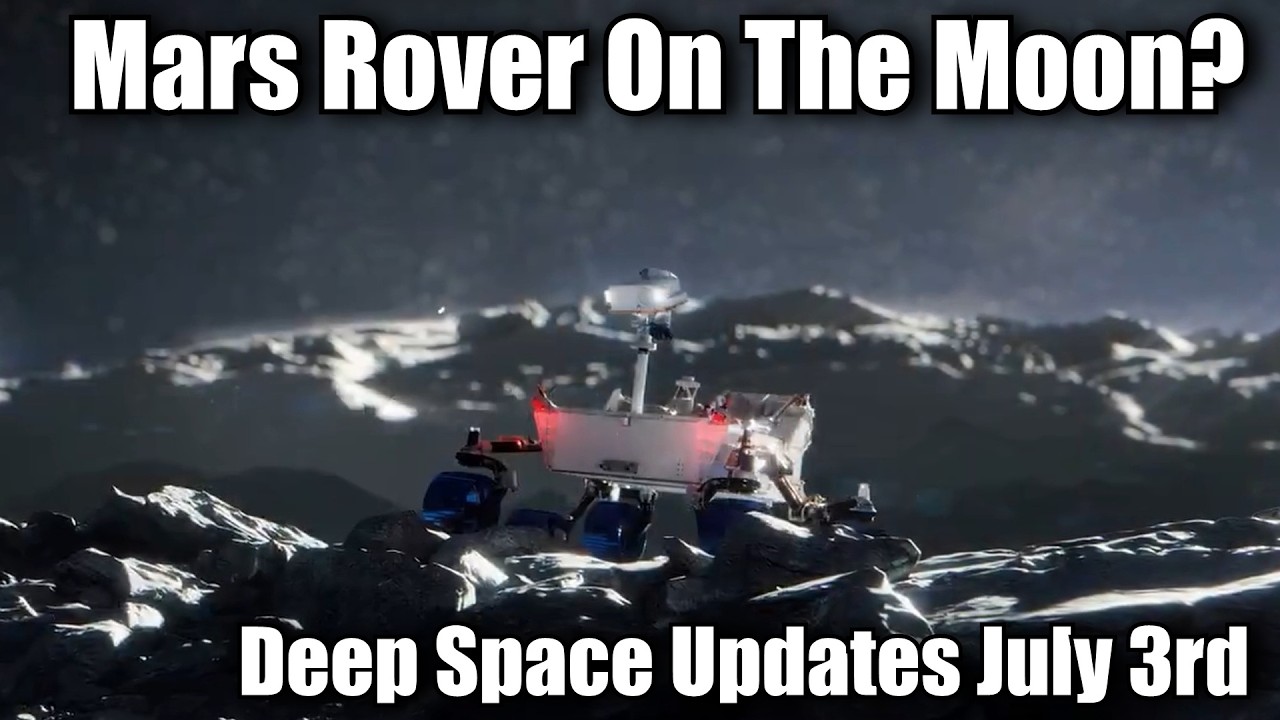
Now, the most surprising announcement here was when Jared stated that NASA were considering potentially sending the PROMISE rover here, which is essentially the full-scale engineering model of the Perseverance rover, to land on the moon instead. This had never been planned to use in a real mission, but it seems like they are looking really hard at implementing the needed radioisotope thermoelectric generator or RTG to power it and get it moving around the Moon. Man, I love this idea because it can power itself through the long 14 Earth day lunar nights and then explore around as much as they like at the south pole region with almost no communication delay.
All NASA’s other rovers are just solar powered here because, you know, it isn’t easy for commercial partners to get hold of an RTG. Just surviving the lunar night is very difficult even if you do end up with daylight coming back in after all that time. Promise, with its RTG, would not have to worry about that at all and should be able to drive around anywhere in the darkness for years just like Perseverance and Curiosity on Mars.
I think it’ll be interesting to see what additions NASA will engineer into this to adapt it for the Lunar south pole. Of course, if they do go ahead with this, NASA won’t have this as a test bed for the Mars rover, but at this point, Jared thinks that all the years of experience that NASA has with Perseverance on Mars, it is likely much more useful now up on the moon.
Now NASA has also had plenty of International Space Station action too. Astronauts Chris Williams and Jessica Meir have successfully carried out a rather unique repair job on their spacewalk this week. Back in late May, the Canadarm2 suffered an unexpected malfunction. One of the wrist joints on the robotic arm began pulling unusually high current with its motor and failed to move as commanded.
After some investigation, NASA and the Canadian Space Agency jumped into action. Chris and Jessica removed the faulty wrist joint and installed a spare that had already been stored aboard the space station. The walk lasted 7 hours and 20 minutes, and once the repair was complete, mission control in Houston powered the arm back up and successfully verified the wrist powered back up correctly with all the data connections flowing.
Through the week, they’ve been putting Canadarm2 through a series of motion tests. Assuming no further issue, it should already be ready for full operation. This has been a great design. Canadarm2 was built with replaceable joints to keep it operating for decades. In this case, the faulty removed joint will be returned to Earth presumably with SpaceX’s Dragon for inspection and perhaps even repair.
Now although there was no stream or coverage to speak of, the critical Swift mission designed to boost the orbit of NASA Swift Observatory that we talked about in depth last week has indeed launched on Friday morning. The [[LINK:index]]LINK spacecraft had reached orbit as intended, leaving the Katalyst team to acquire a signal and confirm the solar panels had deployed. All has gone well, which is great news.
They’ve established communications with LINK, and over several weeks, Katalyst will assess the propulsion, sensor, and navigation systems, and then, we hope, have it approach the Swift Observatory and complete a survey of it before going in for the capture. If they can, it is then going to take several months to push it into the higher orbit, so best of luck to all the teams involved in pulling this off.
Now finally, it is worth a special mention that Rocket Lab this week announced that they are going to be acquiring Iridium. Peter Beck, the CEO, gave us a full rundown on all this, but essentially this is going to mean that Rocket Lab alone will not only be a launch provider and spacecraft creator, but also a vertically integrated powerhouse. It is essentially a terrific shortcut where Rocket Lab will have access to the extremely valuable spectrum used by Iridium for its communication networks, as well as, obviously, the constellation itself.
More specifically, the L-band spectrum allocated to the Iridium constellation serves over two and a half million customers right now worldwide. With this acquisition, Rocket Lab is going to build on the constellation to scale up into untapped markets and, as they say, pioneer new space-based services. I tell you what, if you go all the way back to that first launch of Electron in 2017, it is absolutely incredible how far they’ve come.
So I hope you enjoyed this video, my friends! If you did, don’t forget to hit subscribe so we get to keep making them. If you want to continue with more space goodness, check out this video here next. Thanks for watching all this way through as always! I’ll catch you next weekend!
Transcript [Can NASA Make A Mars Rover Work On The Moon?]
Chapter 1: Intro
Hello, it’s Scott Manley here. June is over, July is just starting. We’re getting ready for the 250th birthday of the USA. It is time for another batch of deep space updates. And we have had, uh, five different Starlink launches in the last couple of weeks. Four from Vandenberg on the 21st, the 25th, the 28th, and July 1st. And by the way, that one on the 25th of June was the 400th Starlink launch. We also had a launch from Slick 40 on the 29th of June.
Chapter 2: Launches
Elsewhere, well, we had a very, very interesting launch that just seemed to come out of nowhere. On the 19th of June, out of New Zealand, the Rocket Labs Electron launched at Victus Hayes and the Puma spacecraft out of Mahia. So, this was the tactically responsive space launch, right? Victus Hayes for basically the Department of Defense, Department of War. And, uh, the whole thing about this was they had the spacecraft. They knew it was going to have to be launched, and they got 24 hours’ notice to launch it. And what’s interesting is that it looks like this has been launched into a very specific orbit to rendezvous and perform proximity operations with another spacecraft.
So, it turns out that the orbital plane it went into is the same one as the payloads that were on the CAS 500 mission that was launched back in May. And there’s a spacecraft in there called Jackal, which is going to be part of this. So, the Puma spacecraft, I believe, was built as well by Rocket Lab using their Pioneer platform. And yeah, it’s going to perform up and perform the rendezvous and the proximity operations and all the other stuff. They managed to do this launch from getting the phone call to lifting off in 16 hours and 42 minutes, which is, yeah, that is pretty darn fast.
So anyway, uh, that came out of nowhere. You know, we knew this was going to happen. We knew that Rocket Lab had this contract, and when we saw the NOTAMS appear without anything else in the pipeline, we guessed this is what it might be. And for a couple of days, we weren’t sure, but it was very exciting to actually see this happen.
[China]
Anyway, moving forward a couple of days to the 23rd of June in China, we had the Long March 7A launching a satellite to geostationary orbit out of Wang. Again, this is another communications technology test spacecraft, a Tongu Tongen Jiu Xian 26A. That means we don’t know very much about it, but it apparently has been launched on a geostationary transfer trajectory and presumably will be settling down into orbit at some point.
The 23rd of June also saw the Falcon 9 launching Starfall, not Skyfall, Starfall. Yeah, and there are lots of questions about this particular flight as well. So yeah, I made a video a few weeks ago about Starfall and, uh, you know, describing how this is a re-entry capsule capable of—and they were going to test it and land it in the ocean. It could be used for like manufacturing stuff in space and bringing it home, or it could be used for in-space cargo. This was the first actual test flight.
However, there was a lot of mystery, right? First of all, we didn’t get any onboard imagery, right? There was this, like, uh, there were some modifications to the spacecraft to the upper stage with the gray stripe for long duration. It only spent a couple of hours in orbit. It made a fairly high, uh, apogee as well. And it performed a plane change maneuver, which is unusual. We’re not sure exactly why it might have done that. And it was like a fuel dump event and everything.
So anyway, we’re not quite sure why it did this, but I think it might have shortened the amount of time that it spent in space, and that would probably explain why it had to perform a downrange landing on a drone ship. But the fact that we didn’t get any images from onboard makes us think that it might have been some other payload, something for the Department of Defense, some other, you know, uh, National Reconnaissance Office with a Starfall cherry sitting on top. Regardless, the Starfall has been recovered, brought back into port, and it looks like they’ve manufactured a silver tarpol, and I don’t know, like, it’s all hidden. We’ll see what happens next.
Now, another interesting thing about this is, according to Jonathan McDow, the person who tracks everything that goes into space, the US Space Force did not give the spacecraft a tracking number, right? So, they didn’t consider it a payload that was going to stay in orbit. That’s kind of interesting. So he gave it a special designation of its own.
There was also a statement given from the Department of Defense about a Golden Dome test being successful, like, at exactly the same time. So there was some speculation that maybe the payload carried on this was somehow related to that test. We don’t know. Again, secrets. However, we did find out some of the payload that was carried on Starfall because Starbase Brewing. We’re proud to announce that it flew their, uh, microgravity, their microbrew experiments on board.
So, uh, they carried a bunch of, uh, like yeasts. They carried, uh, some of the brewery archive space exposure demonstrator, which held dozens of different strains of brewing yeast, distiller yeast, and wine yeast from around the world. I fully expect that Starbase Brewing will be coming out with some new products in the near future. Uh, yeah, we’ve had space beer before. NASA flew it on a suborbital flight, and, uh, Inspiration 4 carried a bunch of hops. Uh, it sounds like beer in space is still a thing that is going to keep on happening.
Okay. On the 26th of June, Rocket Lab out of Mahia launched an Electron. Uh, the mission was called 10 Owl of 10, and it was launching another synthetic aperture radar satellite for SINS Inspectives Stricks number eight. Uh, I believe that’s the 10th launch of the 26 or whatever that they’re going to be launching for their constellation. So, uh, yeah, that flight was a success. And just this morning, 2nd of July, we had LEO Sat 29 of those launching on the Atlas 5. And this is the last flight of the big Atlas 5, the one with five boosters, the one with a 5 m fairing. It’s also the last flight of a Centaur 3 with a single RL10 engine. The only, uh, the only ones left are for Starlininer, and those aren’t launching anytime soon.
But yeah, also part of this is that with these new LEOs in operation, apparently I’ve heard that Amazon is planning to move ahead with beginning initial service using their constellation; they have enough coverage to keep up service. Uh, but yeah, that’s, you know, end of the Atlas that has a fairing. And this morning on July 3rd, Erda Quagulin Adall, a Lockheed 10-11 Tristar, carried a Pegasus XL rocket to the skies. It actually launched this time after multiple scrubs, and that rocket carried the Swift rescue mission catalyst link spacecraft.
We already have news that they are, in fact, communicating with the spacecraft so that it is healthy. And there are now, of course, many, many more steps to make sure the spacecraft is operating in orbit so it can actually perform this rescue mission. One of a kind. As I said, this is NASA’s real-life Hail Mary mission this year. And, uh, I’ve got a video on it. Watch that. Best of luck.
Uh, also worth noting that on July 1st, Rocket Lab was also supposed to launch, uh, an S payload for, uh, QPS, part of their constellation, and they counted all the way down to zero, lit the engines, and then aborted. So, that is a rare last-minute abort for Rocket Lab. We’re not sure when they’re going to get back on that. Uh, looking forward to future launches.
Chapter 3: Other News
The Nancy Grace Roman Space Telescope is now at the Cape. Are seeing a whole bunch of photographs of it being integrated. It looks like an absolute monster. This is going to fly on a Falcon Heavy potentially by the last day of this month, more likely next month, but we are very excited to see this thing head out into deep space and start discovering some new stuff.
[China]
Okay, so now Leo Labs, again, the company that tracks stuff in space with space radars that they build. Uh they observed that the Chinese Shenlong reusable space plane had deployed a payload. Uh they couldn’t correlate it with any other object in the catalog and it was in the same orbit. So it’s presumed that this is something which has been deployed. Now it may uh be picked up again. We’re not really sure but it is interesting to see that we are now actually tracking uh these kind of operations by uh China’s space assets. Um, this was actually observed by the radar that was down in New Zealand, which is interesting because this isn’t a telescope or radar that is in the US. This is, of course, Leo Labs are able to deploy their radars around the world thanks to, you know, uh it being a relatively small system.
Chapter 4: Blue Origin Updates
Blue Origin, obviously a lot of eyes on Blue Origin right now since the whole moon-based thing does seem to be hanging off them and their rocket, which just exploded. Well, uh, they showed off some new lunar infrastructure. They are a power tower. So, they pointed out that, uh, at the South Pole, this the solar power comes from the side. So, they have this, uh, this demonstration of a system that deploys a tower that’s 26 m tall standing on top of their Blue Moon Mark 1, and it deploys a large solar panel, which can there turn and track the sky. Now, uh, it’s not clear how much of the year that this can do it. Depends on where it actually lands. But this is, you know, a very cool piece of infrastructure which you would need to need to operate at the South Pole.
Also, the Blue Moon Mark 1 has been, you know, the Endurance spacecraft has been going through more testing. We’ve seen more photos of that, but obviously without a launch vehicle. They have plenty of time to test this and make sure that it’s absolutely ready to launch whenever one is ready. There have been some videos released showing the cleanup time lapse of this operation as they’re getting the pad cleared out and they’re preparing for what is going to happen next. And what is going to happen next was revealed just a couple of days ago in a mockup video, a CGI video showing how they’re going to work now without their whole strong back or transporter erector. Now they’re showing that they’re going to integrate their rockets in like the horizontal integration facility. The first and second stages are going to be joined and then those are going to roll out to the pad and then using a crane system they’re going to deploy it to the vertical position and then the crane will attach the payload fairing and the payload adapter on top of that.
The tower which survived the explosion is going to be repaired. Although it sounds like they might have to actually disassemble it. But on top of that repair, they’re actually going to add a big extension out sideways that will contact out to the rocket and carry the umbilicals and everything else that’s needed to operate this. Interestingly, I think I think somebody pointed out that uh they’re going to need to rotate the rocket 90° to be able to connect to the existing plates or something like that because the fins used to be would go sideways to where the uh tower was.
So, they’re going to have to rotate the thing which means it’s going to have to d-rotate once it takes off. We are going to have a role program with the new Glenn. Anyway, this integration uh you know technique, this concept of operations as they like to say. This will also apply to the new Glenn 94. It means that I’ll be able to use the same equipment one way or another rather than having to modify their uh strong back. Okay.
Chapter 5: Shuttle
Uh California Science Center let a bunch of journalists in to see their new Endeavor exhibit. So, at California Science Center, they have the Endeavor Space Shuttle there. And for a long time, it just sort of like sat on the ground and was really awesome and really cool that California had a full-on space shuttle. But, uh, thanks to their procurement, they managed to also find enough bits to make solid rocket motors, casings anyway, empty casings.
The only remaining external tank. They are now stacking this vertically or they’ve stacked it vertically in a custom-built building and it’s expected to open in November of this year. It’s looking absolutely amazing to see a shuttle in the launch position like this. And of course, you’re going to be able to go up in the gantries and look all the way around it. And you know, I’m sure the cafeteria will sell the double stack cheeseburgers or whatever. Uh anyway, very uh very excited to see the first images of this thing since uh it’s been a couple of years that that’s been kept under wraps.
Chapter 6: Asteroids
Now, you might have heard that I had a busy few days. Uh, it’s been Asteroid Day, June 30th every year, and I’m always involved with the Asteroid Institute, going to places talking about asteroids. I went to Meteor Crater, uh, to the Lowell Observatory. We had like a space day where we were teaching kids how to play Kerbal Space Program, including some extraordinary young kids who will no doubt grow up to be rocket scientists, and the world will be a better place. I gave some great talks, and there was the award of the Schwiker Prize, and that was a transformational moment for me in understanding planetary defense.
So, I’ve talked about the threat of asteroids hitting the planet and how, you know, humanity has sort of reached this amazing point where we now know how to stop this, right? We know that you could use something like DART to change the orbit of an asteroid so it missed the planet, and really it was just now about finding all the objects that we would have enough time to do this.
But, uh, the Schweiker Prize is an award that is given to researchers who come up with a proposal which, uh, helps to improve planetary defense in some material way, that you know, the best idea of the year. It’s named for Rusty Schweiker, right from Apollo 9. And, uh, this one again, it transformed my view because what they pointed out is that now that we are talking about, and now that humanity is expected to have huge numbers of assets in orbit, you know, communications constellations, right? Starlink, right? The data centers they’re running, you know, all sorts of stuff, the telescopes. Now, planetary defense really needs to start taking account of these assets, not just you just in orbit, also in the And on the moon and in orbit. You don’t have the benefit of the atmosphere to slow things down and shield you from the smaller objects.
So, you’re now going to have to start thinking more about things like meteor streams. And, you know, this in turn has a knock-on effect. You know, that DART diversion scenario. Well, when you do that, it actually creates a cloud of debris which stretches before and after and will no doubt come through the vicinity of the Earth. So, this, the whole, the prize winner was basically coming up with a bunch of proposals to actually investigate this, uh, this thing. But I mean, I think just my mind was blown by the whole idea that humanity, as it is spreading out now, needs to think about defending humanity’s universe as more than just being defending the planet Earth. Anyway, that was all very cool.
Yeah. So, there was a bunch of astronauts there as well. You know, Ed Lu, Steve Smith, Nicole Stott, obviously Russ Schweikert. I was there, and the people at my table were like, “What astronaut are you?” I was like, “I’m not an astronaut. I only play one on the internet. You will still get your money’s worth in scintillating conversation.” It was great.
And finally, one interesting thing that happened on Asteroid Day, actually no, it was actually a couple of days before, was, uh, see, Asteroid Day was this whole idea that was created. It was supposed to be something like Earth Day so that people could think about the, you know, asteroids in the universe and how they could be assets, how you could mine them, and how you could also have to defend against them and somewhere in between. People would have a theme, something to raise awareness.
Well, as a day, it has always been June 30th, but it’s never been officially recognized by the U.S. until this year because Mark Kelly and John Cornyn and some others basically got a bill passed, got it signed, got it voted on, unanimous vote, Asteroid Day is now an official thing according to the U.S. government. So, yeah, now what did happen on June 30th, which is a big deal for asteroids, is the Vera Rubin telescope officially began operation. It is beginning to start taking its time lapse of the night sky. It’s using its 3.8 gigapixel camera to scan that sky, get images, get really deep data on everything, and watch how it changes over time. And that is perfect for tracking objects moving through the sky. This, it’s only like two days in. I fully expect we will suddenly see a massive jump in the number of asteroids being discovered. And I’m excited for this.
Uh, but I’ve already seen data from one person that says, “Oh, look. We found some like centimeter scale debris in high Earth orbit that no one has been tracking.” So, there’s going to be other things like that that we’re going to find. We’re going to find like more supernova, more transient events. This is incredibly exciting. This has started now. It’s funded for the next 10 years. I fully expect that the value of this will keep it running for a lot longer.
Chapter 7: Moon Base
Okay. Uh, Moonbase. There was a moonbase press conference number two, and the main thing that came out of this was there’s four new missions that have been signed up, and these are sort of very simple missions for NASA. They basically given money to Astrobotic, Firefly Space, and uh Intuitive Machines.
So there’s two landers from Astrobotic. That’s the two small paragrin landers, and Firefly is going to fly another Blue Ghost. Intuitive Machines is going to fly one of their uh Novas.
And essentially the only thing that NASA, it sounds like the only thing that NASA is putting on these right now are like the scalps payload that it looks at lunar surface plume interactions. That’s high-speed cameras that looks how that interacts. Uh, then there’s the radiation environment tracking, the let instrument that looks at radiation on route to the moon. And then there’s a laser retro reflector.
So, I don’t know if NASA is planning to put other more dedicated payloads on each of these over time, but the fact that you’ve got four different uh landers going to different places, collecting this kind of baseline data, it’s kind of actually useful as for its environmental, you know, understanding the moon as a place to work. Uh, but it might just be that they’re, you know, giving money to these lander companies so they can keep flying the landers and get experience with them so that they can start putting more expensive payloads on them.
Regardless, that wasn’t even the big, you know, spending, you know, $500 million, $600 million on landers, that wasn’t the story that people really heard out of this. What people really heard was the promise of a lunar rover, another lunar rover. And this basically said, “Hey, so we built this engineering model for the Curiosity and the Perseverance, and it’s basically a fully functioning rover that just hasn’t been put on a rocket and sent to Mars. Could we take this and put it on the moon? Could you take a Mars rover with a nuclear power source, a radioisotope thermoelectric generator, and could it operate?
I I suspect there’s a lot of changes that need to be made. First of all, the radiation environment on the moon is going to be harsher because the Martian atmosphere kind of shields all that. Uh, and the other thing is the long nights mean that the temperature of the rover is going to get much, much lower than it is on Mars. So, it might be that this simply doesn’t work. But I find it fascinating that the whole thing was, “Hey, we need some more rovers. What’s that one doing? Can we put that in a rocket?” Well, let’s find out.
Now, an RTG driven motor on a rover on the moon would actually be useful because it means it can go into places other rovers can. If they can handle long periods of darkness, then it can in fact go into craters and look at things that were permanently shadowed. And so, that’s really interesting. However, the fact that it needs RTGs does raise a question of what the supply is because there’s a very limited supply of those, and any mission that’s going to go out to like Saturn or beyond really needs these kind of things.
And so, uh, will this mean that there are other missions that NASA can will have to choose not to fly so that they could fly a nuclear-powered rover on the moon? Uh, that’s a good question, and honestly I think that uh you know US Department of Energy just needs to be making more plutonium 238 so we don’t have to make these kind of awful Sophie’s choice kind of things. Oh, that’s a terrible thing. I would prefer if NASA wasn’t having to make these really hard choices between cool space missions because they are lacking the materials and supplies necessary for it.
Another asteroid day related thing is Hayabusa 2. You remember it collected samples from asteroid Ryugu and returned them to Earth. Well, after leaving, after flying by the Earth and dropping its return capsule, it went off into deep space and it’s going to fly by another asteroid called Torune on July 5th. Also happening around that time is we’re expecting China’s Tanwen 2 to get close enough to like actually start sharing some pictures again on July 4th or 5th. I fully suspect that they will do it on this date just to sort of uh, you know, try to take some thunder away from the US having its big birthday. That just sounds like what I would do I think if I was in China.
Chapter 8: EVA
Um, anyway, let’s see. There was a spacewalk on the International Space Station where, uh, Chris Williams and Jessica Mayer went out to repair the cannid arm. So they had it was a 7-hour 20-minute spacewalk, and their primary objective was to take a wrist joint from the stores and replace the one on the current cannon arm. So they have hot spares up there that are on the truss. So, uh, the wrist joint had malfunctioned during, uh, some operations back in May. So they set up this spacewalk to actually replace that part, and we’ll see how that does. Obviously, the arm is pretty important since it’s actually required to capture things like the Signis spacecraft. You don’t want to be without that.
Rocket Lab has acquired the Iridium company that obviously runs the Iridium network, but they also have recently acquired things like the Aeron, uh, you know, aircraft tracking company, and, uh, they’ve also been working on things like position navigation and timing services. So yeah, they’ve paid $8 billion for Iridium, which honestly seems kind of expensive, but Rocket Lab has been interested in getting into the constellation game. And Iridium does actually own rights to chunks of the spectrum, which they could start using more efficiently if they built more modern satellites.
Firefly is expecting to be able to start launching their Alpha rocket from Sweden starting in 2028. There was a press conference between SSC and Firefly where they laid out the progress that has been made in terms of, uh, building like the launch control center, payload processing, integration building, tracking and control system, all the stuff that they need for their launch complex, launch complex 3C in Sweden in this range, to be very specific. Uh, and so this will add a new potential launch pad in a new location for Firefly.
The US Space Force announced that they have successfully deployed Meadowands, which is a mobile satellite jamming system. This has been built for them by L3 Harris Technologies. It’s basically like a container that sits in the back of a truck. It can be transported anywhere in the world. And when there’s a satellite in line of sight, it can be hit with EWR to stop the satellite from doing things that you might want it not to do. If you are operating from a forward base and you want to, uh, restrict, you know, an adversary’s capabilities, this seems like quite a useful capability to have—something that you can actually deploy anywhere in the world. And look, I do not relish in any way the concept or the prospect of war in space, but I’d rather have electronic warfare happening rather than actual anti-satellite weapons breaking satellites up and, you know, Kesslerizing the whole set of inner orbits. Uh, yeah. So anyway, I thought this was a really interesting, uh, development.
Chapter 9: OIG Reports
And now we’ve also had two pretty important reports from NASA’s Office of Inspector General. And I know that sounds boring, but they always have such meaty information that they’re worth talking about. So this was actually looking at NASA’s launch infrastructure. And basically they said, “Yeah, you know, this is all great, but it’s kind of dated and it’s really not going to be able to handle the capacity growth that we are expecting.” Uh, you know, we’ve seen the number of launches from the Cape increase by a huge amount in the last couple of years and we’re expecting further launches to go forward.
NASA is going to need more launch sites, not only at Cape Canaveral, but we’re not only at the, you know, the space center, but also at the nearby Cape Canaveral Space Force Station. Uh, and they’re not really in a position to start this growing. So, there is going to be a crunch on launch site availability where, you know, we’ll find some companies will have to decommission various launch sites to make room for new ones.
But also in this report there were some details on again what a mess the SLS contracts have been and uh the exploration upper stage which I still hear people saying no they shouldn’t have canceled it. It was just ready to go. So we got some numbers that said that uh the EU was originally contracted for $962 million. When NASA finally told them to stop working on it they had spent $2 billion on that right more than twice as much. And the OIG projected that had they finished this, had they run it to completion, it would have cost a total of $3.7 billion and by then it would have been 7 years late. Um, that’s not good.
On top of that, there’s the mobile launch platform. Again, the original cost for that was projected to be uh 383 million. That was the cost plus contract or whatever. And by February when they were told to, you know, knock that off, stop wasting money, they’d spent $1.6 billion. That the OIG said it would have exceeded $2 billion if they’d actually finished the whole thing. So that would have been something like six times the original cost. And frankly, that is that’s unacceptable. You know, that’s pretty awful to be honest. Uh anyway, uh yeah, you can go and check out that report. There’s all sorts of other deep dives on this that’s worth checking out.
But the other uh OIG report that everyone’s talking about is the report on commercial crew, which of course has been hugely successful with SpaceX. It has been rather less successful when Boeing is concerned. And then they go in and they dig into this and they talk about how NASA had a lot a great deal of overconfidence in Boeing’s design and they accepted Boeing’s sort of unrealistic schedules and limited insight. And this of course meant that uh you know Boeing was left to do what it wanted and wasn’t given the help it really should have been given when things started messing up.
NASA, you know, NASA just let Boeing do its thing because they thought that Boeing knew what it was doing. Well, it turns out that no, it wasn’t. Doesn’t know what it’s doing. On top of that, right, there’s been this delay in classifying the crude flight test mission as a mishap, which has actually in turn slowed potential resolution of Starliner issues. And they’re also dealing with like a 20 plus% cut in the workforce at the commercial crew office, which is going to make things even slower. Still, NASA is going to have to buy extra launches. They’ve already actually bought the extra launches and they’ve got them penciled in from SpaceX, but it’s still not clear where their Starliner is going to get to a position where it can actually fly.
Chapter 10: Coming Soon
Okay. So, again, another report that is absolutely worth reading if you’re kind of into that thing. Uh, yeah, elsewhere, SpaceX. Yeah, we’re getting closer to another flight of Starship and Super Heavy. Starship was taken out to the test stand and successfully tested.
We’re expecting a launch in the next couple of weeks, maybe. Definitely this month. I’m feeling that next month is this month is pretty good. Um, but yeah, that’ll be obviously incredibly exciting and annoying because I have all these other commitments here and I won’t be able to go. Um, another extraordinarily cool note to end on is uh PJ Harvey, you know, rock legend, indie rock legend PJ Harvey has released a tune about the Voyager spacecraft, the Voyager mission. And it was sort of like Professor, you know, Brian Cox, you know, TV celebrity scientist or whatever, asked PJ Harvey to, you know, contribute a song to one of his stage shows, right, which he’s touring.
And um I mean it basically is like she’s singing about the Voyager spacecraft and there’s a whole video that goes alongside it and that is really awesome because I’ve been following PJ Harvey, Paulie Harvey since like god the early 90s. I think I heard her on John Peele and you know actually honestly I heard a lot of stuff on John Peele. So it’s really awesome to see this icon recording this space tune about this other icon that means so much to me.
Yeah. Uh that that is uh Yeah. again. Go and check it out. It’s It’s a very cool little thing. So, that’s the end of the news. I’ll see you again in a week or so. Maybe we’ll see Starship launch before then. But what I’m really expecting in the next few days is an uncountable number of rockets to be launched on July 4th. I’m Scott Manley. Fly safe.