Posted on 06/23/2026 3:39:56 PM PDT by Words Matter
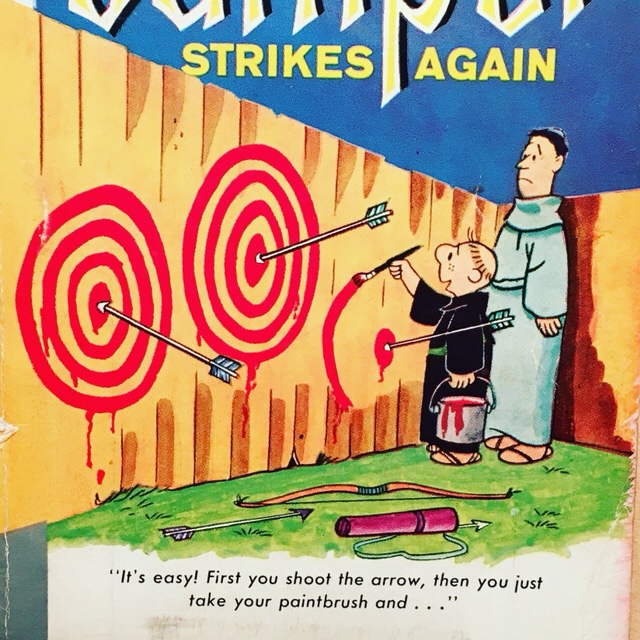
It's so easy...
first you shoot the arrow..
..then you paint the target
Retroactive justification.
When the UN's traditional anti-Israel blocs want to level a particularly inflammatory accusation, they package a predetermined verdict as the result of an "independent inquiry." The only real investigation appears to be finding new ways to manipulate methodology, ignore inconvenient facts, or recycle outright falsehoods in service of a conclusion that was decided in advance. The goal is not to discover the truth, but to give a political narrative the appearance of due process.
For decades, it is difficult to find a single UN statement on Israel that did not cast the country in a negative light. The pattern is so consistent that claims of impartiality have long since lost credibility.
Not to mention such COI propaganda by outrageous bigots peddling the "Jewish control" [2022 by Miloon Kothari, 'working' with Navi Pillay in 2025] tropes in its false "genocide" slur.
Sounds like “progressives” here in this country.
Since the 1970s. There wasn’t one impartial UN body when it comes to that country.
Its UNRWA has been heavily involved in Oct 7 atrocities. See also https://unwatch.org
The UN is dominated by the OIC (Organization of Islamic Cooperation). The OIC has oil money 💵 money 💰 money 💴. Just ask Tucker Carlson!
“To be sure of hitting the target, shoot first, and call whatever you hit the target.” — Ashleigh Brilliant
Right
True. Thebl 59 Islamic nations bloc
Report: U.N. “experts” accepted funding from China, Russia, Qatar, pushed their interests
May 26, 2026.
pinned, Reports
From Watchdogs To Ideologues: How Politicized UN Rapporteurs Are Subverting Human Rights.
Executive Summary:
In November 2006, UN Secretary-General Kofi Annan described the system of Special Procedures as “the crown jewel of the UN human rights system.” Nearly two decades later, that jewel has lost much of its luster—tarnished by politicization, disregard for impartiality, and a complete failure of accountability to minimal norms and professional standards.
The Human Rights Council today maintains 59 Special Procedures mandates—46 dealing with global themes, and 13 addressing specific countries—an increase of nearly 30% from when the Council was created in 2006. Although Special Procedures are unsalaried, they receive certain financial support when carrying out official duties, including UN funding for country visits, as well as training, staffing support, and other institutional resources.
Mandate-holders are granted a global platform from which to issue UN press releases, hold press conferences, and publish UN reports. While their findings are not legally binding, they can significantly shape public debate, influence UN discussions, and inform how governments, media, and civil society interpret a wide range of policy issues and alleged human rights violations. Their reports are widely treated as credible and authoritative by institutions such as the International Court of Justice and the International Criminal Court, as well as by governments, media outlets, universities, and civil society actors worldwide.
Reports by the Special Procedures “have a weighty doctrinal authority,” according to the European Center for Law and Justice (ECLJ), and are “very often referenced by national and international bodies, in particular by courts.” As of 2021, the ECLJ had identified 140 judgments of the European Court of Human Rights referring to reports by the Special Procedures, as well as numerous references in the judgments of the Inter-American Court. Their influence is therefore significant.
Mandate-holders are treated by leading institutions as neutral experts and are regularly invited to address prestigious international forums and academic institutions. Significantly, the UN affiliation enables them to leverage that authority across social media and international media appearances, where their statements are presented as reflecting the voice or expertise of the United Nations. Though their UN press statements carry a footnote indicating that the experts are “independent,” their remarks are routinely cited as representing the United Nations organization as a whole.
Yet, like the body that appoints them—the 47-member Human Rights Council, a majority of whose members are non-democracies—the Special Procedures have become politicized. The mechanism increasingly functions not as an independent human rights safeguard, but as a vehicle for ideological advocacy, selective targeting, and the laundering of unverified and even spurious allegations through the authority of the United Nations.
Academic scholarship overwhelmingly praises the Special Procedures system. In a leading book on the UN’s Special Procedures, Ted Piccone of the Brookings Institution praises them as “catalysts for change” whose independent status enables them to play a “critical role in shaping the content of international human rights norms.” According to Piccone, the Special Procedures mechanism is “one of the most effective tools of the international human rights system,” which “deserves further strengthening and support from the international community.” He advocated increased cooperation and financial support from governments.
Similarly, NYU legal scholar Philip Alston, who himself served in multiple mandates including as the UN Special Rapporteur on extreme poverty, characterized Special Procedures as “the Council’s most effective mechanism” for responding to human rights violations and holding states to account. He praised their “impartiality” and contribution to interpreting international human rights norms, asserting that some of the experts’ reports had a “major impact.”
Likewise, according to American University’s Ingrid Nifosi-Sutton, the Special Procedures represent “a tremendous development in UN activity in the field of human rights” and “the climax of the legal and political empowerment” of the UN Commission on Human Rights, which was created in 1946, and then refashioned in 2006 as the Human Rights Council. She argued that the central challenge was to make UN human rights monitoring a “proper technical and effective endeavor,” a goal she concluded Special Rapporteurs ultimately achieved, particularly through country visits, reporting, and urgent appeals. According to Nifosi-Sutton, this success placed Special Procedures “at the front line of the international struggle to extend the rule of law.”
This report finds, however, that the reality of the Special Procedures system increasingly diverges from the admiring scholarly assessments. Rather than operating as independent and impartial experts, many mandate-holders now use country visits and thematic reports to advance politicized narratives, disproportionately target democratic states, and shield authoritarian regimes from scrutiny. As detailed below, structural deficiencies—including politicized appointments, proliferation of mandates, weakened evidentiary standards, lack of transparency, and the absence of accountability—have eroded the credibility and integrity of the system in practice.
https://unwatch.org/report-u-n-experts-accepted-funding-from-china-russia-qatar-pushed-their-interests/
https://justsayingitoutloloud.blogspot.com/2026/06/do-these-pro-hitler-holocaust-cheerers.html
‘Do these — pro-Hitler, Holocaust cheerers, Holocaust deniers, neo-Nazis — accuse Israel with that (false) “genocide?”’ AI: Yes
AI Mode Conversation
You said:
Do these — pro-Hitler, Holocaust cheerers, Holocaust deniers, neo-Nazis — accuse Israel with that (false) “genocide?”Do these — pro-Hitler, Holocaust cheerers, Holocaust deniers, neo-Nazis — accuse Israel with that (false) “genocide?”
- Yes, these groups aggressively accuse Israel of “genocide.” For extremists like neo-Nazis, pro-Hitler activists, and Holocaust deniers, this is a calculated ideological strategy known as Holocaust inversion.
By flipping the moral roles—accusing the Jewish state of behaving like Nazis against Palestinians—they attempt to psychologically minimize or shift the blame for their own antisemitism.
1. “Even the score” and relativize history:By falsely claiming Israel is committing genocide, these groups attempt to lessen the unique historical weight of the Holocaust. The underlying rhetoric is that “Jews have their own genocide committers, just as we [the Nazis] had ours,” which helps legitimize their extremist beliefs and normalize fascism.
2. Attack Israel’s legitimacy:Extremist hate groups fundamentally oppose the existence of a Jewish state. According to the United States Holocaust Memorial Museum, Holocaust deniers use this false genocide narrative as an active tool to delegitimize Israel, linking the event to fabricated conspiracies about Jewish power and world control.
3. Shift moral responsibility:The American Jewish Committee and the Anti-Defamation League detail how weaponizing the word “genocide” allows anti-Jewish extremists to shift the blame for antisemitism. By accusing the very victims of the Shoah of carrying out the “crime of crimes,” these groups attempt to invert history and place the responsibility for human rights abuses squarely on the Jewish people.
Disclaimer: Opinions posted on Free Republic are those of the individual posters and do not necessarily represent the opinion of Free Republic or its management. All materials posted herein are protected by copyright law and the exemption for fair use of copyrighted works.