Transcript (looks like my time index was way off)
try: https://www.youtube.com/watch?v=XAPGq_Q-AI8&t=321
Hello, it’s Scott Manley here. On Tuesday, NASA had their big Artemis 3 event... Let’s start talking about the mission. And right away, this is going to be a long endurance mission for Orion to really test its environmental control and life support system. And guess what? That’s actually a mission where having big people on board actually helps to really stress the system. So, having four big dudes is actually technically an advantage for this particular mission.
I’m not sure that actually fed into the, uh, actual crew selection in any way. I’m just pointing it out. But this will be the third flight of SLS, and right now they are stacking that rocket. They are going to have a special spacer built which will replace the upper stage because they don’t need the upper stage. They’re not going beyond low Earth orbit. Currently, the mil panels for that are being bumped formed by ULA, and they will be shipped over to Marshall where they’ll be welded to basically fill in the gap and keep the rocket the correct size so it can interface with the launch tower.
Now, as you’ve probably seen with previous SLS launches, they’ve had some issues with the umbilical seals on the tail service mast. So, those are being redesigned. And as part of the testing for this, they’re actually going to roll out a partially completed stack for a wet dress rehearsal. Basically, it’s going to be the core. It’s going to be the side boosters. There’s not going to be Orion sitting on top of this, but they’re going to interface it. They’re going to check that the seals work. They’re going to fuel it up, verify this well in advance of actually needing to roll it out for a launch.
But before SLS launches, Blue Origin are going to launch their part of the mission. Their HLS, their Blue Moon at Mark 1 and a half, some people are calling it. And there’s a good reason because it’s not a Mark 1, it’s not a Mark 2. It’s very much an in between. And if you look very carefully, you’ll see that it has sort of like the pressurized capsule from the Mark 2, and it has some other stuff on top that we’re not sure where it came from. What they did say is that it could stay in orbit for 90 days. And so that would give, you know, 3 months after it launched when SLS could actually launch to rendezvous with it.
And if you remember, we had these like monthly launch windows that were available for Artemis 2. For Artemis 3, it’ll be in a 33° orbit, which means they should have like one launch window a day with a fair amount of flexibility in that. So this will not be a final product, but it will include many parts of the final product, and the astronauts will in fact be able to board the spacecraft unlike say the Blue Moon Mark 1.
So most of the presentations were just like talking about stuff, not showing any new imagery, which is why it’s a great time to come back to Kerbal Space Program and actually try to show you a bit of this mission. So this is basically the same rocket that I used for the previous one where I did Artemis 2. Uh, however, I have emptied out the second stage. There’s no engine on it, right? There’s no propellant. Instead, this is a dummy rocket. While the second stage doesn’t carry propellant, it may have to carry some mass to ensure like the center of mass is correct during the launch. That can be really critical for dynamics, uh, of the rocket, right? If the center of mass moves too far back, it becomes less stable.
Another interesting thing to note is that the avionics and computers that control the SLS core sit at the top of the booster. But if the, you know, the exploration upper stage which had been in development and is currently canceled, the avionics would have moved to the top of that. So because we have the sort of older booster style, they will still be able to do this without having to move the computers into this dummy second stage. So the SLS core has more than enough performance to put the Orion spacecraft into orbit. Uh, it will put it into a slight suborbital trajectory so that the booster itself will carry on and then de-orbit on the other side of the planet while the Orion spacecraft will, you know, separate and then it will immediately light up its propulsion system so that it actually injects itself into the target orbit which should be like 250 nautical mile 33° inclination orbit in the same plane as the target, right, the Blue Origin Mark 1.5.
And so soon after, the Orion spacecraft will begin phasing orbits where it will try to synchronize its orbit with the target vehicle and eventually perform a rendezvous. And so this is where all those test piloting skills will come in useful because they’re going to be performing proximity operations, uh, with respect to this Blue Moon target which is going to have broadly some of the characteristics of the Mark 2 lander, but they won’t quite be there. The plan is, however, at some point that they will in fact demonstrate docking with that spacecraft and ultimately board it.
So I want to talk a little more about what I think the Blue Moon 1.5 spacecraft is. First of all, we’ve heard like Eric Burgerer did an interview the day after which included some really important information saying, for example, the Blue Moon test lander won’t have any cryogenics on board. So it’s not going to have like the BE7 engines. It’s not going to have the hydrogen or the liquid oxygen on there, but the space that is taken up like by that, you know, tank structure that sits on top of the pressure vessel, that’s presumably going to have something to help control it. We can visibly see that there are reaction control thrusters up there. It’s going to need some sort of propulsion for like de-orbiting.
So, I suspect that Blue Origin will try to take stuff that they already have in development and try to use that to build out this structure. And the most logical thing that Blue Origin have been building is Blue Ring, which is supposed to be a spacecraft bus for other satellites. I fully suspect that they can just dress this up in the correct shape. That’ll include the power, the avionics, and of course the propulsion, which the spacecraft is going to need. And while Blue Ring does have like an electric propulsion capability, I’m not sure they’re going to use that in this case.
I think more likely they’ll just go with their standard bipellent, you know, hypergolic thrusters. That would make a lot more sense. They’ve also said that the pressure vessel used will be the same design or at least is very close to the Blue Mark 2 design, but the Mark 2 design, as we understand it, is like donut shape with a channel down the middle to run propellant lines in the engines.
I’ll bet that there’s no engines on it down there. I don’t think it needs them. They have, however, stated that it will include the environmental control system. So, the astronauts will be able to board it, stretch their legs, and get some room after all, four big guys, you know. Uh, they need their space in space. Uh, it looks like it has some thermal radiators on one side. So I presume that is part of the environmental control system rather than the system which is used to keep the cryogenic fuels cold because, after all, there’s no actual cryogenics on this flight. That’s how they get the 90-day endurance.
So for the main engine propulsion and stuff, that stuff is all going to get tested on Blue Moon Mark 1. This here is testing basically the stuff that can’t go on that, and it is a poor approximation, but it is definitely better than having no test at all. Also, talking about the space suit test, if they would do that, they would be basically putting on the suit and checking it out, making sure that it works in the lander pressure volume rather than doing that inside the cabin inside the Orion because the Orion doesn’t really have enough room to get all that stuff going on. Now, they might even be able to proceed to an EVA, but I don’t see any comments that suggest that’s going to happen. Although, it is a possibility. After all, they would have to be performing an EVA out of the hatch and the pressure vessel on the Blue Moon Mark II. So, it’s not beyond uh you possible that this actually happens. So, they’ll have two weeks on orbit to do this. And I’m presuming there’s no reason for them to undock from the Blue Moon, you know, mockup until they know the Starship is basically there for the next part.
So Starship, yeah, that is going to be an altogether different beast. By the sound of things, the SpaceX representative, she literally said, “We will take a V3 Starship off the line and add a docking port.” That’s what we heard. And our first thoughts were immediately, “Oh, so they’re just going to take a Starship and slap a docking port on the back because that would be the easiest way to do it.” And honestly, that sounded pretty lame. I mean, sure, Blue Origin’s half, you know, mockup or whatever isn’t close to being the full thing. It’s a long way from what we expected for Artemis 3 originally. Uh, but you know, SpaceX saying that they’re just putting a docking port on an existing V3 Starship does even seem to be even lower effort.
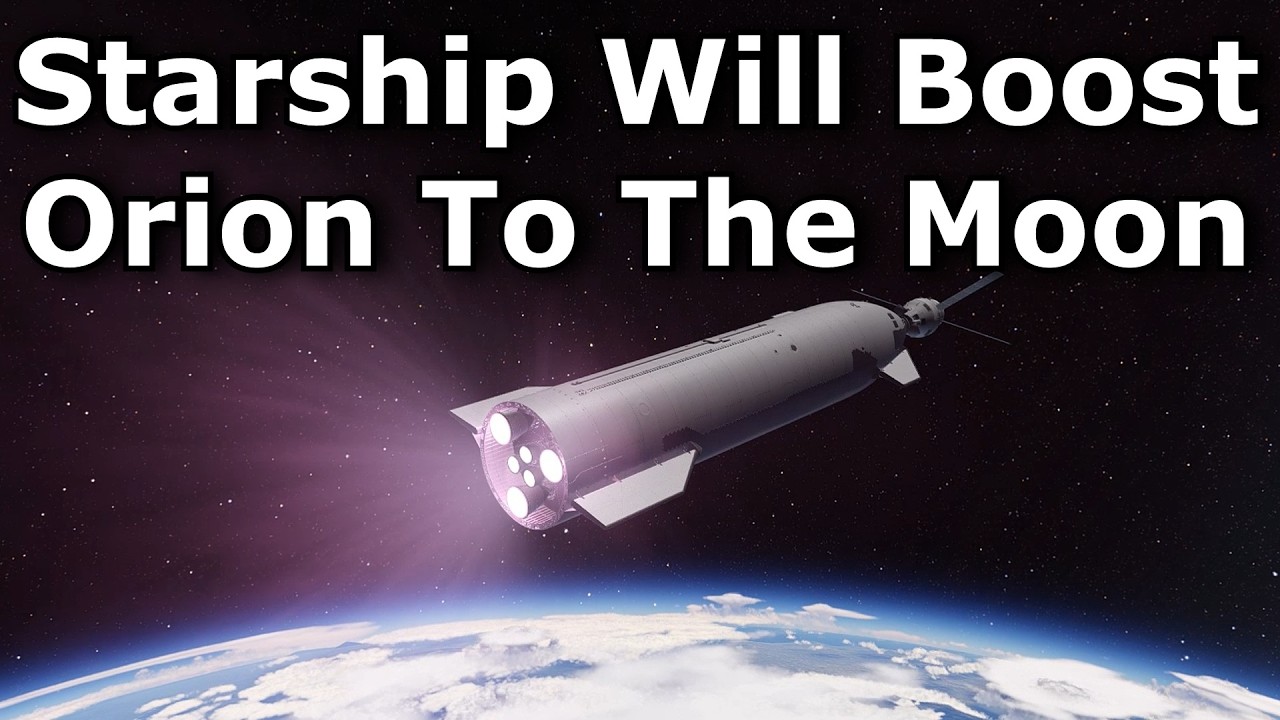
However, since then we’ve heard a few more other things and specifically comments about testing the effects of negative acceleration along the docking interface. And that sounds like a bunch of words. What it means is Starship’s new lunar landing plans involve meeting the Orion spacecraft in low Earth orbit, docking the Starship HLS hardware, nose to nose with the Orion, and then using the propulsion on Starship to bring Orion to lunar orbit, perform the landing, and then have, you know, Orion return to Earth using its own propulsion. And that is definitely a radical change from what the original Artemis 3 concept would have been with the whole near-rectilinear halo orbit and all that. Uh, but that would mean if they wanted to test this negative acceleration, they would need to have the docking port on the nose. And that does lead me to ask what do they mean by taking a stock V3 Starship? Because on the nose of the Starship, you have the heat shield tiles and underneath that you have the nose cone. And obviously underneath that you have the header tanks which are kind of essential for balancing the spacecraft during the re-entry and providing the, you know, fuel for relighting the engines in space. So how would they put a docking port on there? Are they going to attach this outside the heat shield and, uh, like add a fairing to cover it up during launch? Are they going to actually build a completely custom thing? That doesn’t sound like what they’re going to do. So, uh, yeah, there is a mystery as to what exactly is going to go on here.
But what we do know is that while they are going to dock with this and again perform the sort of flyarounds, the proximity operations to make sure that the two spacecraft can work together and maintain attitude. It does sound like there will be nothing behind the docking port. It will be basically an anchoring system for the two spacecraft to join together, meet up, and the crew get to look at Starship from the outside. They don’t actually get to board it because there will be nothing in there other than an empty void. And I mean literally empty, it would probably be a vacuum.
So anyway, this spacecraft, since it’s a V3 Starship and it uses the cryogenic propellant, apparently it is only able to stay in space for like 2 days and satisfy the requirements. So they would have to launch after the mission got to space. They would be launching into the same target plane. Then the intercept maneuvers would happen. The two spacecraft would dock and after the mission, you know, the performance and everything had been verified, which could well include lighting the engines to show what happens to the spacecraft. And of course, the spacecraft is set up in such a way that the crew would be facing towards where the engines are firing. They would be getting pulled down outwards from their seats. That would be eyes-out acceleration. That could be very uncomfortable on the crew.
But primarily NASA would be interested in verifying that the structural integrity of the docking port and everything was able to handle the load on the service module and all that. There is also the question of are there any systems in Orion that are able to handle this negative acceleration? Anything with fluids is going to fall in a certain particular direction. You know, will the toilet spill? Obviously not. But you could imagine that it’s not designed for this.
The service module is particularly critical. It has been designed for 1G loading. It has been designed for zero G loading. But how will it handle negative G loading? They need to know that that is 100% going to work before they perform an engine test which could potentially, you know, put the spacecraft in a configuration that was not designed to handle. And of course, this is me looking in as a casual outsider with some knowledge. There are thousands of people that work on these specific systems that know them intimately and they have their own very detailed questions and understanding of what might happen and what needs to be tested. And that’s what Artemis 3 is all about. And it does seem like very much a downgrade from what was originally announced in Ignition, but all the same, everything they’re doing here is definitely very useful in advancing towards Artemis 4.
I also believe that this could be only the second time that a single spacecraft has docked with two other spacecraft in orbit. The first time would be, uh, Soyuz which visited Salyut and then Mir because they were moving hardware between those two space stations as Salyut was being decommissioned. Like Earth orbit rendezvous for lunar missions always seems to make great sense on paper until you understand the logistics of how many different spacecraft you need to manage and get into the same place. It becomes surprisingly less trivial when you have to coordinate multiple launch vehicles and spacecraft.
But it does seem like a downgrade again having these sort of stand-in pieces of hardware that have been cobbled together in a limited amount of time to satisfy certain minimum criteria. It does feel a bit like the Soviet Vostok program where they basically built two slightly better Vostoks to, you know, score the first time they had three people in a spacecraft and the first spacewalk. And in both those cases, it felt very much like the engineering was being driven by the propaganda, the prestige requirements rather than, you know, the actual engineering requirements. Only in this case, the story they’re trying to tell isn’t about like international prestige. It’s all about how, you know, NASA and its partners can actually execute quickly and make things happen.
We’re 2 years past, uh, the original 2024 lunar landing goal and SpaceX still haven’t shown us anything from Starship Lunar Starship other than a few renders because, of course, SpaceX have been far more interested in working on the giant launch vehicle, the fully reusable capability which will absolutely revolutionize spaceflight if they can make it work. And the HLS system very much relies on it. Perhaps not working on it too early was the best decision. But, um, yeah, uh, interesting times indeed. I hope to find out more about Artemis 3. I really hope that we don’t get to next year and we find that either Blue Origin or SpaceX have to skip the mission for some technical reason.
Blue Origin are obviously dealing with their launch site rebuild and SpaceX are dealing with, you know, trying to build the biggest rocket in the world and not have it explode. Either way, I wish them all success and look forward to Artemis 3. I’m Scott Manley. Fly safe.