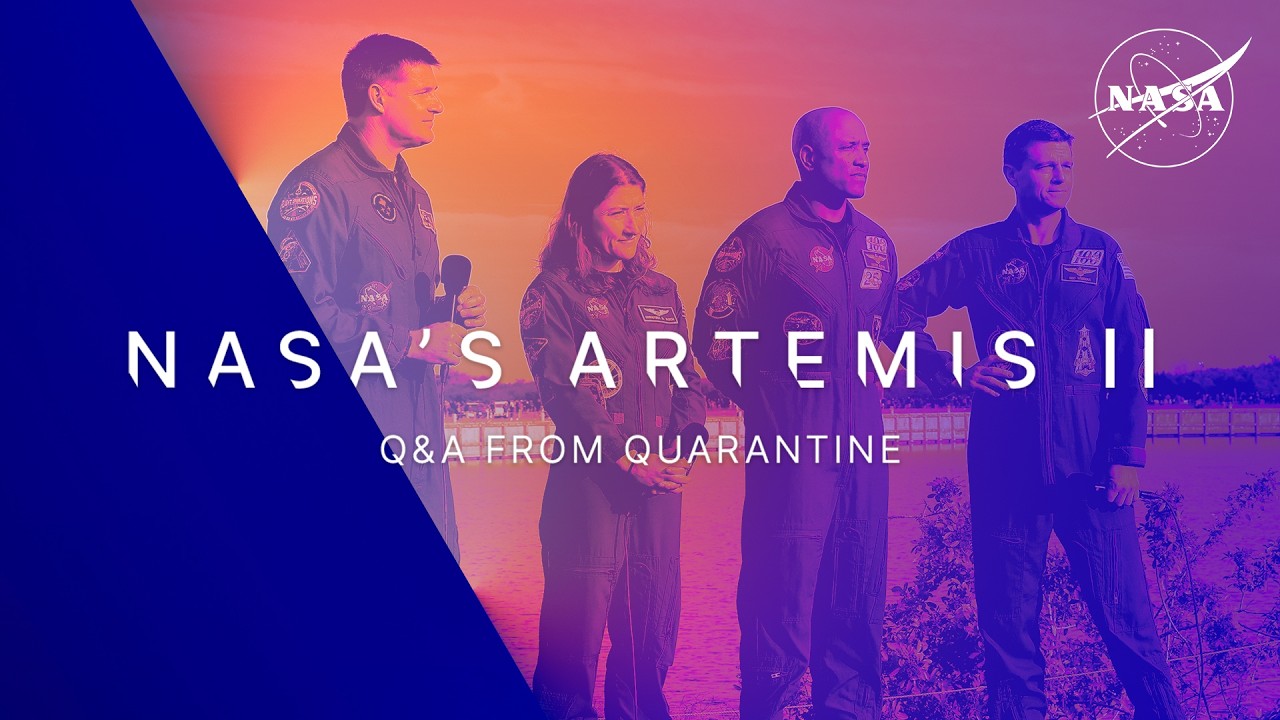
Transcript (via https://textformatter.ai/app ) [the 2500 word limit means it took a bunch of cut and paste chunks, and the AI got fancier in one spot for whatever reason]
You’re looking live at Launch Pad 39 B, where in just a few days, NASA’s Artemis Two crew will lift off to begin their journey around the moon. Good morning, and welcome to NASA’s Kennedy Space Center for our Artemis Two crew news conference. The crew is joining us virtually today from astronaut crew quarters and will begin taking questions shortly. But before we get started, I’ll toss it over to the crew for some opening remarks. Read, take us away.
>> Thanks, Courtney. It’s great to hear your voice. Great to see the rocket on the television. I know we’re here at the Kennedy Space Center, and every chance we can, we’re going out to pad 39 B and just looking at that amazing vehicle that this incredible team has put together. I’ll hand it over to Victor.
>> Good morning. It’s great to see you virtually and looking forward to answering all your questions. >> Good morning everyone. Things are certainly starting to feel real here at the Cape. Our families joined us yesterday and we had a chance to be on the pretest brief for the actual starting of the launch countdown. So we’re excited to be a part of all that, and we’re excited to share with you today. >> It’s really a cool feeling. Right now we’re just down the hall. Our spacesuits. Since we got here, we’ve done a dress rehearsal, if you will, getting into the suits and with the families arriving yesterday, pretty special to take them out to the pad, show them the rocket in the daylight. And then again, all lit up. And it’s spectacular beauty at night. So back to you, Courtney.
>> Thank you all. We’ll go ahead and begin our Q&A portion of this news conference. Our first question comes from Irene Klotz with Aviation Week. Irene, if you’re talking, we can’t hear you.
>> Hi. Can you hear me? >> Now we have you loud and clear.
>> Great. Thank you. My question is for Reid and Victor. Correct me if I’m wrong, but I don’t think either one of you had the opportunity to do any manual flying on your Soyuz and Dragon flights, respectively, and I wanted to just ask a little bit about the Proximity demo that you’re going to be doing. If you can describe in some detail who is going to be doing what part of that exercise and what you are expecting the manual control of Orion to be like, thanks. >> Thank you.
>> Well, I’ll answer the first part of that with on the Soyuz, we have to do a hand controller checkout and a thruster checkout when we first get to space. And the Russian commander always does that from the center seat. But in the left seat, I was right next to our translational hand controller by my right knee. And Max Sorayab looked over at me and winked. It was like, go ahead and just give it a tap. So I have flown a spaceship manually and I can tell you it’s pretty awesome. Viktor talked about our pod.
>> It’s actually a really important evolution. You know, we have to make sure that the Artemis Three and Four missions have this capability. And so we are essentially going to make sure that the vehicle flies the way that we think it does, that we designed it to do. And so we’re going to not only fly the vehicle manually, we’re going to execute the six degrees of freedom. So translating forward, backwards, left, right, up and down. And then also being able to rotate, pitch, yaw, roll, and pitch on roll. But we also want to give qualitative and quantitative feedback to the ground team. So letting them know what it feels like now that we can hear and feel the thrusters and to just understand the human experience.
And so one really interesting thing that’s going to happen during the Proximity operations demo, where we’re going to start out probably beyond 100m and get all the way in as close as ten meters at some point in the demo is to give them feedback. So verbal feedback. And so we’re actually going to switch seats. Reid is going to launch in seat one. I’m going to launch in seat two. But we’re going to take our suits off. And then we’re going to get back into each other’s seats. And he’s going to run the procedure while I fly the vehicle primarily. But I’m also going to put my communication system, actually his communication system on voice activation, so I can just talk to the ground continuously. And so the ground team can hear from the crew. It’s really a crew experience to fly that vehicle, but to give them feedback on essentially, hey, this flies like the simulator or this is how it’s very different from the simulator, so that we can verify and validate the models for training the later crews.
>> I want to add one thing I just want to add to the end of that is it is Victor in seat one. And I will be in seat two. But this is a crew activity through and through. And so Christina will be floating right to Ike’s left to Victor’s left. She is really in charge of the timing, discipline, and the procedural discipline, maintaining the big picture to make sure we get through this safe and if we have any off nominal. She is right there with all of our off nominal steps to get us back on track. And then Jeremy will be floating just to my right, and he is always watching the interim cryogenic propulsion stage. If anything goes wrong with that stage out the window or on the displays, he’s ready to call it back away and get us back into a safe configuration. So it is. It’s all four of us at the controls for that evolution.
>> I have one more thing. >> And oh, grab the wrong mic. But I wanted to add that of course, Prox Ops is really exciting because we are practicing the rendezvous. We get within ten meters of our upper stage rocket. It’s amazing. But there will be another activity where we manually pilot the vehicle on one of our cruise days, so you can stay tuned for that as well.
>> Okay. Our next question is from Bill Harwood with CBS News.
>> Hey guys, it’s great to see you all again. Take you off speaker. It’s great to see you again. My question is absolutely non-technical. You know, the other night I was picking up some takeout food from Tai Tai and Cape Canaveral, and it was a crystal clear night, and I was looking up at the moon, and I don’t normally think this way. I don’t like the moon. I’m an amateur astronomer. I like it out of the sky so I can see the dim stuff. But I kept thinking about you guys saying I couldn’t imagine actually going there. You know, I was trying to picture that in my mind as I was looking at the moon. So I hate to make this long question, but I mean, could a couple of you just talk about it? You’re bound to do the same thing. Look up and have some thoughts. What are your thoughts as people who see the moon as a destination, not just a bright globe in the sky? Thanks.
>> So yesterday we spent some time with our geology team lead, Kelsey, just going over the plan. And depending on which launch day we launch in this window, you know how that changes. But looking at some of the details that we’re going to be examining and the things that they’re interesting and interested in specifically, different colors are just different shades, variations in the albedo of the moon. They’re very interested. We look at it from different angles and different lighting. And so we look at it with sort of under this microscope all the time. And then every once in a while, I step back, sort of like you did last night and just look at it. And I really feel like, gosh, that is really far away. And it just gives me a great appreciation for it. And in the night sky, I spent a lot more time looking at it through binoculars in my backyard, sharing that with my family. We’ve got the binoculars here and hopefully we’ll get some clear skies. They weren’t last night, but for us. But hopefully we’ll get some clear skies and some good viewing.
But the other thing we focused on quite a bit as a crew is just listening to other people’s perspectives on the moon and how different cultures look at the moon. And when we go back honoring just how humanity we all share the same moon in the sky, but honoring humans around the world and how they revere the moon. It’s really important to us. One thing. Yeah.
>> Bill, one of the things you said right at the end of your question was, how do we feel as the people that can call the moon a destination, not just something we’re looking at? And it is our strong hope that this mission is the start of an era where everyone, every person on earth, can look at the moon and think of it as also a destination.
>> Our next question is from Jonathan Siri with Fox News.
>> Thank you so much for taking the time to the entire crew. This question is for anyone who’d like to talk about space medicine. What excites you most about what you’ll be able to study beyond low Earth orbit, and how will it inform future deep space missions?
>> I’ll start with it’s going to be a touch off topic, but the camera that Artemis Three will take and Artemis Four will take to the surface of the moon is going to be a Z9 by Nikon. And we fought pretty hard to get just that camera on board to see what is the radiation environment in deep space going to do to the sensors on that particular camera, so that we can learn about that. We have science experiments on board that are going to be looking at our own cells in our body, and also on little test kits. So we’ll be able to compare that when we get back. We have radiation sensors in the vehicle that are going to be monitoring the radiation environment for the entire ride out and back. And then we also are going to go into most likely if we launch on the first or second, we’ll go into an eclipse period, which will be very stressing for the power and thermal systems on our spacecraft. It’s not really a scientific benefit there, but it’s a huge payoff to our modeling and what we’re going to look at for Artemis Three and Four. I’ll see if anyone else wants to talk some of the details.
>> I just wanted to add that, you know, one of the things that the future Artemis missions are going to do is actually to work on the surface of the moon. And so we also have a fantastic team of exercise folks and operational psychologists that we’re going to get to talk to. And even though this mission is not going to the surface, we are starting some of the processes that we think are going to help them be successful physically, emotionally, and mentally in getting ready for service work. >> Great.
>> Our next question is from Micah Maidenberg with The Wall Street Journal.
>> Hi. Good morning all. Reid, I’d like to ask you to reflect a bit on your role as mission commander. I imagine you may have to make some final calls or tough calls during potentially challenging moments of this flight. Just talk about how you prepare for this job and that responsibility. Thank you so much.
>> I say it every time I get asked this question. I’m flying with Viktor, Kristina, and Jeremy. We have the best crew that you can put together from NASA and the Canadian Space Agency here. So we really have broken down the specifics of this mission across all four of us. There are times when I have responsibility. There are times when others have the direct responsibility. But at the end of the day, every ship needs a captain. And I’m ready to make those decisions. But I’m not making them in a vacuum. I can just watch my crewmates here. I know their facial expressions. They know mine. We know when we’re tense. We know when an immediate decision needs to be made. But the biggest thing that we try to remind ourselves every single time we fly, we say, no fast hands in the cockpit. You do not want to do anything too quick in this vehicle. You need to take your time. You need to process everything. Almost always, it pays bigger dividends to move forward than to go backwards. So no fast hands in the cockpit. We’re going to go slow and we have the ultimate trust in each other. And that’s how we will get through this.
>> Our next question is from Ken Chang with The New York Times.
>> Hi. Thank you. At the very top, Christina said it’s beginning to feel real for the first couple of sets of launch opportunities. You didn’t even get down here. So I was wondering if you could just sort of describe how you feel being quarantined and seeing the rocket on the launch pad and the weather forecast looks good. It looks promising. Thank you.
>> It’s great to be here. I think everyone in the crew office loves coming to Kennedy Space Center. It’s kind of like a, you know, pilots love to be out at the airfield and see airplanes. And so a place where space missions start and some finish is a pretty special place, but it is also just need to be here with this team that has really crushed it. The exploration ground systems, the folks that have gotten the vehicle ready and repaired, the things that need fixing and to watch them really maintain that schedule and to get that rocket into the VAB and back out to the pad. It’s also good to be out here with them and to share some time with them. We spent a lot of time working with our team back in Houston, the flight control and engineering teams that have helped us analyze and proceduralize this mission. And so now it’s cool to be out here with the team that’s, you know, has been maintaining and preparing the rocket. And it’s good to see it. And every day that we’re here is the first time that we’re doing this. And so, you know, we are exploring on this timeline as well. And it does feel good.
>> I want to add one thing. I want to add one quick thing just to remind everyone, this is a test flight. This is the first time we’re going to try. This is the first time we’re loading humans on board. And I will tell you, the four of us, we are ready to go. The team is ready to go and the vehicle is ready to go. But not for one second do we have an expectation that we are going. We will go when this vehicle tells us it’s ready and when the team is ready to go. So we might go out to the pad and we might have to try again a few more times, and we are 100% ready for that.
>> Our next question is from Anthony Leone with Spectrum News.
>> Good morning. Thank you so much for taking our questions. There are so many firsts here for this mission. The first commander of a returned manned mission to the moon. The first black man, the first woman, the first Canadian to visit the moon. What do these firsts mean to each of you?
>> It’s a great question. It’s one that we really do think about a lot. We always say that, you know, we are not doing this for the superlatives. We’re doing this because it’s a unique opportunity. We are going for all and by all. This is what NASA embodies. This is what the space program around the world embodies. And we’re proud to be a part of that journey. I think what’s neat to me about that question is each one of the four of us. We carry a whole lifetime of experiences and perspectives. And when you get us together and we’re in a geology class looking at the moon, you really start to see those all come out. Like the way I was raised as a child is different than the way they were raised, the different influences on our lives, different mentors, different heroes, different interests, and all those differences start to come out in the way we view the science objectives of the mission, and they come out in the way we view the technical hardware. So honestly, for me, it’s just an honor to get to watch the way everybody brings their unique perspectives.
>> It is a big question and I want to highlight, I guess maybe one facet of this is the tension. I call it, I live in this, you know, this dichotomy between happiness that a young woman can look at Christina and just physicalize her passion or her interest, or even if it’s not something she wants to do, she can just be like girl power. And that’s awesome. And that young brown boys and girls can look at me and go, hey, he looks like me, and he’s doing what? And that’s great, I love that, but I also hope we are pushing the other direction that one day we don’t have to talk about these firsts, that one day this is just, and I listen to this, that this is the human history. It’s about human history. It’s the story of humanity, not black history, not women’s history, but that it becomes human history.
>> Yeah.
>> Like everything I’ve heard from my crewmates really resonates. Thank you guys for those amazing words. Something to add is that although it is something to celebrate a bunch of firsts, that’s definitely not necessarily telling the whole story. And it’s also not about celebrating any one individual. If there is something to celebrate, it’s that we are at a time when everyone who has a dream gets to work equally hard to achieve that dream. And we’re at a time where we’ve recognized the importance of. If we are not going for all and by all, we aren’t truly answering all of humanity’s call to explore. That, to me, is what’s worth celebrating.
Space Mission Discussion
There’s so much here and all that really resonates deeply with me. You know, something maybe slightly different from my perspective is what you’re seeing here is, yes, a Canadian is going to go into deep space. And that’s an extraordinary thing because of our American space leadership that curated that. But I hope others outside of Canada feel part of this too, because this is just an acknowledgment of anybody who shows up and is able to contribute something meaningful to our future endeavors can be part of this mission.
And so I hope the Commonwealth feels or sees themselves in this mission. I hope all the international partnerships see themselves flying on this mission because they truly are. And it’s just been an extraordinary journey for me. It’s kind of broadened my perspectives as an astronaut, too. I’m wearing a Canadian patch here that was designed by an Anishinaabe artist in Canada, and it just represents some of the beauty of indigenous culture and their perspective on the moon and the seven sacred laws, and just the richness of doing something together and how inviting that is. It’s shocking to me, but pleasantly surprising how many people show up and are going on the mission with us. It’s not just three Americans and a Canadian. It is people literally around the world. And it’s a beautiful thing. And we’re going to go do something very real, very challenging, and that’s what will make it inspiring.
Questions and Answers
Will Robinson-Smith with Spaceflight Now
Hello all. It’s good to see you again. Going back to the point about preparation versus expectation. You know, the TLI burn is really the big moment that sets you on the course towards the moon. But Christine, you mentioned that there may be the possibility for a U-turn, you know, return after that point. So I wonder, can you talk about what is truly the point of no return once you’re heading towards the moon? When is the last moment that you can say if there is an issue, we’re going to, you know, swing it on back to Earth and what that actually entails. Thank you.
Response
Great question. Yeah, thank you for bringing that up. We do live in a world of preparation without expectation. We’re ready to go. We’re also ready to stay. And yes, that includes all the way even past TLI. There’s a saying in the astronaut office that you have, you know, you can’t say you’re going to space until after MECO (main engine cutoff) for us. You know, you can’t say you’re going to the moon until basically the mission is over.
Well, there is actually a technical answer to your question, and it involves our spacesuits because our suits are not only suits, they are survival systems. They have been designed to keep us alive in the case of a cabin leak for up to 144 hours, six days. And what that means is the entire mission, including our abort options, have also been designed around that six-day mark. So as long as we can get back in six days, we can take an abort option. We could or we could continue around the moon. So that’s really, I think, the more technical answer to your question.
Charlotte Cosset with AFP
Hi. Thank you so much for taking the time to answer your questions. And my question was about the final hours before launch. I wanted to know, how will you spend those hours before launch and the day itself? Do you have any personal or team rituals to help you stay focused or relaxed?
Response
Like you know, it is actually a very long day. We start that we wake up about eight hours before launch, and there’s a pretty tight schedule of things to get out there, some of which you’re going to see when we walk out of the Neil Armstrong Operations and Checkout facility crew quarters and come out of that elevator that you’ve seen crews come out of for years. It’s amazing to be here and get to do that, but that day, it’s because that schedule is so tight. You know, there is not a lot of time for personal rituals, I would say.
But before I fly an airplane, I generally say a very short prayer. And then I try to send my family a note to tell them that I love them. And so one of the neat things about this is a tradition we started is our families are outside the building when we walk out. And so that is the moment that I’m going to get to tell them I love them. Instead of sending a text message or a phone call, I get to tell them I love them and I’ll still say my prayer before we all get into the vehicle. And then that way I can focus on that timeline and making sure that the launch control team is not waiting on us, the crew.
Christopher Mic with Hudson Star Observer
Good morning. Thank you for taking the question, and best of luck to all of you on this mission. I wanted to ask a little bit on a procedure during your training, you’ve encountered that’s been the most difficult to kind of simulate on your Earth-based simulators that you’re kind of looking forward to or hoping to get some data back. They’ll be helpful on orbit or in space to yourself in the future Artemis crews.
Response
I think Christina will take the second half of this. One thing that we really have realized, I love this question. It actually got us thinking. But one thing that we have noticed is that as we go through all this is the first flight and not every procedure to the best of our verification method is sound. It’s 100% ready to go. We should be able to run that procedure without any misgivings. But we have found that this is a first flight. And basically every time we send a command to this vehicle, we take ownership of this vehicle. We have to think about what we are doing right now. So as we’re running through these procedures, we have to be thinking at all times, every single step, what are we doing? What are we asking the vehicle and what is it telling us in response?
And then we also have had to build a tremendous amount of communication and trust with our mission control team in Houston. Three of us have flown on the International Space Station. We have operated with Mission Control for months, if not years of our lives. We know how this process works, but this mission in a small, highly dynamic spacecraft, it is different. And working through that process of how we’re making decisions to move forward in this flight has been a really neat thing. And there’s been give and take. There’s been things that our flight director, Jeff Ratigan, Judd, and Rick have given to us, and there have been things that we have given to them. And as we have built out this entire team, it just feels really good. We all know each other and we’re all ready to take on this challenge.
I’ll throw out a couple of salient examples of moments. I think the first that comes to mind is rendezvous and proximity operations. Definitely our test for that, our pod, we call it. And we’ve talked a lot about that, won’t go into detail, but all of our simulators, we have ones that have very high fidelity volumetrically. We have ones that have very high fidelity flight software-wise, we have ones that have very high fidelity views out the window. We don’t have a motion simulator. And I don’t think even if we did, we could really know how the vehicle will respond. So that’s one. We got a test in space. Another that comes to mind is the flyby. Looking at the moon, what will it actually look like through our eyes, through the windows of Orion? That is something we’re all really looking forward to. And some of the other big ones are our life support systems. We will be venting the carbon dioxide that’s removed from our breathing atmosphere inside the vehicle. The entire mission that was not done on Artemis one, and it does have some effects on our navigation and guidance. So we’ll have to get to space to really see how that affects the vehicle. And if I’m going to say a fourth, I’m going to go with the exercise device because it is a very small spacecraft and not all of us are very small. And when one person exercises in there, it will be very interesting to see how that affects the rest of the spacecraft, what we can do while that’s going on. Does it keep our solar arrays safe enough with all that dynamic motion? There’s a lot to learn there. And there are so many things that are new. Those are kind of the big ones that none of our simulators can adequately address on the ground.
Additional Comments
Can I add one? Just one real quick thing too. Just we have a fantastic training team that has helped us to get to this point, but also I want to just put a plug in for training systems like simulators. One thing it’s not a procedure, but across all of the training, the ability to stop and restart a simulator or run it fast to get to a certain point, that has been something that has been a challenge and something I think we’re going to have to really push on and do better in the future missions.
Jackie Wattles with CNN
Hi, folks. Thanks for doing this. Good to talk to you again. Quick question for Viktor, a kind of follow-up on Irene’s question. I understand, like during these Prox ops, you’ll be evaluating the craft on the Cooper Harper rating scale. I’d love if you can tell us a little bit about what that is. And if you have an idea going into this of how you’ll be rating the vehicle or if you’re expected to be surprised, and then since you’ll all be involved in prox ops, I also wanted to ask, I think I understand this correctly, that there won’t be rangefinders. So you’ll be doing some kind of analog calculations here. I’d love to just hear a little bit about how you guys are going to coordinate on that and what you’re expecting.
Response
Oh, wow. Yeah. Nana reminded Christina reminded me we don’t have a whole lot of time because I love talking about this. So we will be using the modified Cooper Harper scale. Cooper and Harper wrote this report about how to evaluate aircraft. And that’s it’s a great report. It’s actually not super long. So you may want to reference that to get some of the points out. But you know, you get a number out of it. It’s a scale that starts with is the situation controllable and then you go through is it adequate and suitable? Do you get just the minimum performance or do you get the desired performance? And it’s essentially a scale. The lower the number one is better. And you know, nine is not good, not controllable. And the pilot comments, the things that the people say are the other data. So you get a number and then the comments from the crew. And that’s why I think it’s really important, even though I’ll be a hot mic, I think all four of us making comments about what we see, hear, feel because it’s an integrated system is going to be one very important part.
And you touched on something that’s very important and I think is a huge statement of trust from the agency to this crew, is we will not have a rangefinder. There’s no data that tells us the range between us and ISPs. We will be using subtended angles. How big the upper stage looks out the window or through a camera. And so we are the primary hazard avoidance system. These eyes and our assessment of how close we are. And we’ve been training for that for years. Actually, before we started official training, we were doing human in the loop tests for this demo. And so we’ve been able to get lots of practice doing that.
>> Sometimes the simplest stuff is the best.
>> Our next question is from Joey Roulette with Reuters.
>> Hey, thanks guys for doing this. I’m Viktor, I’m really fascinated by that description you just gave right there. And I had a quick follow-up. Like, can you just explain why it’s so important for crews to get into manual controls for these types of spacecraft? Kind of in a, you know, age where everything’s automated these days. And then for the whole crew real quick, I just had a broader question that you guys have probably been asked a billion times, but why is the U.S. going back to the moon and why, you know, as folks in DC will say, why is it important for the U.S. to get there first before other countries? Thanks.
>> Yes. I’ll take the easy flying question and then pass it on to my awesome crewmates. So, you know, if you I’ll put it in terms of, you know, something we’re saying around the metroplexes around the country, these automated taxis and self-driving vehicle services, you see before they’re allowed to operate autonomously, they have a driver sitting in the front seat. And sometimes they’re just a safety observer. They’re there to make sure that the thing doesn’t go off the rails or, you know, take the construction and just decide that it’s going to divide by zero and plow through the intersection or something, or that it can actually distinguish red and green and stop when it’s supposed to stop and go when it’s supposed to go.
It’s kind of like that. We want the automated systems to work, but we also want a crew to be able to jump in and to, you’re not always going to manually dock, but you may need to manually stop a docking that is not going well and be able to get to a safe, you know, a holding point. And so we want to make sure that this system is ready and it can control the vehicle the way we expect it to so that we can be comfortable letting an automated docking happen in the future, more complex missions, and that if something does go wrong, I mean, if you study software statistics, you’ll see that automation is not always the answer. It is fallible, just like humans are in different ways. And so we need to be able to interrupt. Even if we don’t do the operation by hand, we need to be able to stop it safely. And that’s one of the things that we’re testing, is that we can back away from the upper stage in the way that we predicted.
>> Thanks.
>> I can get started, but I think I answered a little bit. >> The question about the why, the why of this mission. There are so many different ways that you can answer that. There’s the industrial benefits, there’s the commercial benefits, scientific technology, innovation, inspiration. And I hope that we talk a little bit about those as a crew. I’ll also just mention that high level. Really the question is not should we go, but should we lead or should we follow? That’s how I see it, because everyone, many, many countries have recognized the value that there is in exploring further into the solar system, to the moon and onto Mars. They recognize that not only can we gain all these extremely tangible benefits, but that we have the opportunity to answer the question. That could be the question of our lifetime, which is, are we alone? When we go out and meet people? People ask that all the time. Have you seen evidence of this? What can we learn? And the fact is that answering that question starts at the moon. The moon is a witness plate to our entire solar system’s formation. It’s a stepping stone to Mars, where we might have the most likelihood of finding evidence of past life. But it’s also a Rosetta Stone for how other solar systems form all the billions of other solar systems in our galaxy, where we’ve seen from some of our other telescopes, like Kepler, that there are planets orbiting other suns. All of this starts to unlock when you go to the moon. And for me, that’s one of the most important scientific reasons to go.
>> And we don’t have to answer. Right.
>> Kristina. That was, that was amazing. I, I’ll just, I guess I’ll just add the only thing that kept coming to my mind there and let me see if I can relate it back. Maybe this will be a swing and a miss, but we just ate breakfast together. We were laughing most of the time. I was actually crying in one of the jokes. It’s just so funny. But I brought a little map of Antarctica to breakfast this morning, and I just put it out on the table and one of us has been there. One of us has wintered over at the South Pole. Christina has, and I’ve never been to Antarctica. And just sitting there at breakfast for just five minutes, listening to her talk about her experiences when she stands at the South Pole of planet Earth. It’s just white all the way around. As far as it’s just white, perfectly white. Because there’s no mountain to block your view. There’s just white that reaches out to the horizon. And then she was talking about how she would go down to McMurdo Station for resupply ships and setting up science experiments. And all of a sudden I was imagining being there. I was imagining seeing what she was seeing. I was imagining feeling the cold, feeling the sun, seeing all the different views that she was seeing. And the only reason all that was unlocked is because I was talking to someone who had been there. I think at the end of the day, we have got humanity’s calls to go explore and to go do these things, and then to share them with the world and to motivate. We might motivate ten kids to go do something great. We might motivate one kid to go do something great, and that’s a success to me.
>> That landed. Thanks.
>> Our next question is from Ryan Cotton with NASA Spaceflight.com.
>> Hi everyone. Thanks for your time. I know it’s busy as we get to the pointy end of the count here, but I’m really interested to see if any of you have any talking to the geology earlier on. If any of you have any specific features of the moon, which you’re most excited or most technically interested to spot out of the window, is there anything you especially looking out for, or is it just, you know, the entire moon? I suppose it is the entire moon, but you know. Thanks.
>> I’ll start. If anyone wants to add. There’s. What’s interesting about this launch window is we. Depending on which day we launch, it really changes what we’re going to see on the far side of the moon and the early parts of this window, we’re going to see an eclipse. So we’ll see the sun go behind the moon. And this is something new that we just started learning about last week, how the scientists are amazing. You know, they the plan changes and they’re like, okay, we thought we were going to go do this, but maybe we can do something else. And right away they came up with some instruction for us on how we can leverage this opportunity to look for things that they’re interested in on the moon, like lofting of dust is something that has been observed by a couple of astronauts during Apollo, but there’s no real documentation of it. And so this transport of lunar regolith around the moon is very interesting. Does it have to do with magnetic fields or what is causing this? And so this provides an interesting opportunity to look at that and also to look at the corona of the sun in a different way.
And so we have been brushing up on how we’re going to leverage this opportunity, this very short window. So that’s pretty neat as we come around the far side of the moon, no matter when we launch in this period, we will see part of the far side of the moon. And so Oriental is just this huge crater on the far side of the moon. We just learned last week, I didn’t know this. You can see the edge of it from Earth when the moon kind of rotates around a little bit in its orbit, it’s tidally locked to the Earth. But you do see different sides of the moon a little bit more at certain times of the year. And so with telescopes, you can see the edge of this crater. But no one has ever seen this full crater on the far side of the moon. And so this would be really neat. I’m kind of excited to have a look at it. It’s just enormous, super complex. And you could stare at it probably for hours.
>> You know, there’s a report that one of the astronauts that went to the moon in the Apollo program wrote, Jack Schmitt, that he said about 3,000 miles is where you start to pick up the color. And then as you leave and go back beyond 3,000 miles, you start to lose the color. And so the scientists really are excited about getting these, you know, four sets of human eyes, the best cameras in the universe, close to the moon. And so not any one specific thing, but just to be able to observe the moon and cosmic phenomena with human eyes up close. And, you know, to see things like the lunar regolith, we think of it as monochrome or, you know, black and white or gray. And there’s olivine, which is green and pyroxene, which is gray or brown. And so we can get close to see some of those minerals in the regolith up there that add color. And that is one of the things that I’m really looking forward to is being closer and seeing some of that detail.
>> I think the only thing I want to add very briefly is we think, I know I did when we started training for this mission that we’ve been to the moon. Apollo was at the moon. They’ve seen the whole far side of the moon. But actually, it turns out there’s about 60% of the far side, I think, that has never been seen by human eyes because of the lighting conditions. Apollo always wanted that light on the front side of the moon for their landing and launch capability. So as Jeremy said, when we see Oriental, human eyes have never seen that, never seen that. We’ve seen it in satellite photos, but humans have never, ever seen that before. That’s cool.
>> Our next question is from TJ Mascaro with the Epoch Times.
>> Good morning. Thank you so much for taking the time. Going back to preparations and expectations, the International Space Station has its entire life been about preparing humanity to go back to the moon and onto Mars and beyond, but it was always someday. Now it seems that that someday is finally going to come. And so I was just wondering if, you know, if you guys have felt any sense, any greater sense of immediate correlation between the work you did on station and now, and specifically, if you could say anything, any specific example of what you did during your missions on the space station that has come up and that you’ve kind of referenced during your training? And Jeremy, I know you haven’t been there yourself, but maybe if there’s anything that you witnessed while you were Capcom.
>> I kind of tuned out because I thought I was going to have to answer this one. So maybe I’ll go last. [LAUGHTER]
>> We see the signs. As soon as you highlighted the International Space Station, I hope we all smiled. You see the signs of it everywhere. That is the platform that we have lived and worked on, and that is really our training base for the last several decades, 25 plus years to get us venturing deeper into space. And now the time has come. I want to highlight, just in the last few weeks, the administrator has announced plans for Moon Base and has kind of reshuffled a little bit the Artemis architecture. And what that did is that fired us up. That gave us a lot of hope. We just changed our schedule last week to meet with our training team and the astronaut office, to go through all the things that we want to feed forward into Artemis three training nuances, because all of a sudden the tempo has picked up and we are fired up, we’re ready to go. We’re ready to help that team. Our motto from day one has been Help Artemis three succeed. And really we’re getting ready to see that the toilet on board Orion is on the International Space Station. A lot of our suit parts have been tested on the International Space Station. Our CO2 scrubbing, the amine swing beds have all been tested on the International Space Station. So that system has been a great test bed for us moving forward. And all of us have had our hands on those. We have Capcom, all of us are capsule communicators, communicating with the crew on the International Space Station. And I was actually texting Jessica Meir this morning. She wrote back, she’s really excited to talk to us on the loop. She’s up on the International Space Station right now. So I feel like we sometimes we think of the space station as really far away. And it is kind of unique that for us, we feel like the space station is just our friends up there, and it’s a place that we’ve lived and worked, and it does not feel that far away for us. So it’s really cool to highlight the great work of the International Space Station.
Artemis II Crew News Conference
>> Okay. Our next question is from Alexis Arango with TMO. >> Hi.
>> Question. What is that? What excites you most about NASA’s vision for the sustained presence on the moon? And how does it feel to know that you are helping lay the foundation for everything that comes next?
>> I feel like I’m talking too much. One of my favorite inscriptions in the U.S. Capitol is inscribed in some wood in one of the subcommittee rooms. It says, “Where there is no vision, the people perish.” I think about that all the time. Sometimes you need solid technical foundations. You need companies like Blue Origin, SpaceX, Lockheed, and Boeing. All these companies are out there right now doing amazing things. We have a lot of smaller companies that are successfully landing on the surface of the moon. That is all going to pick up at the end of the day. It takes courageous leadership to go and set a vision, a bold vision. Kennedy did it in the 60s, and we reaped huge rewards. We feel like we’re at the cusp of this happening again on an international stage. To me, that’s the thing that feels right right now: there is a vision, and it is a workable vision. We have the budget, we have the capability. For the first time in human history, we have a diverse industrial base around this world that can actually enact and enable this mission and turn these dreams into reality.
>> I’ll add something to that. It really resonates with me. When you have a program, you have to be willing to adapt when you learn new things. When you make a change, it’s not that something before was wrong or that we failed. It’s just like in your own life; you have to be willing to learn and adapt and then take what you have in that moment. I feel like often people interpret the change as something being broken or failed. No, I mean, we’ve been training the system. All these companies that have been working on this have learned so much. It’s like an apprenticeship program, and we’ve learned a few things. Now we’re going to adapt and move forward. All around the world, everyone who’s part of this program has the opportunity to adapt, lean into it, and do the very best we can, which is super exciting. This is the stuff that fires us up: to imagine being in that era of Mercury, Gemini, Apollo. When you look at the timelines of what they did, man, that’s what we’re capable of. We’re at a period right now where we can just lean into that and go after it. That’s super powerful. We’re happy to do our small part, our small drop in the bucket, and then hand the baton on when we get back.
>> Yeah. I just wanted to add that I’m very excited about the vision. All the things that you’ve heard, I 100% sign on to that. I just want to say that I’m most excited about the leadership that is carrying that vision and sharing that vision. You know, our leader, Jared Ahmett, we’ve got fantastic leadership at our center, Vanessa, the team that is making that vision a reality, all the way down to our flight operations team in Houston and the trainers. The people that are making that vision a reality are also equally inspiring.
>> Great.
>> Our final question today is from Brandi Campbell with Fox Weather.
>> Hey everyone. Thank you so much for answering all of these questions. I just wanted to ask you guys what your mindset has been like since you arrived in Florida, knowing that the launch is coming in a few days? I just can’t imagine being in your position and knowing what’s ahead of me. So can you guys just share what’s been going through your minds?
>> All four of us.
>> I think all four of us will answer, especially since this is the last question. This is an amazing place to be. I wish we could just walk the halls together here in the crew quarters. The folks in the kitchen that are cooking for us have shirts covered in patches of previous missions. When you walk down the halls of this facility, you see names in foreign languages. You can think about the different places that they were born, the lives they have lived, and the legacy that we’re a part of. It is a really very special place. This is where humanity began reaching for the stars. Christina and I have both launched from Russia, from the Baikonur Cosmodrome in Kazakhstan. We really feel that huge international partnership when we’re here. You can look around at the history and the legacy of it, and then it is surreal to jump in your car and drive out to launch pad 39B and see this massive vehicle sitting there on the pad that has legacy all on its own. 39A and B are where we flew Apollo. That’s where we flew shuttle. Our vehicle has parts that were flown on the space shuttle that have been reused and repurposed. Our engines flew on space shuttles, our booster segments have been reloaded and flown on space shuttles and were recovered. So it is, in a way, a glimpse into the past. When you see this vehicle on the pad, you look at the size of this vehicle and know it’s going one place: it is going to space, and it is going to go there in a hurry. When those engines light, this thing is moving out. It’s surreal. I almost want to say, though, I just feel relaxed. It’s good to be here. We’ve trained for this, and we’re ready to go.
>> Like the two things that I feel are legacy, which Reed just really captured, so I won’t go more into that. But I will say the other one is just space, or gray space, or protecting that relaxation, that headspace. My family arrived yesterday, and so now I’m not going to sit in my room and just study, study, study. I’m actually going to clear my headspace so that we’re ready on launch day for that ten-day sprint. It’s about protecting that. I think, you know, and also spending time with each other. Like Reed mentioned this morning at breakfast, we had fun. For me, it’s just about protecting that emotional headspace.
>> Yeah.
>> I feel a lot of what’s been shared already, and something that has come to mind several times being here at Kennedy and actually living here prior to a launch is the time that I came here with my family when I was around 10 or 11. I often cite that trip as what cemented my interest in the space program. I came home with a couple of posters from the gift shop, and it has been a dream of mine ever since. That’s something I reflect on a personal level. Professionally, it is just about one foot in front of the other for me. I like to think of it as a train. We are on the train right now. The system is going to get us all the way into that capsule, and it’s going to get us launched and out to space. Our job is just to do what we’ve been trained for and let the training take over. Just remembering that we’re here to fulfill that mission contributes to what they say, and I found it to be true: the astronauts are the calmest people on launch day, and I feel that within our group ever since we’ve gotten here.
>> Something that’s been crossing my mind: my parents, I know they arrived here last night. I won’t see them until we get our behind-the-glass visit, obviously, because we’re in quarantine, as well as launch guests. We’ve all got family and friends that are coming in, and lots of people are just coming to watch. Something that’s really neat is that I love about this place is the Atlantis display, the space shuttle Atlantis. It’s extraordinary. People that have the opportunity and the time to get over there and have a look at that, it is just truly marvelous to see and a special place for me as a Canadian to see the real Canada on one. It just reminds me of what you were talking about: the vision that we’ve had over decades that brought us to this point, just standing on the shoulders of giants. I always love to tell the story: I can’t imagine the courage of the people who thought, you know, a robotic arm had never been done in space. Some Canadians, a group of Canadians said, “Yeah, we’ll take that on.” It was the Americans who gave us that opportunity to supply it. Some people stepped up and said, “Yeah, it’s never been done before, but we’ll do it, and we’ll even write Canada on the side.” If it fails, it would have just been this enormous embarrassment. But it wasn’t, of course, because they were resilient, and they did all the things that the extraordinary team behind us does, and they ultimately succeeded. If you have a chance, go see that. It’s truly extraordinary. For me personally, I just feel like the others: we’re well prepared. We’re so fortunate to have an extraordinary team behind us that put us in a place where I just feel ready to go.
>> All right. Before we wrap up today, we’d like to give the Artemis II crew a moment for any closing remarks. Go ahead.
>> It’s hard to close this out. We really, I think we just need to close with two words: gratitude and savor. We are savoring every minute of this, but I think our teams are savoring every minute of this. I hope the world savors a little bit of this as well. And then gratitude. This is an international partnership. It is the whole world working together. We have traveled to every place that human hands have touched this vehicle along the journey. We’ve been over to Germany, we’ve been throughout Europe to see the teams that have put together our service module with the Airbus team there. We’ve been all across the United States where our engines have been built, where the boosters have been built, where the core stages have been built. Jeremy and I were there when our core stage rolled out and went on a barge and floated its way over to Kennedy Space Center. We’ve talked to all these teams. We’ve seen how courageous they are. We really just have gratitude for this entire international team that has put this vehicle together and this mission together. We hope we can go out and inspire the world.
>> Victor.
>> I just want to continue in gratitude. I want to first just acknowledge my gratitude to God and also glorify God. You know, we get a lot of attention. People want to put our faces on everything and ask us all the questions. I also want to reflect a little bit of that back to where it really is rightfully deserved, back to God and then to our families. Our families have been along for this entire journey, the third quarantine of this series, and all the years of training and travel. They’re here now, and extended families are coming. Just the love and support. My favorite thing about human spaceflight is the love and support that the community shows you. We started in gratitude, and I want to end in gratitude.
>> Premier moi, I appreciate a moment extraordinaire to Canada. And second, I just want to, on behalf of all Canadians, express our gratitude to Americans for bringing us along on this incredible journey to pursue exploration.
>> I’ll add to all the gratitude you’ve heard a word of congratulations. Congratulations to everyone who has contributed to this mission, to the entire campaign, indirectly, directly through support, through sharing the message. Congratulations, you are about to make history and, more importantly, you’re about to make the future. Over to you, Courtney.
>> All right. That’ll wrap up our news conference today. To our Artemis II crew, we are so proud of you. We’re rooting for you, and we can’t wait to see all of the incredible things you’ll accomplish on this mission. Next up in our series of briefings is our L minus three briefing coming up today at 2 p.m. Eastern. So we’ll see you back here very shortly. And as always, you can keep up with all the latest mission news and events at nasa.gov. Thanks for joining.