My Talk With Jared Isaacman: 50 Days as Head of NASA | 20:11
Ellie in Space | 217K subscribers | 12,435 views | February 6, 2026
Posted on 02/06/2026 7:44:31 PM PST by SunkenCiv
My Talk With Jared Isaacman: 50 Days as Head of NASA | 20:11
Ellie in Space | 217K subscribers | 12,435 views | February 6, 2026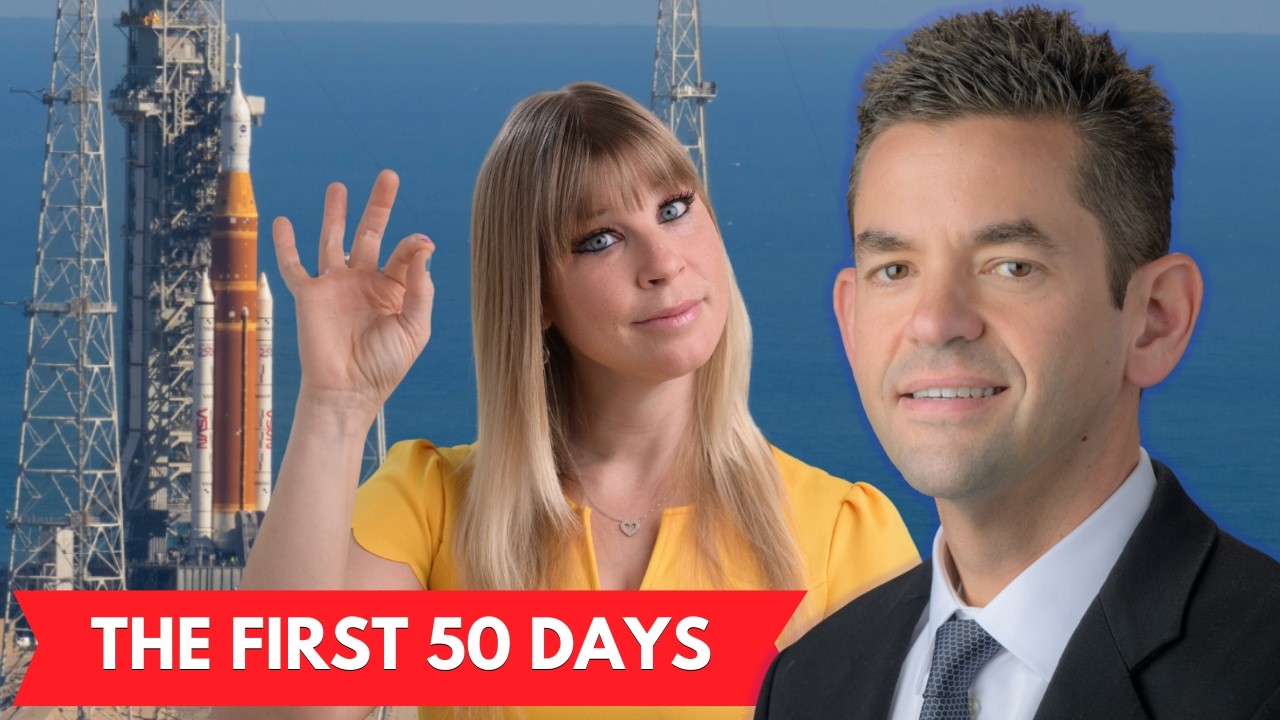
(Excerpt) Read more at youtube.com ...
YouTube transcript reformatted at textformatter.ai follows.
Even Felix of the What About It? channel was sufficiently interesting for me to get through the whole vid. He got gagged over some supposed violation, Ellie covered it, this was a while back, mid- to late 2025. The only upcoming stuff is the Crew Dragon 12 launch in a week or two, and the next Starship launch, possibly in March. Artemis II got bumped back to March or April. I doubt the problems will get fixed in a month. If it does fly in March, it obviously won't fly in April. April is more likely than March, but I don't think it will be fixed by then, either. Obviously I'd love to see it happen in either month, I'm just not optimistic.
TranscriptThis is a massively complex rocket. You can't get it wrong. The last time you launched it was more than 3 years ago. It's officially been 50 days since Jared Isaacman took over as head of NASA. Getting here wasn't easy. A turbulent confirmation, intense scrutiny in a spotlight that followed every step. And since swearing in, there's been no easing into the job. Isaacman tells me he's working 18-hour days, diving head first into some of the biggest decisions facing America's space program right now. From Artemis to commercial partnerships to what comes next for human space flight, the pressure is on.
So, what do the first 50 days at NASA really look like? Here's my conversation with Jared Isaacman.
It's just gone by so, uh, so quickly. Um, when people I see and they're like, "Congratulations on the confirmation," I'm like, "That was last year." Like, that was a lifetime ago. We're moving.
Yeah, for sure. I mean, I know that you've already had so many situations and probably done so many things already in office. Do you want to talk about like has it been more than you expected or you've really just hit the ground running?
I don't, you know, I don't know if I can say it was more than I expected or not. I mean, we've been busy. I mean, we're, uh, you know, I think it's fair to say we've been rolling like at pretty much an 18-hour day every day since confirmation. But, um, yeah, there's a lot that's gone on, right? I mean, pretty early on we had, uh, we had the Crew 11 return. Uh, you know, we've obviously been preparing for Artemis. You want to get out to all the centers and hear from the people that are trying to do the job, uh, so you can better empower the workforce to get things done. We've got big science missions like, uh, Roman. So, wanted to get out to, you know, Goddard and see that firsthand. So, um, yeah, it's certainly been, uh, a lot. And now again, we got Crew 12 that's going to launch next week. So, uh, no complaints at all. This is exciting. This is why you're at NASA.
Absolutely. Well, you're still less than two months on the job, which is pretty crazy, where many of the biggest challenges predate you. What surprised you the most when you actually got into the position?
That's a great question. I've answered it a fair amount and I think it surprises folks a lot when I say it, but, um, you know, as I visited every one of our centers and tried to do it rather quickly and heard again from the workforce, uh, you know, that you know, what's going well so we can do more of it, what's problematic so we can fix it. And I would say even beyond that in terms of information gathering we set up an inbox that, uh, goes, you know, right to the top, bypasses all layers of management so you can hear directly from the workforce if they don't have the opportunity to express it in person when I'm there but they want to send me their ideas. Uh, you know, a big kind of regulatory and policy exercise that we've been undertaking as well to figure out again what's impeding progress so we can go faster. And what I would say what I've gathered from all of this is a lot of our core competencies, you know, what you would expect NASA to be extremely good at, required to be good at, not optional in order to undertake the mission, um, you know, has been largely outsourced over the years, outsourced or even lost in some cases. And, um, and that's kind of disappointing in a lot of ways.
So, what we're doing, um, is we're about to launch a directive to kind of, uh, regain and rebuild NASA's core competencies, the things you would expect us, uh, to be able to do extremely well. Now, this doesn't mean you don't work with partners, you don't have great contractors and vendors. We've always had that throughout NASA. Like, we never go at it alone. We didn't do it in the 1960s. We won't do it today. But there are certain areas where we need operational and engineering expertise to properly do our job. We don't have that in-house the way we used to and we're going to fix that.
Can you give just like one example of something that you expect that they should be better at or NASA should be better at and you're going to make sure happens?
And I, I, I do want to clarify it's not, uh, you know, necessarily to be, um, to be better at. It's to kind of retain the expertise, right? We always have someone that we can call in some of these circumstances. Um, you know, there are certainly vendors and contractors that do the job today. The question is, should we be doing it? Should they be civil servants? Um, you know, I'll tell you, a lot of the people that you would speak to in mission control, for example, when the astronauts come over the radio and say, "Houston," um, they're contractors and, uh, now they, you know, the badges are very similar. They come into work every day and work alongside everybody, but the real question there is, is mission control a core competency for NASA? And I would say, uh, when you go down to the Cape at Kennedy Space Center, uh, you know, a lot of people who work on getting Artemis 2 out to the pad, um, or work in our firing room at the launch control complex, they're contractors. Uh, they work for NASA, uh, you know, for an entire career in that capacity, but they don't get the benefits of necessarily being a civil servant as you might expect. And that means now we have an external dependency on something that you would normally think launching rockets and managing operations in space is something we should be, uh, really good at. Uh, and it comes at a greater cost for sure and that cost comes, uh, at the expense of putting more astronauts in space or, uh, you know, launching more great missions of science and discovery or constructing a moon base. Uh, so that's something, you know, you're, we're going to want to fix.
[ad text redacted]
Let's talk about Artemis. Top of mind, right? A lot of people I've seen on X are criticizing NASA after the Artemis 2 wet dress rehearsal issues and, you know, I guess maybe a launch slip although you've had multiple launch windows but you said yourself you fully expected the wet dress rehearsal not to go flawlessly after years in between the launches. So how do you personally tell the difference between like a genuine red flag and a normal issue you would expect to surface during a WDR?
So this is a good question. Uh, I would say first I'm loving the enthusiasm around the mission. So for, you know, for sure there are people that have written articles and rightly draw attention to the fact that, you know, we had hydrogen leaks on Artemis 1 and here we are more than 3 years later we have hydrogen leaks again. Um, I don't really take that as, you know, hard criticism. I think it's just kind of stating the obvious that there's, you know, there's challenges when it comes to launching, uh, you know, a rocket with 8.8 million pounds of thrust, you know, farther into space than we've ever been before. And it should have been fully anticipated. I did this. This is why we didn't communicate a launch date.
I, I, I mean, I said it to everyone, you know, everybody was looking for an invitation for the big Artemis 2 launch. And I said, "Look, we have one date right now. It's called wet dress. We're going to get through wet dress. Then we're going to get through the flight readiness review. Then we're going to communicate a date because yes, if you launch this is a massively complex rocket. You can't get it wrong. The last time you launched it was more than three years ago. It draws on a lot of, uh, you know, hardware that goes back to the shuttle program. I mean, we got a, we, one of our RS25s on Artemis 2 has actually flown many times before on previous shuttle missions. It shouldn't be surprising that we're going to have to take a couple tries at this to get it right. So I fully expected it. When people are critical though of it, you got to remember this is the start of a journey. This is not the end state of it. You know, I've come out and said many times, look, Apollo ended at 17. We don't want that with Artemis. We want to go to Artemis 100 and beyond. So, the architecture that we have today, which I don't even fault. I mean, this was the best idea at a time when we didn't have rockets landing on ships. Reusability wasn't a full thing yet. Uh, so did it make sense to work with all the vendors and the talent, the expertise that ran, uh, the shuttle program for a long time? Sure it did. And that's where we start and that's what we're going to use with Artemis 3 and Artemis 4 and Artemis 5. Uh, until such time as commercial industry has the capabilities to send us to and from, uh, the moon at a great rate and with affordability because that's honestly the only way you're going to build the moon base and maintain the enduring presence is if you're launching crew and cargo to the moon measured in months, not years. Uh, so this is the start of the journey. This is not the end state. This is going to be the capability that's going to return American astronauts to the surface of the moon. This is the right direction, but this is not what's going to be launched on Artemis 10 or Artemis 100. We probably don't even know the capabilities we're going to exercise that far into the future. It's kind of an exciting thing we do at NASA. We constantly recalibrate and work on the near impossible.
Well, you just made an announcement yesterday about astronauts will be flying with modern smartphones starting with Crew 12 and, of course, Artemis 2. My understanding is that before this decision, the newest camera slated to fly on the Artemis 2 mission, uh, around the moon would have been a 2016 Nikon DSLR alongside GoPro cameras that were a decade old. So, how did this decision come about? And, you know, obviously this is huge.
Well, I have to say I, uh, I had a long time to prepare for this job. It was kind of a stop and go there for a bit and, uh, so I had some idea. I mean, I was able to do some information gathering on, uh, you know, areas that we could probably bring some, you know, process improvements into the agency and for sure I was aware that it was, uh, a challenge for a long time to, you know, clear iPhones for our crewed missions. So I think it was a good thing to do for the inspirational aspects of it. You know, astronauts now are going to be able to capture imagery on the fly that they otherwise would not have been able to do, especially when you're flying, uh, around the moon, but it goes, um, much more than that, right? It's actually, it's about fixing what could be a, you know, a dated process. And, um, look, we're at one atmosphere on the station. We're one atmosphere in Orion. We all are here living in one atmosphere. Uh, how many times have our phones, you know, combusted? Probably not very often. Not to say the risk isn't zero, but we should have enough data at this point in time where we could make the right decision, uh, to clear that hardware. So for me, it was as much about the inspirational component to it. Not to mention giving the astronauts the opportunity to, you know, send record a message for their loved ones.
Uh, you know, that's how cool is that going to be? They're taking, you know, real risk to go out on a lunar mission like Artemis 2 or spend nine months on the space station. Let them record some memories and for their loved ones. Let them record some inspirational content to share with the world. But I think most importantly, let's challenge a dated process and make it better because there's all sorts of good hardware we're going to need to get up into space if we're going to unlock the orbital economy, you know, return to the moon, build the moon base, and press out from there. We can't let that slow down the machine.
What other areas inside NASA do you think are ready for the same kind of rethink where changing the process, you know, might be what we need to do versus changing the hardware? Well, I'll tell you what, I certainly have ideas. You know where the better ones come from? The people that are trying to do the job. So, we literally stood up a policy burndown exercise where every employee, every contractor within NASA can submit, and anonymous if they want, a policy that either needs to be rewritten or just deleted outright. And I can tell you there's over like 700 submissions at this point.
Okay? So, there's no shortage of them. Oh my gosh. Now, some of them maybe they don't have the full context and it's actually a good thing. A lot of them need to be rewritten and deleted. There's no question about that. Um, you know, if we got to do this, right? I mean, you know, for a long time now since the end of the first space race, NASA has not had a real geopolitical competitor, someone that could really rival us from a science and discovery perspective in the high ground of space. We got that. Now, this is a whole different ballgame. I mean, you know, in hindsight, we had all the schedule margin in the world against the Soviets during the space race. I mean, obviously, they haven't landed any cosmonauts on the moon. We have plenty of time in hindsight. We don't have that now.
I mean, if we're off from a year or two, you know, we're going to see our arrivals, you know, techn that's a problem. So, we have to rightfully review how we do things from a time when there was no competition to a time now where there is serious competition. And who better than to engage the workforce that's actually trying to get the job done and hear from them what's working and what's not.
Well, I feel like that's where, you know, it's a little stressful because it's like obviously safety first and you don't want to rush things, but at the same time, the clock is ticking.
Oh, yeah. I mean, look, the safety card is a valid one, right? I mean, we had Remembrance Day. Um, there have been tragedies at NASA. Mistakes were made. Um, you capture those lessons learned. You apply them and you do everything possible to never make those mistakes again. You have to go into risk eyes wide open to it, fully understand it, do everything you possibly can to minimize it. Um, and then at some point you have to accept it and move on. We are not getting the risk to zero when we're trying to explore the worlds beyond ours. Um, it is an incredibly threatening environment. You know, when we send our astronauts to the space station, we're accelerating four human beings to 17,500 miles an hour under 1.8 million pounds of thrust, 8.8 million pounds of thrust. 25,000 miles an hour we're sending our Artemis 2 crew on in an environment with no pressure, no breathable air, micrometeor and orbital debris whizzing around like crazy and radiation. Um, it's a threatening environment. We have to use all the brain power and tools that are available to us at NASA to bring that risk down to the lowest probabilities possible and only when we've exhausted all our options to minimize further do we accept our risk and do we move forward. So, but where I think that can be a mistake, right, is when you apply safety and risk equally across the spectrum of objectives we have here at NASA. Like human space flight is very different than eclipse mission where our goal there is simply empowering commercial providers to get more landings on the moon so we can build a moon base. Like, we're okay with a couple of them tipping over. That's all right. You know, do we try and drive the risk to zero on a flagship mission of science and discovery that's three billion dollars or would we accept three billion dollar missions? People don't necessarily like my 101 $100 million ones. How about three billion dollar ones except one fail to succeed and get maybe twice as much science, twice as much data, and that much faster. We should consider doing that. Um, an iPhone, right? I mean, we're taking it into one atmosphere here. Um, we have iPhones that are in one atmosphere all the time. There's probably a billion of them around the world. Um, you know, what is the probability of them combusting and then we can maybe apply that to the environment we're taking into knowing it's nearly identical. So, um, there's a lot of ways that we can get at hopefully the right answer without just, you know, kind of needlessly at times saying like, "What about safety?"
Sure. Uh, well, a House committee just advanced a NASA reauthorization bill that quietly gives the agency more flexibility to buy end-to-end deep space transportation services from commercial providers after the early Artemis missions. Is this something that should have happened a long time ago?
I don't know if it necessarily should have happened a long time ago, but we're certainly starting to look at things in the right direction. I do not think NASA is at its best when it competes with industry. I think NASA is at its best when we are doing the near impossible. What industry is incapable of doing, what no other government agency is capable of doing, what no other nation, frankly, is capable of doing. That's when we're at our best. That's when we're recruiting the best talent because they know there's nowhere else they can go other than to work on this endeavor. That's where we're truly kind of pushing the boundaries in air and space. And when we crack the code and we figure out something compelling and there is lots of demand outside of NASA, so a real market to support it, you hand it off to industry and you let competitive forces drive innovation and bring costs down. Uh, we know that works really well in launch, in observation, in communications, certain infrastructure, definitely landers as we look at programs like CLIPS and such. Uh, so that's where commercial industry makes an awful lot of sense and launch obviously plays a key component in that.
So, um, and I also think it's right that we start signaling what happens beyond Artemis 5. Artemis 5 is in law right now. We know our pathway to get there. We're going to work urgently to it. But it's helpful to industry to know, look, from Artemis 5 and beyond, we got a lot of options, which could very well include, you know, kind of the SLS consortium bidding their vehicles. And if they can do so competitively, I mean, that's an impressive rocket when it's out on the pad. I have no problem with lots more of them, but I also want to make sure other players who've invested quite a bit of their own resources, whether that's Blue Origin or SpaceX, you've got Rocket Lab coming on board, you got Vulcan, give them a shot, you know, to compete and I think that's what Congress is signaling.
Well, awesome. Well, Jared, I know you're one of the busiest people around. So, thank you so much for giving us some of your time and I'm so happy that you're finally head of NASA. I'm truly happy for you and for America. Oh, well, hey, I'm happy for you. Uh, congrats on the growing family, the new home. I'm glad we were finally able to chat a little bit, and I know we will again soon.
Yeah, definitely. Awesome. Well, thank you so much.
Thank you.
So, I was fortunate to interview Jared before he went on his Polaris Dawn mission, and I'm so thankful that he made time to chat with me now as head of NASA. I'm truly so excited for NASA's future with Jared at the helm, and I want to thank him for making time for this interview.
Artemis II got bumped back to March or April. I doubt the problems will get fixed in a month. If it does fly in March, it obviously won’t fly in April. April is more likely than March, but I don’t think it will be fixed by then, either.
—
I’ll fill in the reason that the problems may not be fix for other readers here. As pointed out on another YT video, the problem lies not with the SLS, but with the transporter, specifically its hydrogen transfer system.
It was originally built for another earlier system by several private contractors, and subsequently modified for Artemis.
Here’s the problem(s): there are no blueprints, documents etc for various reasons in NASA’s possession; nor will either original contractor supply them, leaving NASA’s engineers to fix the leak problems with no idea what they are actually doing. So all “fixes” are temporary and problematical.
After THREE YEARS, how did NASA fail to fix a leaky rocket?! HINT: It’s not the rocket!
https://www.youtube.com/watch?v=3ojqpDt7xZ0
and what is going on now:
FINALLY! Congress demands answers from SpaceX and Blue Origin! HLS update!!
https://www.youtube.com/watch?v=aC9kDNV2cbk
Disclaimer: Opinions posted on Free Republic are those of the individual posters and do not necessarily represent the opinion of Free Republic or its management. All materials posted herein are protected by copyright law and the exemption for fair use of copyrighted works.