Posted on 01/31/2013 8:21:22 AM PST by ProgressingAmerica
Dennis Prager made a great quip when he said: "They don't know why they don't like the term "justice"" - in reference to people who believe strongly in so called "social justice". And he's right. People who are dead set in favor of "social justice" are equally dead set against "justice".
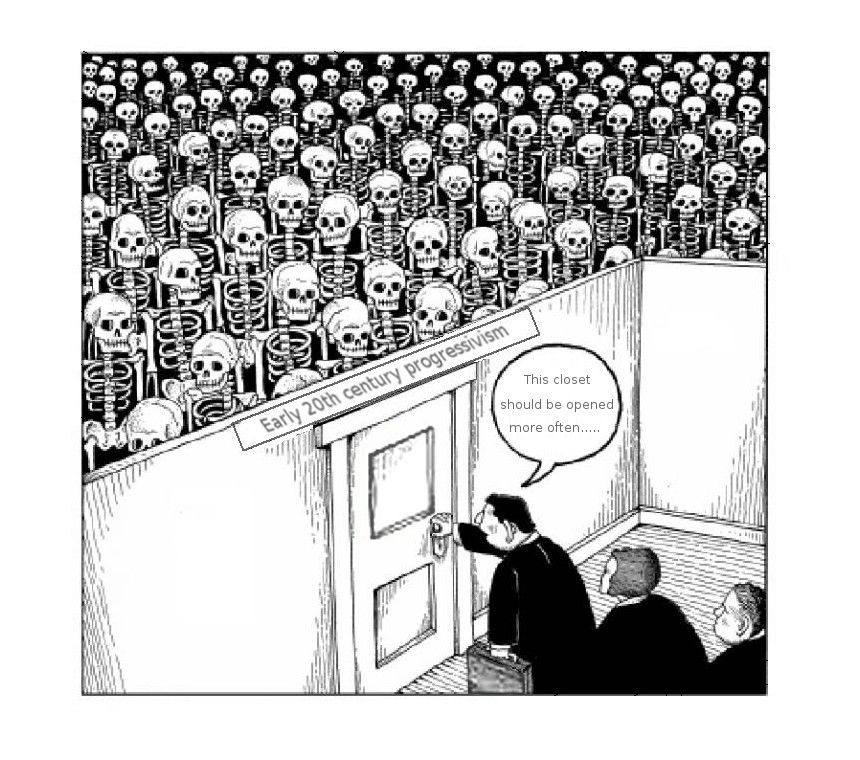
This is illustrative and instructive in understanding the mindset of progressives. At least to a degree. If you live in the real world, you'll never fully understand progressives. But we can go pretty far in our endeavor. Much further than most people realize. For example, Herbert Croly writes in his book "Progressive Democracy" the following: (Page 362)
In the past the administration of the civil law, except through the agency of the courts, was of small importance, because the law was supposed merely to recognize and interpret customary ways of economic and social behavior. But when the chief object of legislation is to carry into effect an experimental social program, the administration of the law has a different and more responsible function. Legislation is being used as a means of modifying social behavior, not social behavior as an excuse for formulating legislation. The legislator has become an innovator. He is dealing with an extremely complex and elusive material, and it is most difficult for him to define in advance how the objects of the law are best to be realized. The difficulty of the job has not prevented him from very frequently trying it out ; but he has learned something from his failures. He is learning that an extremely detailed and comprehensive statute is usually ineffective, because of the impossibility of anticipating all the conditions which affect the operation of a specific rule. Social legislation is coming more and more to demand results rather than prescribe means. Statutes are being passed in the interest of the safety of employees in factories, which merely define safety as such freedom from danger to life and health as the nature of the employment will reasonably permit. The duty of drawing up a set of regulations which will provide sufficient safeguards for the life and health of the operatives is intrusted to a commission. All that the legislature does is to declare that industrial employment shall be reasonably safeguarded. The commission makes a comprehensive investigation of the conditions upon which the health and safety of the industrial employees depend and it issues orders based on the result of its investigations. These orders can be attacked in the courts, but in adjudicating the case the courts have to accept as final the commission's record of the facts.
I'm sure most of you saw it, because you couldn't miss it. He just described Obamacare. Why is Obamacare 3000 pages long? Because the entire thing is a lead in to massive regulation. Commission after commission after commission, layer of control after layer of control. Forbes reported last October that "So far, more than 13,000 pages of federal ObamaCare regulations have been issued". And that's just the beginning. 3000 pages = 13000 pages, at a minimum.
Croly is surprisingly honest in this part of the book with the following line:
But when the chief object of legislation is to carry into effect an experimental social program, the administration of the law has a different and more responsible function. Legislation is being used as a means of modifying social behavior, not social behavior as an excuse for formulating legislation.
That's social legislation. It's experimental legislation which is designed to get people to change their behavior. Now I'm sure may of you knew full well that a lot, if not most legislation has that goal. But now you know that it actually has a name. That's not legislation, it's social legislation.
Croly uses the line about results and means, which really isn't all that different than "means and ends". For a lengthy examination into the progressive view of means and ends, see Saul Alinsky's book Rules for Radicals, Chapter 3. I'll just summarize it this way: "If the end is what you want, then the means is how you get it". In this case, the means is social legislation. Croly even makes the point that the courts are powerless against social legislation. Keep in mind that Croly wrote all of this in 1915. But you and I have the benefit of 20/20 hindsight. I'll ask you the question:
Have the courts been powerless in the face of social legislation?
The clear answer to this is yes. We've lived it our entire lives. Because these statues do not contain "detailed and comprehensive" wording and measures, what exactly is it that they are violating? Now, sure, from a strict constitutional standpoint, the role of congress and the role of the president are clear and defined. But the courts made sure to get rid of that. Last November I wrote this, detailing portions of the role of the courts in progressivism. The important thing is Taft's 1928 ruling:
If Congress shall lay down by legislative act an intelligible principle to which the person or body authorized to [exercise the delegated authority] is directed to conform, such legislative action is not a forbidden delegation of legislative power.
See. It's constitutional for congress to pass social legislation in which the power is delegated to the executive and a commission. The point of social legislation is meant to create a vehicle for commissions and regulatory bodies. But to what end? Once the regulatory body takes over to run the show, what kind of regulations should they implement?
They should implement social regulations. Again, with the word "social" appended. John Dewey, in his essay "The Social Possibilities of War" explains that:
To dispose of such matters by labeling them state socialism is merely to conceal their deeper import: the creation of instrumentalities for enforcing the public interest in all the agencies of modern production and exchange. Again, the war has added to the old lesson of public sanitary regulation the new lesson of social regulation for purposes of moral prophylaxis.
And of course, "the supremacy of public need over private possession". Now, does Obamacare do this? It does. Did the courts uphold Obamacare? Absolutely. Just as Croly knew they would. But is Obamacare a vehicle for regulation? No. It's a vehicle for social regulation. They don't want general regulations that make common sense. They want social regulations for the purpose of moral prophylaxis - the supremacy of public need over private posession. Centralized planning. Bureaucratic despotism.
Just as the believer in "social justice" doesn't like "justice", it can be said that the social legislator doesn't like legislation, they only like social legislation. The why is clear: total and ultimate power to centrally plan society. And the social regulator, just like the social legislator, also wants to conduct experiments via regulation(and legislation, respectively) in order to see just how far they can go and what you will accept.
If you want to put an end to progressive social legislation, then it might make sense to start looking toward an overturn of J. W. Hampton & Co. v United States - or at least that portion of the ruling which enables centralized planning.
The answer to many of the questions facing us today is too simple for purely political minds to articulate.
The choice is between individual freedom and slavery to government--a tyrannical form of slavery.
Although I have posted the following on earlier occasions, the following principles need to be reiterated again and again to the men and women we elect to office.
Several years ago, a business man by the name of James R. Evans, in his book, "America's Choice: Twilight's Last Gleaming or Dawn's Early Light," suggested 7 simple principles which every citizen could benefit from considering as they watch the so-called "progressives" attempt to enslave them through legislation and Executive Orders.
"1. Does this legislation or idea increase, or decrease, individual freedom and creativity?"2. Does this legislation or idea increase, or decrease, the power of some citizens over other citizens?
"3. Does this legislation or idea recognize that the persons who will exercise the power are themselves imperfect human beings?
"4. Does this legislation or idea recognize that government is incapable of creating wealth?
"5. Does this legislation or idea authorize taking from some what belongs to them, and giving it to others to whom it does not belong?
If 'thou shalt not steal' is a valid commandment, can we assume that it is meant to apply only to individuals and not to government (which is made up of individuals), even if those persons in power pass laws which sanction such redistribution of the wealth of others?'"6. Does this legislation or idea encourage, or discourage, the very highest level of morality and responsibility from the individual?
. . .when government makes actions 'legal' by some citizens at the expense of other citizens, the result may be behavior which would not be considered possible by individuals acting alone."7. Does this legislation or idea propose that the 'government' do something which the individual cannot do without committing a crime?"**
**7 principles drawn from James R. Evans book, "America's Choice," and reprinted in a Stedman Corporation (Asheboro, NC) booklet entitled "I'm Only One, What Can I Do?"
The simplicity of these questions and of the core message of the following words by some of America's Founders might jar some citizens into a recognition of what "progressives" and this Administration are doing to the future of liberty for their posterity:
"...nip the shoots of arbitrary power in the bud, is the only maxim which can ever preserve the liberties of any people. When the people give way, their deceivers, betrayers, and destroyers press upon them so fast, that there is no resisting afterwards. The nature of the encroachment upon the American constitution is such, as to grow every day more and more encroaching. Like a cancer, it eats faster and faster every hour. The revenue creates pensioners, and the pensioners urge for more revenue. The people grow less steady, spirited, and virtuous, the seekers more numerous and more corrupt, and every day increases the circles of their dependents and expectants, until virtue, integrity, public spirit, simplicity, and frugality, become the objects of ridicule and scorn, and vanity, luxury, foppery, selfishness, meanness, and downright venality swallow up the whole society." - John Adams"This was a favorable moment to shut and bar the door against paper money." [This statement referred to a proposed provision in Article I, Section 8, that would have read 'and emit bills of credit (paper money) of the United States,' which the Founders rejected by an overwhelming vote.] - James Madison- Notes of the Federal Convention 1787
"...there have always been those who wish to enlarge the powers of the General Government. There is but one safe rule...confine (it) within the sphere of its appropriate duties. It has no power to raise a revenue or impose taxes except for the purposes enumerated in the Constitution....Every attempt to exercise power beyond these limits should be promptly and firmly opposed." - Andrew Jackson's Valedictory
"...experience hath shewn, that even under the best forms (of government), those entrusted with power have, in time, and by slow operations, perverted it into tyranny; and it is believed that the most effectual means of preventing this would be, to illuminate...the minds of the people...to give them knowledge of those facts, which history exhibiteth. History, by apprizing them of the past, will enable them to judge of the future...it will qualify them as judges of the actions and designs of men; it will enable them to know ambition under every disguise it may assume; and knowing it, to defeat its views...." - Jefferson's Bill for the more general diffusion of knowledge for Virginia
"Although all men are born free, slavery has been the general lot of the human race. Ignorant--they have been cheated; asleep--they have been surprised; divided--the yoke has been forced upon them. But what is the lesson?...the people ought to be enlightened, to be awakened, to be united, that after establishing a government they should watch over it....It is universally admitted that a well-instructed people alone can be permanently free." - James Madison
"These principles form the bright constellation which has gone before us and guided our steps through an age of revolution and reformation. The wisdom of our sages and the blood of our heroes have been devoted to their attainment. They should be the creed of our political faith, the text of civic instruction, the touchstone by which to try the services of those we trust; and should we wander from them in moments of error or of alarm, let us hasten to retrace our steps and to regain the road which alone leads to peace, liberty, and safety." - Thomas Jefferson-First Inaugural Statement of Principles of Good Government
Meanwhile....Prager’s fellow talk show hosts at Salem Radio Network have no problem with Social Legislation like Rubio-Obama Amnesty....which will allow 10-30 million Illegal Aliens get Illegal Alien Amnesty for breaking our immigration laws....costing American taxpayers trillions.
Timely post and thread. Thanks to you both.
Placemark.
Disclaimer: Opinions posted on Free Republic are those of the individual posters and do not necessarily represent the opinion of Free Republic or its management. All materials posted herein are protected by copyright law and the exemption for fair use of copyrighted works.