Posted on 01/18/2013 12:56:33 PM PST by Ron C.
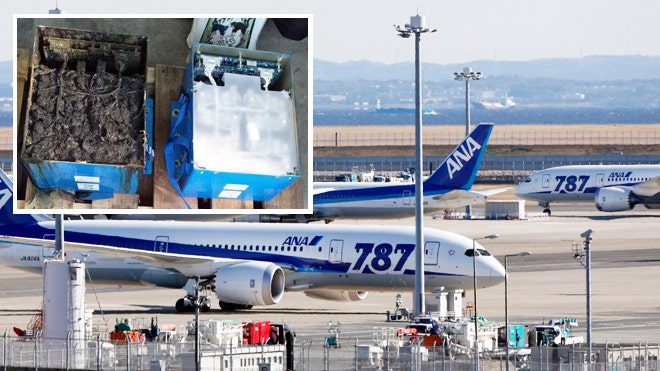
A charred lithium ion battery at the center of the worldwide grounding of the Boeing 787 Dreamliner showed evidence of thermal runaway -- which is indicative of a design problem, experts tell FoxNews.com.
The All Nippon Airways plane made an emergency landing Wednesday morning in western Japan after its pilots smelled something burning and received a cockpit warning of battery problems. Nearly all 50 of the 787s in use around the world have since been grounded.
The batterys burned insides indicate it operated at a voltage above its design limit, a Japanese investigator said Friday. Thats a clear sign of an out-of-control chemical reaction, explained Reginald Tomkins, a professor of chemical engineering at New Jersey Institute of Technology.
(Excerpt) Read more at foxnews.com ...
If Boeing were forced to replace the batteries in the Dreamliner, that rigorous testing would be a fresh problem.
The redesign is much smaller than the extensive testing that would go on, that would be time consuming. Wed be talking about months. Many months.

The new one on the right looks to be a simple open box (no top cover) - gotta wonder why it isn't in a flame-proof steel box that would help prevent fire. Perhaps better that than an explosion.
Exa Rong Rife
Interesting. I wonder if aircraft testing included a scenario that simulated a ‘fully-loaded’ stress test over a long period of time..in other words, having every appliance turned on in the kitchens, cockpit, not to mention all the music ports, movies and computer users, etc.
I’ve seen larger metal cased battery packs oilcan before...and split metal, even along welds.
A power source, like a battery (meaning multiple cells), without the means to shut down the individual cells via a fuse or switch is simply asking for trouble.
Some batteries are safer than others like the good old, heavy, lead acid batteries in our cars but these newer batteries are KNOWN to overheat and to build a battery in a mission critical application like an aircraft is beyond stupid. From laptops to electric cars and now airplanes it should be obvious to anyone who knows which direction electrons actually flow, you need protective devices at the cell level.
Wrong. These are Japanese made batteries.
Sad to say!
Most people don’t understand this mess. Anything — ANYTHING — that is installed in an aircraft as equipment, has to be tested and paper-worked to death. It’s weight and effect on the CG envelope has to be discovered and then allowed per FAA regs. All — ALL — ops and maintenance manuals must be approved by the FAA and then supplied to all users. The supplier has to be officially blessed by the FAA and no — NO — non-approved device or part can be used or even mentioned. The part supplier has to undergo the equivalent of a military TS background check. The legal liability assumed by a supplier and builder is open-ended. You cannot add a four-pound GPS to your Cessna’s panel without a complete rework of the airplane’s paperwork. Then, after all that, there is public perception. Boeing is in deep trouble. So is the current battery supplier. Law suits will be ongoing for the next 15 years. The Lockheed L-188 Electra suffered four crashes before it was discovered that engine mounts were failing. It never recovered, although the Navy bought it as the P-3 with wing re-working.
Exa Wong Wife
Wurlitzer has one possible and obvious answer - "...the means to shut down the individual cells via a fuse or switch is simply asking for trouble."
Too, why not a built-in over-heating alarm.
A whole bunch of people haven't done due diligence here.
loads you mention are not suported by the batteries,wouldnt make a dif.
This was/is a design flaw and IMOP related to improper charge and discharge resulting in thermal runaway resulting in the battery case being consumed by intense heat
While I certainly cannot, nor should not, dispute a single thing you posted, it is amazing after all that GOVERNMENT paperwork, they would allow a battery design, with cells known to overheat in many other applications, on an aircraft.
The only semi-safe design for these batteries are to have every cell contain a thermal trip device such that on cell cannot generate enough heat to cascade other cells into a ignition source with NO internal off switch. Once they start to overheat they take on a life of their own.
These are balancing chargers -- at the cell level and 4X redundant. Still, even with the redundancy I think this was more likely a runaway charging problem, although the lithium cobalt oxide chemistry is more sensitive than lithium iron phosphate would be and only slightly higher in energy density.
True, the cobalts start to generate their own oxygen in a big way.
We got new sonobouys aboard the P-3 for a time that had lithium batteries. They were so dangerous that the Navy instituted special, new procedures for jettisoning the things if they caught fire.
Interesting comment! One has to wonder how these planes were certified by the FAA. Perhaps they were partially built in Japan, escaping some of the FAA regs?
Computer design is a tool. It is no replacement for human experience. The 787 relies on too much on technology, and not enough on basic aircraft design. Trying to squeeze every ounce of weight and inch of space has come back to haunt them.
“....which is indicative of a design problem”
They were designed to last for the life of the aircraft, so technically, there is no design problem.
Yuasa. Well known in powersports applications and one of the most respected. Have to remember, they “built to specification”. These young engineers at Boeing now are far too biased toward the bleeding edge and now some of them won’t fly in their own airplanes.
Appreciate your response and the clarification. THose cables in that picture along with every other component are fried. There’s a lot of people in trouble right now..I wouldn’t want to be in their shoes. But I’m even more thankful that no one was hurt.
It will be interesting to see the failure analysis.
They were designed to last for the life of the aircraft, so technically, there is no design problem.
Much like the lifetime guarantee on pacemakers.
It’s my understanding that although the manufacturer certifies the aircraft safe, the individual nations operating it certify it separately for use in that country’s airspace. Such a system has been used to keep a competing country’s product out.
I am curious is this the Lithium-Ion Phosphate which are more geared towards aviation use (just got on my radar screen recently).
The L-188 Electra never recovered because the jet age had started. Many pilots say the Electra was the best plane that they had ever flown in their careers. The tv show Ice Pilots features them still flying for Buffalo Airways in Yellowknife, Canada.
Hmmm...
It sounds like Boeing is covering their butts.
I've been using these batteries for almost 10 years and when the batteries are manufactured, the nominal voltage is 3.7 volts per cell. The maximum per cell voltage in a fully charged state for a properly charged battery is 4.2 volts.
The only time they go into a thermal runaway state is when they are charged to a state above 4.2V per cell or if they are discharged at a rate higher than their designed to deliver.
In both cases (over-charge and over-discharge) they will develop internal shorts which trigger the thermal runaway.
I've never heard of a Li-Ion battery going into a thermal runaway all by itself.
One of the unique features of Li-Ion batteries is the ability to wire them in series and parallel at the same time. This allows the batteries to be formed into packs that deliver a higher voltage and capacity. When wired in parallel, each cell must be balanced before or during the charging process to ensure that each cell's voltage never rises above 4.2 volts.
If one cell resting voltage is higher than those of the rest of the pack, and each cell's voltage is not monitored during charge or if all the cells in a pack are not balanced with each other before charging, then it's possible to over-charge a single cell above it's maximum rated voltage, which will trigger a thermal runaway.
Once a cell goes into thermal runaway it can trigger other cells.
If you're talking about Lithium batteries, they have a maximum life of about 2-4 years, whether they're used or not. Depending on how they're used, this could be shorter.
They definitely won't last the life of the airplane, which is 20-30 years.
Why not just get a windmill from a wind farm bolted to the undercarriage. Voila! No toxic lithium and no overheating battery.
The batteries really don’t power anything unless ground power or on board generator power is not available. They are back-up/auxiliary power only.
“In the case of the 787, two 32-volt lithium-ion primary batteries provide power as key elements of the aircraft’s more-electric architecture. The main battery, located forward in the electric/electronic (E/E) equipment bay below the cabin floor by the front passenger doors, provides power for aircraft start-up, ground operations such as refueling and towing, and acts as backup power for the electrically actuated brake system. It can also assist the second battery, located in the aft E/E bay, in starting up the auxiliary power unit (APU) and, in the event of a power failure, energizes essential flight instruments in the flight deck until the drop-down ram air turbine spools up.
The battery that caught fire on the Japan Airlines 787 in Boston was the second main battery. This unit’s primary purpose is to electrically start the APU when neither of the engines is running and the aircraft is not connected to external ground power. In this case, the battery energizes the righthand of the two starter/generators connected to the APU. The aft battery also provides another minor role, namely to power navigation lights during battery-only towing operations.”
http://www.aviationweek.com/Article.aspx?id=/article-xml/AW_01_21_2013_p22-537845.xml
I should clarify that I was talking about Lithium Ion cells which are rechargeable and not Lithium cells which are not.
Lithium cells, such as watch batteries have a very long shelf life, whereas Lithium Ion cells have a limited life span, depending on their operating environment.
Now all they have to do is figure out why the windshield cracked ad the fuel leaked.
Airliners have electrically heated windshields. It’s not unusual for the outer pane to crack from the heating and cooling of the panel. Only the outer pane cracks. It’s alarming, but not too serious. The integrity of the windshield is not compromised when this happens.
Airliner windshield panes crack fairly regularly.
didn’t they learn from klinton and flight 800?
Were offending batteries made on the same day. Reminds me of Detroit production line scenerio...What was the BAD day? Hummm
Thanks for correcting my spelling.
No doubt the battery company followed Boeing’s specs...
Many of the problems with this airplane can be traced to so many outside suppliers in various countries.
I heard the other day that lithium batteries are not allowed as cargo on aircraft after a crash that was thought to have been caused by a number of such batteries having caught fire.
If they didn't, it would be almost criminal. I can't imagine why these flaws are just coming to light after the years and years this plane has been in development. It sure puts Boeing in a bad light.
Several years ago, there was a great deal of discussion on FR about the 787 vs. the hated A-380. Well, the latter did have some problems at start-up, but has become a noncontroversial part of the fleet. This business with the 787 is disheartening.
Thanks much - interesting stuff! Now I wonder if they’ll ever find out what caused it. (Over or under charged?)
So in short this was a starter battery (and a backup breaking battery) - if I read correctly. Sounds like the load for starting is greater than the battery is designed for - if after starting the engines, it has to come into play too soon afterward for breaking. Too much demand for too small a battery perhaps?
You're welcome.
Some good comments in this thread. I enjoy ‘technical discussions’ and learn something every time I do. Ping for more reading later...
“They definitely won’t last the life of the airplane, which is 20-30 years.”
Not if the Lithium battery catches on fire, which was the unspoken punchline.
I think that the point here is that the 787 lifespan is going to be measured in weeks. Hence, these batteries are certainly going to last for the life of the aircraft.
It’s normally not used unless other power sources are not available.
It would be a bit unusual to start the APU or the main engines with the batteries.
It was probably last done when they were testing the planes.
Disclaimer: Opinions posted on Free Republic are those of the individual posters and do not necessarily represent the opinion of Free Republic or its management. All materials posted herein are protected by copyright law and the exemption for fair use of copyrighted works.