Federal Firearms Freedom Act Proposal
I think that we should eliminate federal gun control. I believe that most of it is located in two portions of the federal code, in Title 18 and in Title 26. Both Title 18 and Title 26 guff are derived from the NFA, the FFA, the GCA, and the FOPA. (Please FReepmail me if I have missed any other sections of the U.S. code related to the private ownership of firearms.)
Here's my proposed text for a repeal:
Federal Firearms Freedom Act
1) United States Code Title 18, Part I, Chapter 44 is hereby repealed in its entirety.
2) United States Code Title 26, Subtitle E, Chapter 53 is hereby repealed in its entirety.
The first part takes care of all of 922 and 923. The second part takes care of the Internal Revenue Code related to 922 and 923.
A Brief Chronology of the Kenyan Clown's Circus
- November 7, 2008 — Mr. Obama mocks Mrs. Reagan in his first press conference after winning the election: Obama Uses Press Conf To Mock 85-Yr. Old Widow.
- November 9, 2008 — Mr. Obama holds a private conversation with Poland's president that seeds an international disagreement with an important ally: Obama, Polish president at odds on call
- December 9, 2008 — The Blagojevich scandal is still developing, but it appears that Mr. Obama is up to his ears in it: Details Of Complaint Against Blagojevich
- January 4, 2009 — Mr. Obama's choice for Commerce Secretary, Governor Richardson, quits even before Mr. Obama's inauguration due to a previously undisclosed scandal: Bill Richardson will withdraw as Commerce Sec.
- January 26, 2009 — Mr. Obama has a busy first week: He stumbles in taking his oath of office and has to retake the oath later; he grants his first presidential interview to Al-Arabiya; his first call as president is to the Palestinian Authority; he picks a public fight with Rush Limbaugh; his maladroit handling of the press is not only arrogant but also petulant; when publicly signing various executive orders, he makes it embarrassingly clear that he has neither read these orders nor understood their import.
- January 31, 2009 — In perhaps the most idiotic move so far by the Kenyan Clown, Mr. Obama has reportedly decided to slash the military budget by 10% in a time of war. This is being done while he is trying to push through the most pork-laden bill in the history of Western civilization.
- February 3, 2009 — "Tax and Spend" is already in full gear, with the Kenyan Clown signing in his first tax increase, a massive increase on tobacco levies, including an amazing 2000%+ increase in the loose tobacco tax.
- February 4, 2009 — Yet another prominent nominee, Senator Daschle, quits before even being appointed.
- February 5, 2009 — The Kenyan Clown has now reportedly decided to drop charges against Abd al-Rahim al-Nashiri, the terrorist who planned the Cole bombing. He has also issued an executive order sending $20 million to Hamas and which pays for terrorists from Gaza to relocate to the United States.
- February 6, 2009 — The Democrats' mad dive into socialism accelerates today with crazy ideas of limiting all executive compensation and the conversion of the government's bank stock from non-voting preferred to voting common. The latter is compulsory nationalization, and would mark a nadir of socialism in our government.
- February 12, 2009 — In a powerful rebuke to the Kenyan Clown's risible plans to move responsibility for the census from the Commerce Department to the White House, Senator Judd Gregg withdraws from his nomination to Secretary of Commerce. The Kenyan Clown, with his singularly unpresidential propensity for derision, then proceeds to mock Senator Gregg's principled actions.
- February 14, 2009 — After the passage of the most pork-laden bill in the history of Western civilization, the Kenyan Clown breaks down in public weeping. This follows closely on reports that the administration is considering dropping all sanctions on Iran, and the Kenyan Clown's decision to "slow" missile defense efforts in Europe.
- February 15, 2009 — Barack Obama sends bust of Winston Churchill on its way back to Britain. In another shameful chapter to the Kenyan Clown's disgraceful occupancy of the White House, Mr. Obama has decided to dishonor the memory of the first foreigner to be named by Congress as an honorary citizen of the United States. (See also the Free Republic thread Obama Disses Brits, Will Media Miss?)
- February 20, 2009 — Plumbing new depths, the Obama administration has now announced that it will no longer condemn human rights abuses by the vile totalitarian government of Red China. This shameful capitulation to the Chicoms marks an even lower nadir than any of the foreign policy disasters of the Carter years.
- February 21, 2009 — The national debt now stands at $10,802,021,982,124.74 as of February 19.
- March 2, 2009 — The Kenyan Clown has decided to wreck our efforts in eastern and central Europe by offering to kill our missile defense program in Europe. Obama Offered Deal to Russia in Secret Letter.
- March 5, 2009 — In a show of petulance and arrogance perhaps unequaled in modern diplomatic history among major nations, Mr. Obama publicly slights the British Prime Minister. Barack Obama 'too tired' to give proper welcome to Gordon Brown, London aghast at President Obama over gifts given to Prime Minister Brown.
- March 7, 2009 — The Kenyan Clown has now decided on rapprochement with the murderous Taliban, the political body with the most direct operational responsibility for the infamous attack on the World Trade Center. President Barack Obama declares America should be ready to talk to the Taliban.
- March 8, 2009 — The national debt now stands at $10,953,034,411,520.15 as March 5, and will soon cross $11 trillion. The public debt has soared over $300 billion in the 5 weeks that Mr. Obama has occupied the White House.
- March 10, 2009 — The Kenyan Clown's utterly unsuitable choice for Chairman of the National Intelligence Counsel, Charles Freeman, has also now withdrawn from his higly controversial nomination. http://www.freerepublic.com/focus/news/2203751/posts
- March 14, 2009 — The public debt now stands at $10,983,549,928,728.74 as of March 12th, and it will most likely break $11 trillion in the next few days.
- March 16, 2009 — The Kenyan Clown now is bruiting a disgraceful proposal to force veterans to use private insurance to pay for the treatment of service-related disabilities. The American Legion Strongly Opposed to President's Plan to Charge Wounded Heroes for Treatment.
- March 17, 2009 — The public debt rises above $11 trillion for the first time on March 16, 2009.
- March 20, 2009 — In an appearance utterly unbecoming in its lack of dignity and respect for his office, the Kenyan Clown mocks the Special Olympics: President Obama Jokes About Being a Bad Bowler: 'It's Like the Special Olympics'.
- March 21, 2009 — Obama White House Bars Press from Press Award Ceremony.
- March 23, 2009 — Now Obama has insulted French President Sarkozy!
- March 25, 2009 — The deranged Kenyan Clown chuckles over the current economic travails: Kroft to Obama: Are you punch-drunk (Obama jokes about "gallows humor")
- March 26, 2009 — This quote summarizes the current deranged state of mind of the Kenyan Clown: "President Barack Obama's intelligence chief confirmed Thursday that some Guantanamo inmates may be released on US soil and receive assistance to return to society. 'If we are to release them in the United States, we need some sort of assistance for them to start a new life,' said National Intelligence Director Dennis Blair at his first press conference." (Terror inmates may be released in US: intel chief)
- March 31, 2009 — The Kenyan Clown fires the head of General Motors.
- April 1, 2009 — Incredibly, the Kenyan Clown tops his previous best in maladroit gift-giving by presenting the Queen with an I-pod.
- April 1, 2009 — The Kenyan Clown his steep dive into marxist mania: The Washington Post is reporting that the Obama administration is now planning to directly make firing and hiring decisions on the GM board.
- April 1, 2009 — The national debt continues its steep ascent and is now at $11,126,941,485,713.37. It has now climbed 1% in just two weeks. At this torrid rate, it will grow over 20% this year alone.
- April 2, 2009 — In the most ignominious act ever by an American president, the Kenyan cur bows deeply and kisses the hand of the Saudi king.
- April 5, 2009 — In a remarkably doltish performance in Strasbourg, Obama says: "There's a lot of — I don't know what the term is in Austrian — wheeling and dealing, and, you know, people are pursuing their interests, and everybody has their own particular issues and their own particular politics." Obama says interesting to find wheeling, dealing happens in Europe, too
- April 6, 2009 — The Kenyan cur refuses to visit our war dead at Normandy: Barack Obama rejects Normandy trip to avoid offending Germany
- April 6, 2009 — As expected, the Kenyan cur announced cuts intended to decimate our military: Pentagon to end F-22 production, America 'to slash military spending'
- April 13, 2009 — The Kenyan Clown decides to normalize relations with Cuba.
- April 16, 2009 — The public debt now stands at $11,218,863,034,278.70.
- April 17, 2009 — A prominent member of the press, Ms. Helen Thomas, reveals the manipulation of the complaisant press by the Kenyan Clown: "The Gibbs press operation has this annoying practice of alerting selected reporters that Obama plans to call on them during a presidential news conference. It all smacks heavily of managed news.". Low-Key Voice At White House: Gibbs Cautious In Talking To Reporters.
- April 27. 2009 — Political correctness at its maximum: US says not testing travelers from Mexico for flu
- April 27, 2009 — The Kenyan Clown has Air Force One suddenly buzz Manhattan: Air Force One photo op panics NYC - finger-pointing begins
- April 30, 2009 — The Kenyan Clown has indeed elected to release terrorists onto streets, and to add insult to injury, to put them on the public dole: BREAKING: White House Overrides FBI and DHS on Gitmo Release
- April 30, 2009 — The Kenyan Clown's administration, charged with faithfully executing the laws of the land, instead elects to coerce Chrysler's creditors: Statement From Non-Tarp Lenders of Chrysler
- May 2, 2009 — In an unprecedented abuse of power, the Kenyan Clown's administration threatens Chrysler's creditors: Chilling Audio "Whitehouse Threatened One Of My Clients"-Attorney For Chrysler Lenders (Audio)
- May 3, 2009 — The Kenyan Clown continues his assault on capitalism: Obama: Wall Street Will Play Less Dominant Role.
- May 21, 2009 — Having wreaked direct damage on G.M. and Chrysler, the Kenyan Clown now targets truck owners nationwide: Banning the pickup truck
- May 23, 2009 — The public debt now stands at $11,305,673,498,034.18.
- June 16, 2009 — The public debt now stands $11,400,723,732,452.21.
- June 29, 2009 — In a day that will live in infamy, the Kenyan Clown stands in solidarity with Cuba and Venezuela against the judicial removal of the leftwing Honduran President by the Honduran Supreme Court for abhorrent acts violating the Honduran Constitution.
- July 2, 2009 — The public debt now stands at $11,545,275,346,431.39.
- July 11, 2009 — The Kenyan Clown has decided to resettle 1,350 Palestinian refugees from Iraq in Southern California.
- August 8, 2009 — The Kenyan Clown sets up a snitch line at flag@whitehouse.gov
- August 31, 2009 — The public debt now stands at $11,812,870,150,873.53. At this rate, it will go over $12 trillion sometime in the next six weeks.
- September 2, 2009 — The Kenyan Clown announces plans to start direct indoctrination of schoolchildren into an Obama cult of personality, emulating North Korea and Zimbabwe.
- September 9, 2009 — In an undignified, unseemly, and thoroughly unpresidential address to the nation in our history, the Kenyan Clown berates Americans and exhibits entirely inappropriate anger and demagoguery.
This election brought a few firsts:
- The first person elected president who admits to using cocaine.
- The first person elected president to have had dual citizenship in Kenya.
- The first person elected president to call our Constitution a flawed document.
- The first person elected president to be involved in a major political scandal before even the Electoral College vote. The Blagojevich scandal is still developing (Dec 9), but it appears that Mr. Obama is up to his ears in it.
- The first person elected president to so bungle his public taking of the oath of office that he has to later take a mulligan and redo it in private.
It should be an interesting four years.
Here are a few random predictions:
- August 4th is destined to become "Obama Day." At least we will finally have an official August holiday. (Update: on November 9th, one day after I posted this prediction, a newspaper article supporting "Obama Day" popped up at Planning under way for Obama holiday. A second update: on December 3rd, an Alabama county declared its own "Barack Obama Day".)
- The traditional White House Christmas activities will disappear over the next four years, and Eid al-Adha will take on new prominence.
The United States of America
President Ronald Reagan said it best: we should strive to be the shining city on the hill. Let's do the best that we can, and lead by example -- as the Good Book says, do unto others as you would be done by.At a societal level, I am very concerned about how impolite we are becoming. Good manners are the essence of civilization, and if we cannot practice them ourselves, we will never be able to instill them in our children.
Economy
At an economic level, I am very concerned about our economy; I believe that all of the economic evidence of the last 20 years shows that "free trade" is anything but -- it seems to be unsustainably expensive. Even Gramlich at the Federal Reserve is having reservations about the level of foreign debt (see Figure 2 from that paper a bit on down this page, it shows a very unhealthy upswing in our foreign debt to GDP ratio) though Gramlich is still firmly in the free trade camp. Robert Rubin puts his concerns about the debt level in general even more strongly in this paper. Another paper on debt concerns by Michael O'Hanlon is here.
Our external debt is growing rapidly:
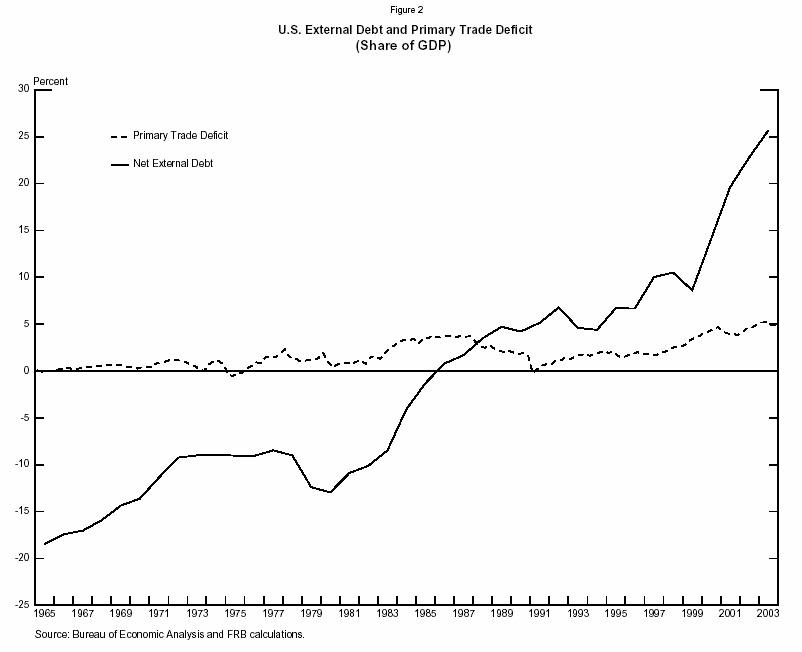
This is a serious matter. The World Bank has objective criteria for moderately indebted and severely indebted nations:
Indebtedness : Standard World Bank definitions of severe and moderate indebtedness are used to classify economies in this table. Severely indebted means either of the two key ratios is above critical levels: present value of debt service to GNI (80 percent) and present value of debt service to exports (220 percent). Moderately indebted means either of the two key ratios exceeds 60 percent of, but does not reach, the critical levels. For economies that do not report detailed debt statistics to the World Bank Debtor Reporting System (DRS), present-value calculation is not possible. Instead, the following methodology is used to classify the non-DRS economies. Severely indebted means three of four key ratios (averaged over 2000-2002) are above critical levels: debt to GNI (50 percent); debt to exports (275 percent); debt service to exports (30 percent); and interest to exports (20 percent). Moderately indebted means three of the four key ratios exceed 60 percent of, but do not reach, the critical levels. All other classified low- and middle-income economies are listed as less indebted.
Looking at the non-DRS criteria, our national debt to GNI (GNI for 2003 was $10.9 trillion) is certainly over 50% at around 60-70% (our external debt alone is 25% of GNI); our national debt to exports is around 600%-700% (we exported $1.02 trillion in goods and services in 2003) which exceeds the 275% criterion; our national debt service to exports is well above 30%; our interest on our national debt to exports is over the 20% criterion.
Notice that I am using public debt figures; our debt positions as a country are worse, not better, since we are a large debtor nation.
So on all 4 non-DRS criteria, we are already in the "worrisome" category:
|
I imagine that the first effect will be that day when Moody's or S-and-P decides to put our sovereign debt "on review" of its AAA status. Moody's has not hesitated to lower Japan, which if you know anything about the Japanese economy in comparison to our own should give you pause, since Japan has arguably a far more robust economy than we do.
For reference, Moody's rating for Japan is based mostly on Japan's large and increasing public debt -- about 170% of GDP while we are still in the 70% range -- but there are some significant differences, including the fact that Japan, despite its lowered rating, is paying far less interest than we are due to accommodative measures from the Bank of Japan and the fact that Japan is wealthy -- Japan has strong positive income from not only its strong exports but also its overseas investments such as the Japanese government's $700+ billion dollars worth of U.S. Treasury debt. Amusingly, Japan is issuing lower rated debt at anywhere for 0% for short term money to 2.4% for long-term money to buy AAA debt (ours), and is benefiting from the spread since we pay over 5% for long-term money.
Strong Defense
A strong defense is as necessary now as it ever has been; the lessons of history have not been repealed, and we must remain strong and vigilant. We cannot ship all of our industry to China and remain a viable military power, much less a superpower. We cannot ship all of our research to India or China, and remain a military leader.
Politics
The people have spoken again, and for the first time we have elected a radical left-winger. It's going to be an interesting four years.