Posted on 04/24/2008 5:57:39 AM PDT by NYer

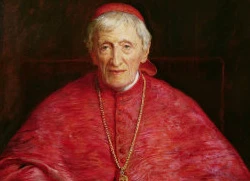
.- The Vatican has approved the beatification of Cardinal John Henry Newman, the English convert and theologian who has had immense influence upon English-speaking Catholicism, the Birmingham Mail reports.
John Henry Newman was born in 1801. As an Anglican priest, he led the Oxford Movement that sought to return the Church of England to its Catholic roots. His conversion to Catholicism in 1845 rocked Victorian England. After becoming an Oratorian priest, he was involved in the establishment of the Birmingham Oratory.
He died in 1890 and is buried at the oratory country house Rednall Hill.
The Catholic Church has accepted as miraculous the cure of an American deacons crippling spinal disorder. The deacon, Jack Sullivan of Marshfield, Massachusetts, prayed for John Henry Newmans intercession.
At his beatification ceremony later this year, John Henry Newman will receive the title Blessed. He will need one more recognized miracle to be canonized.
The case of a 17-year-old New Hampshire boy who survived serious head injuries from a car crash is being investigated as a possible second miracle.
With thanks to freeper Huber for bringing this to my attention.
Lead kindly light..................
Man am I ever glad I took the easy way out and just did what Jesus said to do and got myself Born Again. All that miracle stuff is just to much work.

I like this photograph. He looks as though he's about to speak.
It's not as simple as it seems.
Yes, the Apologia of Newman conquers by its style, yet its style is far from being the main cause of its profound effect, its present (and increasing) position in European letters and in the story of our civilization. Its style alone, nay, its matter {viii} alone, would not have achieved these things. What has achieved them?The place of the Apologia is due to the fact that it puts conclusively, convincingly, and down to the very roots of the matter, the method by which a high intelligence, not only Anglican but of Oxford, and from the heart of Oxford, accepted the Faith.
It is one of the myriad converging proofs of Catholic Truth that its appeal is multiform. From its beginnings men appreciated that. It is all bound up in the story of Whitsuntide (in the octave of which this is written). One man and woman thus, another man, another woman in a wholly different way, from attitudes most adverse, from positions each, in the eyes of an opponent, impossibly hostile, repeats the famous words, "My Lord and my God."
- from the forward by Hillaire Belloc
What if you already have the title “blessed” or “saint?”
Well, isn’t that nice! But will it make the John Newman/John Neumann confusion better, or worse?
And we’re all happy for you, too.
Yikes! Of course that’s “foreward” - that’s what typing in a hurry and putting in a link will do for your facility in spelling . . . .
Let me see here, Jesus says it is, you say it isn't. Ponder,. ponder, ponder, who to believe? He who created the universes in six consecutive 24 hour days and went up on a cross for me? Or you.
Sorry AnAmericanMother, but, I'm going with Jesus. You do the reading, I'll do the praising.
Who makes it possible for you to know Jesus's word? How do you know about the Crucifixion and Resurrection? It isn't through Tacitus or Josephus, though they mention Jesus in passing. It's through Scripture -- which was collected, reviewed, and approved by the Church, out of the hundreds of quasi-Christian "scriptures" circulating in the Mediterranean world in the century after the death of Christ.
You can't reject the Church and not reject her work on behalf of her Head. Which is the only way you know Him.
Hey ... where's the entrance ramp to this highway to heaven? Is it in Scripture, because I have not found it.
Where do you get that a day has 24 hours? That’s only on earth, and there was no earth, in the beginning, so sun or any other stars, so HOW DO YOU KNOW????
Why not do both?
Better persevere to the very end, as St. Paul wrote, or else the Lord will vomit you out, as St. John wrote, for being lukewarm and complacent.
Do you know what makes up the church of Laodicea? Do you understand the significance of being a part of the Church of Philadelphia?
Do you understand what Jesus said to Nicodemus in John 3:3-21?
You are kidding aren't you? If not, I will answer your question, but I do hope you are kidding and not really that ignorant of God's word.
You might start at John 3:1-21. Hard for me to understand how you could read Scripture and have missed John chapter three.
I don't understand your question? Unless you are asking, "What if you are already really Born Again and are a Blessed Saint?"
Why thank you tax chick, I am grateful.
No, sorry but it's through the guidance of the Holy Spirit. You see, God helps you understand His book, if you are first and foremost His and second you ask His help.
Look, there were several hundred books circulating in the eastern Mediterranean in the centuries after Christ's ministry. Some of them were Gnostic, some heretical, some complete fantasy.
The Church (primarily St. Jerome, but many others) reviewed all this material and decided what was true and right, and declared what would become the Bible.
So you can't reject the work of the Holy Spirit through the Church in establishing the Canon of the Bible, because the Church MADE what you claim is your ultimate authority. By rejecting her, you reject the work of the Holy Spirit, upon which you claim to rely.
You’re welcome. I’m happy for anyone who has a sincere Christian faith!
Okay, I always get very curious when I see this line. If you don't mind, would you answer this question? Apologies to Avicenna or Averroes, who I think I've stolen this from.
Mr. X is on a deserted island. As far back as he can remember, he has always been on this island - he somehow knows English. He has no knowledge of the world beyond his island. He is a kind man, who sincerely seeks truth. One day, a crate washes up on the beach. Inside, it is full of books. Each book has no writing on its cover, and all are bound with the exact same leather. Each book of the Bible is inside, individually bound, including the keuterocanonical books. Also inside are the Infancy Gospel of Jesus, the Gospel of Thomas, the Gospel of Mary, the Gospel of Judas, the Apocalypse of Peter, Plato's Republic, Aristotle's Nicomachean Ethics, the Koran, the Hadiths, some of the Vedas...and more!
Just to be clear, is it your contention that the Holy Spirit will lead Mr. X to pull only the Books of the Bible out of that crate, not including the Deuterocanonical books, if he is sincere in his search for truth?
Jesus, not the Pope, not an individual, but Jesus, God, the Creator of the universes said: "Unless you are born again you will go to the lake of fire." John 3:3b.
You can argue till you are blue in the face or till the instant you are facing eternity, but understand this; your eternity, your salvation, is your responsibility. You pick your path based upon whatever you would like to use as facts. I have picked mine by putting my belief and faith in the Holy Word of God and His inerrant word.
The Catholic church yes, but not the Roman Catholic church. There is a huge difference. Fundamental Bible believing Born Again Christians who are members of the church of Philadelphia, as defined and identified in Revelation chapter three are members of the Catholic Church, but are not members of the Roman Catholic church.
Since AnAmericanMother and I were attempting to argue the same point, I want to comment on your response to her as well. First, the Roman Catholic Church is absolutely a subset of the Catholic Church - you'll find no disagreement from us there. There are plenty of Eastern Catholic Churches as well - the definition of Catholic we use (I am assuming you don't) includes all Churches in communion with the See of Peter. Yes, the Roman Church is the largest, but it is not the only.
If you are claiming, and I may be wrong, that the Holy Spirit gave the Bible to the "invisible" "catholic" Church, i.e. the group of all believers in Christ, and that is where canon stems from, I have a follow-up question. Do you believe the Deuterocanonical books are inspired Scripture? If not, why do the world's 1.15 billion Catholics believe it is, certainly a majority of Christians - has the Holy Spirit led them into error?
I am sincerely curious as to your answers - I've got hundreds more questions for you, but I don't want to ask them all at once. In regards to my salvation, I struggle every day. I do know I was saved from Original Sin by my Baptism and I've followed Jesus' command and eaten His Body. I hope I get to Heaven, but I know I'm not there yet.
And, actually, if you don’t mind, I have one more question. Do you believe American Indians, living in 200 AD, are cursed to Hell? Despite the fact there was no possible way for them to hear the Gospel?
Let me answer your question with a question. What does Jesus and the Bible say regarding that very subject. While not American Indians, the subject is discussed and answered in Romans.
There are many churches that are not "Roman Catholic" but nevertheless Catholic, i.e. acknowledge the successor of Peter as their head.
. . . . what you said! . . . .
Peter was not the head of the church, James the half brother of Jesus was.
"If anyone should say, 'Why then was it James who received the See of Jerusalem?' I should reply that he [Christ] made Peter the teacher not of that See, but of the world." - St. John Chrysostom.
You use the terms “See of Jerusalem” and “Holy See”, what is the “See of Jerusalem” and “Holy See”?
Have you ever read what Jesus said about putting traditions ahead of the Word of God in Mark Chapter Seven?
And since the bishops meeting in conference actually determined what would fall outside the Bible and what would fall inside the Bible, it's a circular reasoning. If the bishops had authority to establish the Bible (which is nowhere mentioned in the Bible, of course) they had authority to establish traditions in the Church.
In Mark, the Pharisees' traditions were established by men; but the problem they had was keeping the letter without the spirit - keeping the technical aspects of the law but without its justice - "This people with the lips doth honor Me, and their heart is far from Me."
The Holy Spirit guided the Church Fathers/elders/bishops (the presbuterous - and that word does appear in the Bible) in preserving the Word of God and compiling it in what we call the Bible, rejecting many, many books which were contemporaneous with but not the word of God. The Holy Spirit also guides the Church in resolving problems of faith and morals that arise from time to time (the various early heresies and their offshoots) and, as Christ promised, will see that the gates of hell do not prevail against His church.
So what you call 'traditions' that 'fall outside the Bible' are led by the Holy Spirit. St. Paul even mentions some of them in 2nd Thessalonians 2:15 - "brethren, stand fast, and hold the traditions which ye have been taught, whether by word, or our epistle." The Greek is dia logou - "by word of mouth".
The traditions of your religion are of no interest to me, I have chosen to follow He who shed His blood for me not those who would have me shed my blood for their comfort and power.
And, although it troubles you, the traditions of men (the early bishops of the church) established the Word of God as it now exists in the form we call "the Bible". We most firmly believe that they were led by the Holy Spirit, but men they were, nevertheless.
I'm sorry that it makes you uncomfortable, but it's an irrefutable historical fact that the two are intertwined.
To consider which traditions to accept requires very careful examination, sober thought, and the assistance of the Holy Spirit. Men can easily be led astray, as we have seen in the Episcopal Church, to thinking that almost anything, including their personal desire or political correctness, is the "promptings of the Holy Spirit". But that may be true also in Biblical interpretation. Remember what St. Peter said in 2nd Peter 2:16 about those who wrest Scripture unto their own destruction. He wouldn't have cautioned against it unless misinterpretation were possible -- hence, again, fallible men come into the equation.
It introduces an element of uncertainty, true. But there it is, and you cannot ignore portions of the Bible, just because they make you unhappy. It's the portions that make us unhappy that we should pay the closest attention to -- it's too easy to ignore those chapters and verses in the Bible with which we, personally, disagree. Heaven knows I am guilty of that myself!
I ignore no Scripture that is used in context.
But we are bound to give thanks alway to God for you, brethren beloved of the Lord, because God hath from the beginning chosen you to salvation through sanctification of the Spirit and belief of the truth:Whereunto he called you by our gospel, to the obtaining of the glory of our Lord Jesus Christ.
Therefore, brethren, stand fast, and hold the traditions which ye have been taught, whether by word, or our epistle.
Now our Lord Jesus Christ himself, and God, even our Father, which hath loved us, and hath given us everlasting consolation and good hope through grace,
Comfort your hearts, and stablish you in every good word and work.
St. Paul is being very plain. The Greek is equally plain: that the Christian faith as transmitted by St. Paul is taught not only through epistolhV but also through logou, and the absence of the modifier suggests not only "our" (his) but others.
St. Peter is also very plain, in context, in 2nd Peter 3:16:
And account that the longsuffering of our Lord is salvation; even as our beloved brother Paul also according to the wisdom given unto him hath written unto you;As also in all his epistles, speaking in them of these things; in which are some things hard to be understood, which they that are unlearned and unstable wrest, as they do also the other scriptures, unto their own destruction.
Ye therefore, beloved, seeing ye know these things before, beware lest ye also, being led away with the error of the wicked, fall from your own stedfastness.
Showing that Scripture may be misinterpreted by the amaqeiV (those who are not learned - the word has as its root the verb for "learn" or "be instructed" - you may recognize its resemblance to "mathematics") and asthriktoi (those who are not steadfast) - the same word appears in verse 17, and that good man John Bunyan translated it as "standfast".
There is only one learned and steadfast interpreter that dates back at the latest to men who themselves knew the apostles and were taught directly by them.
Disclaimer: Opinions posted on Free Republic are those of the individual posters and do not necessarily represent the opinion of Free Republic or its management. All materials posted herein are protected by copyright law and the exemption for fair use of copyrighted works.