Posted on 09/29/2009 5:41:50 AM PDT by JoeProBono
"There is a fifth dimension beyond that which is known to man. It is a dimension as vast as space and as timeless as infinity. It is the middle ground between light and shadow, between science and superstition, and it lies between the pit of man's fears and the summit of his knowledge. This is the dimension of imagination. It is an area which we call The Twilight Zone." - Rod Serling
SYRACUSE, N.Y. (AP) On a Friday night in October 1959, Americans began slipping into a dimension of imagination as vast as space and as timeless as infinity. They've really never returned.
(Excerpt) Read more at google.com ...

-Featured many soon-to-be-famous actors, such as Robert Redford, William Shatner, Burt Reynolds, Robert Duvall, Dennis Hopper, Carol Burnett, James Coburn, Charles Bronson, Lee Marvin and Peter Falk, as well as such Hollywood legends as Buster Keaton, Art Carney, Mickey Rooney, Ida Lupino and John Carradine
“The Obsolete Man” with Burgess Meredith is my absolute favorite; sad that we seem to be heading in that direction at warp speed...
One of my favorite Twilight Zone episodes was “Two”.
The ONLY actors in that episode were Charles Bronson and Elizabeth Montgomery, and there was no speaking.
It was all facial expression, gesticulation, and body language.
My favorite is a more contemporary episode starring Barack Obama in “The Empty Suit”.
Probably the most innovative television show of all time!

Strong stuff.
The very best episode of all, IMHO, is “Willoughby.” As in, “Will you be getting off in Willoughby, sir?”
“Willoughby...where a man can live his life full measure.”
http://www.joost.com/0945njx/t/The-Twilight-Zone-1-2-hr-Two?channel=09401u6#id=0945njx
Wow! Thanks for the tip!!
Great stuff!
I have at least 10 that are my favorites. Inga Stevens with the hitchhiker that follows her, the 4th dimension, with the little girl falling out of bed, the old man and his dog trying to find heaven, the Civil War episode with the woman sitting on her porch watching casualties of the Civil War pass by, Burgess Meredith with the nuclear holocaust and him having all the time in the world to read books, the sun getting closer to the earth, the girl who is ugly and needs surgery to make her look normal, the traveler who stumbles on this home where there is an imprisoned man who begs to be let out, and he is warned not to do so, Mardi Gras where the uncle makes his heirs wear masks, to name a few.
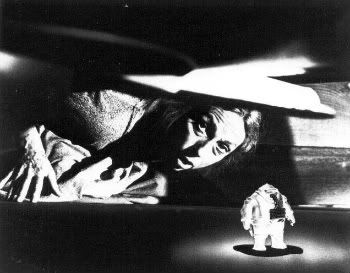
Twilight Zone Agnes Moorehead
“After hours” with Ann Francis, I had this mad crush on her.
One of my favorites! The episode was written by same guy who did The Waltons. “If dogs ain’t allowed in Heaven, I’ll keep on walking.”
The one where the pretty girl is considered ugly, in a world where everyone else looks like Helen Thomas on a good day or Michelle Obama on a bad one...
Another classic episode, submitted for your consideration: “To Serve Man,” starring Lloyd Bochner. “It’s a cookbook!”
My fav is the one with the atomic bomb and the guy is finally alone so he can read to his heart’s content but then breaks his glasses.

As big a fan as I am of “The Twilight Zone”, 1959 also saw the introduction of “One Step Beyond”. I always found that creepier because the episodes were supposedly based on actual events.

In a similar vein, another great episode is “The Shelter,” starring Jack Albertson. A group of suburban neighbors gathers at the home of a physician, to celebrate his birthday. It is also revealed that the doctor has installated a bomb shelter in his basement.
The party is interrupted by news of a pending nuclear attack; the physician and his family retreat into the small shelter while their friends stand outside, pleading for admittance. In the end, the neighbors use an improvised battering to gain entry into the shelter—just as the attack warning is cancelled. While the neighborhood has survived (physically), the fabric of the community has been forever changed.
Sterling’s closing comment: “For civilization to survive, the human race has to remain civilized. Tonight’s very small exercise in logic from The Twilight Zone.”
I still find it incredible that Serling wrote two-thirds of the episodes himself, and he was only 35 when the series debuted.
You got that right. And definitely one of the longer episodes.
So many were great, but “Walking Distance” with Gig Young remains my favorite. Especially now!
from a bygone era where talented people actually regarded television as literature. Nothing on the air today comes close to approaching this quality.
You better remember "It's a Good Life" or Billy Mumy will make this thread go to the cornfield.

The Shelter (Season 3, Episode 68) Message: As Rod Serling put it, For civilization to survive, the human race has to remain civilized.
Serling was a genius. He also wrote the screenplay for the original “Planet of the Apes.” Love that guy.

Time Enough at Last (Season 1, Episode Eight) Message: Be careful what you wish for, with underlying themes of anti-intellectualism. This episode is one of most well-known episodes in Twilight Zone history and one of the most-loved, coming in 1st place in a favorite episode poll in a recent issue of Twilight Zone Magazine. The story involves Henry Bemis (played by the great Burgess Meredith), a spineless and cuckolded bookworm who is constantly teased and harassed by his shrewish wife and slavedriving boss regarding his love for books. An H-bomb detonates while Henry is stealing a moment to read in the vault at the bank where he works, destroying all nearby civilization and killing everyone but him. Henry goes through a gamut of emotions from horror at the destruction to jubilation that he is finally alone and unbothered. This eventually turns to intense loneliness when he realizes that he is the only one left on Earth. He is near suicide when he notices that a nearby library seems mostly intact. Again overjoyed, Henry enters the library and discovers thousands of books that survived the explosion. He happily sorts through the contents and is about to sit down for the first of many leisurely reading sessions when he stumbles and breaks his glasses. The episode ends with Henry crying out, thwarted forever from reading his beloved books.
“Walking Distance” is all the more profound when you consider the real-life story of Gig Young’s own death: murder-suicide.
Yes, I’m familiar with it. Knowing he was so tortured explains the poignancy in his wonderful performance, doesn’t it? And the musical score was sheer perfection.
That is my #1 favorite!
I’ve got the entire dvd collection. One of the best purchases ever made. Hours of quality viewing. Nothing compares to The Twilight Zone. There are some dog epis but those are few and far between. Rod Serling left us with some great tv.
The music for that one was especially creepy. There was one where Lincoln had a dream about his own death, and he sees himself laying in a coffin, and then they play the creepy music.
What is the plot for that one? I don’t remember it.
He also wrote a screenplay about a prizefighter, whose name escapes me now. I think they made it into a movie.
“Requiem for a Heavyweight.”
"Martin Sloan, age thirty-six. Vice president in charge of media. Successful in most things -- but not in the one effort that all men try at some time in their lives -- trying to go home again.
And also like all men perhaps there'll be an occasion...maybe a summer night some time...when he'll look up from what he's doing and listen to the distant music of a calliope -- and hear the voices and the laughter of the people and the places of his past. And perhaps across his mind there'll flit a little errant wish...that a man might not have to become old -- never outgrow the parks and the merry-go-rounds of his youth.
And he'll smile then too because he'll know it is just an errant wish. Some wisp of memory not too important really. Some laughing ghosts that cross a man's mind...that are a part of The Twilight Zone."

I don't know much about it, but there has been some discussion in scientific circles that creativity peaks at a very young age, which is why a lot of seemingly very talented young artists flame out as they grow older.
Orson Welles was 26 when he directed Citizen Kane, and 27 when he directed The Magnificent Ambersons, by far his two biggest successes.

I looked it up on wikipedia:
Requiem for a Heavyweight was originally a teleplay written by Rod Serling and produced for the live television show Playhouse 90 on 11 October 1956. Six years later, it was filmed as a 1962 movie starring Anthony Quinn, Jackie Gleason, and Mickey Rooney.
The teleplay won a Peabody Award, the first given to an individual script, and helped establish Serling’s reputation. The broadcast was directed by Ralph Nelson and is generally considered one of the most famous examples of live television drama in the United States, as well as being Serling’s personal favorite of his own work.
More on Mr. Serling:
Rod Serling served as a U.S. Army paratrooper and demolition specialist with the 511th Parachute Infantry Regiment, 11th Airborne Division in the Pacific Theater in World War II from January 1943 to January 1945. He was seriously wounded in the wrist and knee during combat and was awarded the Purple Heart and Bronze Star.
Serling’s military service deeply affected the rest of his life and influenced much of his writing. Due to his wartime experiences, Serling suffered from nightmares and flashbacks. During his service in World War II, he watched as his best friend was crushed to death by a heavy supply crate dropped by a parachute onto the field. Serling was rather short (5’4”) and slight. He was a noted boxer during his military days.[2]
Mr. Serling, I SALUTE YOU!
When he thinks that a meeting has gone on too long and lost its focus, he's been known to walk to a back corner of the room, look into an imaginary camera and say "Submitted for your consideration......."
Needless to say, he has earned the gratitude of the participants many times.
Disclaimer: Opinions posted on Free Republic are those of the individual posters and do not necessarily represent the opinion of Free Republic or its management. All materials posted herein are protected by copyright law and the exemption for fair use of copyrighted works.