
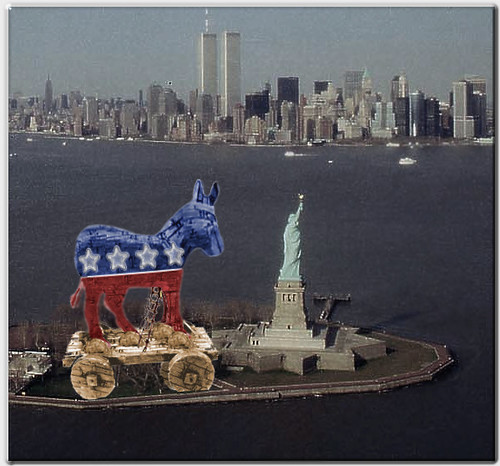
This is a Tea Partier:
Go with the Tea Partier.
Posted on 11/11/2009 10:22:40 PM PST by Jim Robinson
Wish I could be there!
Ping your lists. Ping, er, call your friends, neighbors, co-workers and relatives. There’s a tea party going on!!
Good Job, Fearless Leader!
Give them a kick in the keester for me, will ya? “This one’s for Grammie”! WHAM!
This is a Tea Partier:
Go with the Tea Partier.


bump
ToY.....tea and Florida....bump
Hoping we can keep up the anger with both the Democrats and the RINOs! Let them know we have had enough! I really hope this keeps going!
Amen!
See you there Jim.... :-)
Damn this globull warming. Not a single storm this season, and one comes up in November. :)
Give DC hell.
Will see you there! I bow to you, sir!

I’ll be there! Whoo Hoo!! bttt



Veto of federal public works bill
March 3, 1817
"To refer the power in question to the clause "to provide for common defense and general welfare" would be contrary to the established and consistent rules of interpretation, as rendering the special and careful enumeration of powers which follow the clause nugatory and improper. Such a view of the Constitution would have the effect of giving to Congress a general power of legislation instead of the defined and limited one hitherto understood to belong to them, the terms "common defense and general welfare" embracing every object and act within the purview of a legislative trust. It would have the effect of subjecting both the Constitution and laws of the several States in all cases not specifically exempted to be superseded by laws of Congress, it being expressly declared "that the Constitution of the United States and laws made in pursuance thereof shall be the supreme law of the land, and the judges of every state shall be bound thereby, anything in the constitution or laws of any State to the contrary notwithstanding." Such a view of the Constitution, finally, would have the effect of excluding the judicial authority of the United States from its participation in guarding the boundary between the legislative powers of the General and the State Governments, inasmuch as questions relating to the general welfare, being questions of policy and expediency, are unsusceptible of judicial cognizance and decision."
James Madison
President of the United States
“What defines the “general welfare”?
As James Madison explained, the general welfare is defined by the list of enumerated powers in the seventeen clauses that follow. These include the power to borrow money, to establish post offices, to define and punish piracy, to raise and support armies.
The fundamental point was that the federal government did not possess a general grant of power, but was limited to enumerated or delegated powers. The rest of the general reservoir of governmental power (known as the “police power”) was left to the states. The Tenth Amendment reiterated the point.
The language of the Constitution was quite explicit about this precise to the point of punctuation. A draft of the document at the Constitutional Convention contained a semicolon between the taxing phrase and the general welfare phrase. As an independent clause, the taxing power could have been used for any purpose under the sun. Instead, the sharp-eyed founders substituted a comma for the semicolon, thus tethering the taxing power to the general welfare clause and the enumerated powers.
It is notable that the enumerated powers all involve subjects that are of genuinely national significance many concern foreign affairs, the territories, and the federal district. Hardly anyone would deny that the army and navy could be left to states or individuals. The enumerated powers are also notably specific. Why write that Congress has the power to “provide for the punishment of counterfeiting the securities and current coin of the United States” if Congress could punish all sorts of other crimes?
Of course, the list includes the power “to make all laws which shall be necessary and proper for carrying into execution the foregoing powers.” But this simply meant that Congress enjoyed a choice of means by which it could achieve the foregoing ends.
It is true that, contra Madison, Alexander Hamilton regarded the general welfare clause as a grant of power beyond those enumerated. But even Hamilton agreed that the end had to be general. ...”
Read it all: http://biggovernment.com/2009/10/24/the-education-of-congressman-hoyer/
Alexander Hamilton, in Federalist 22 writes : The fabric of American empire ought to rest on the solid basis of THE CONSENT OF THE PEOPLE. The streams of national power ought to flow immediately from that pure, original fountain of all legitimate authority.
That’s us. That’s we, the people.
In Federalist 23, he writes of the “principal purposes” of a union of the states: “...the common defence of the members; the preservation of the public peace, as well against internal convulsion as external attacks; the regulation of commerce with other nations and between the States; the superintendence of our intercourse, political and commercial, with foreign countries. “
Those are the principal purposes of our United States government. Not taking over private corporations like banks and auto companies and insurance companies. Or, the entire health care system. Not determining and confiscating the pay of private individuals. Those, my friends are the principal purposes of Socialist regimes.
Consent of the People http://www.wiseandfrugalgovernment.blogspot.com/
Disclaimer: Opinions posted on Free Republic are those of the individual posters and do not necessarily represent the opinion of Free Republic or its management. All materials posted herein are protected by copyright law and the exemption for fair use of copyrighted works.