|
Posted on 06/01/2003 12:00:09 AM PDT by SAMWolf
|
|
 are acknowledged, affirmed and commemorated.
|

| Our Mission: The FReeper Foxhole is dedicated to Veterans of our Nation's military forces and to others who are affected in their relationships with Veterans. We hope to provide an ongoing source of information about issues and problems that are specific to Veterans and resources that are available to Veterans and their families. In the FReeper Foxhole, Veterans or their family members should feel free to address their specific circumstances or whatever issues concern them in an atmosphere of peace, understanding, brotherhood and support.
|
|
|
|
- Vera Cruz to Mexico City (1847-1848) From a rendezvous at Lobos Island almost 50 miles south of Tampico, General Scott's force of 13,660 men, of whom 5,741 were Regulars, set sail on March 2, 1847, for the landing near Vera Cruz—the first major amphibious landing in the history of the U.S. Army. On March 5 the transports were off the coast of their target, where they met a U.S. naval squadron blockading the city. In a small boat Scott, his commanders, and a party of officers including Robert E. Lee, George G. Meade, Joseph E. Johnston, and Pierre G. T. Beauregard ran close inshore to reconnoiter and came near being hit by a shell fired from the island fortress of San Juan de Ulua opposite Vera Cruz, a shell that might have changed the course of the Mexican War and the Civil War as well. 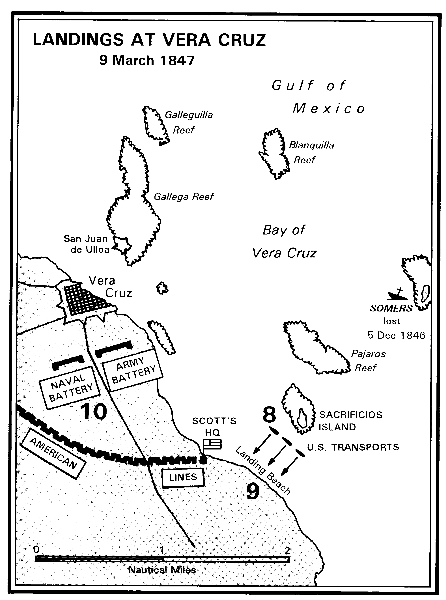 Scott chose for the landing a beach nearly 3 miles south of the city, beyond the range of the Mexican guns. On the evening of March 9, in four hours more than 10,000 men went ashore in landing craft, consisting of 65 heavy surf boats that had been towed to the spot by steamers. The troops proceeded inland over the sand hills with little opposition from the Mexican force of 4,300 behind the city's walls. The landing of artillery, stores, and horses, the last thrown overboard and forced to swim for shore, was slowed by a norther that sprang up on March 12 and blew violently for four days, but by March 22 seven 10-inch mortars had been dragged inland and emplaced about half a mile south of Vera Cruz. That afternoon the bombardment began. Town and fort replied, and it was soon apparent that the mortars were ineffective. Scott found himself compelled to ask for naval guns from the commander of the naval force, Commodore Matthew C. Perry. The six naval guns— three 32-pounders firing shot and three 8-inch shell guns—soon breached the walls and demoralized the defenders. On March 27, 1847, Vera Cruz capitulated.  U.S. warships bombard San Juan de Ulua fortress at Veracruz. Scott's next objective was Jalapa, a city in the highlands about 74 miles from Vera Cruz on the national highway leading to Mexico City. Because on the coast the yellow fever season was approaching, Scott was anxious to move forward to the uplands at once, but not until April 8 was he able to collect enough pack mules and wagons for the advance. The first elements, under Bvt. Maj. Gen. David E. Twiggs, set out with two batteries. One was equipped with 24-pounder guns, 8-inch howitzers, and 10-inch mortars. The other was a new type of battery equipped with mountain howitzers and rockets, officered and manned by the Ordnance Corps. The rocket section, mainly armed with the Congreve, carried for service tests a new rocket, the Hale, which depended for stability not on a stick but on vents in the rear, which also gave it a spin like that of an artillery projectile. The rockets were fired from troughs mounted on portable stands. In addition to his two batteries, General Twiggs had a squadron of dragoons, in all about 2,600 men. He advanced confidently, though warned by Scott that a substantial army commanded by Santa Ana lay somewhere ahead. On April II, after Twiggs had gone about 30 miles, his scouts brought word that Mexican guns commanded a pass near the hamlet of Cerro Gordo. Near Cerro Gordo the national highway ran through a rocky defile. On the left of the approaching Americans, Santa Ana with about 12,000 men had emplaced batteries on mountain spurs and on the right of the Americans farther down the road his guns were emplaced on a high hill, El Telegrafo. He thus had firm command of the national highway, the only means he thought Scott had of bringing up his artillery.  The final battle of Cerro Gordo, April 18, 1847. Fortunately for Twiggs, advancing on the morning of April 12, the Mexican gunners opened fire before he was within range and he was able to pull his forces back. Two days later Scott arrived with reinforcements, bringing his army up to 8,500. A reconnaissance by Capt. Robert E. Lee showed that the rough country to the right of El Telegrafo, which Santa Ana had considered impassable, could be traversed, enabling the Americans to cut in on the Mexican rear. The troops hewed a path through forest and brush, and when they came to ravines, lowered the heavy siege artillery by ropes to the bottom, then hoisted it up the other side. By April 17 they were able to occupy a hill to the right of El Telegrafo, where they sited the rocket battery. Early on the morning of April 18 the battle began. Though Santa Ana, by then forewarned, had been able to plant guns to protect his flank, he could not withstand the American onslaught. The Mexicans broke and fled into the mountains. By noon Scott's army had won a smashing victory at a cost of only 417 casualties, including 64 dead. Santa Ana's losses were estimated at more than a thousand. Scott moved next morning to Jalapa. The way seemed open to Mexico City, only 170 miles away. But now he faced a serious loss in manpower. The term of enlistment of seven of his volunteer regiments was about to expire and only a handful agreed to re-enlist. The men had to be sent home at once to minimize the danger of yellow fever when they passed through Vera Cruz. The departure of the volunteers, added to wounds and sickness among the men remaining, reduced the army to 5,820 effectives.  Colonel Harney charges the Mexican position. In May Scott pushed forward cautiously to Puebla, then the second largest city in Mexico. Its citizens were hostile to Santa Ana and had lost hope of winning the war. It capitulated without resistance on May 15 to an advance party under General Worth. Scott stayed there until the beginning of August, awaiting reinforcements from Vera Cruz, which by mid-July more than doubled his forces, and awaiting also the outcome of peace negotiations then under way. A State Department emissary, Nicholas P. Trist, had arrived on the scene and made contact with Santa Ana through a British agent in Mexico City. Trist learned that Santa Ana, elected President of Mexico for the second time, would discuss peace terms for $10,000 down and $1,000,000 to be paid when a treaty was ratified. After receiving the down payment through the intermediary, however, Santa Ana made it known that he could not prevail upon the Mexican Congress to repeal a law it had passed after the battle of Cerro Gordo making it high treason for any official to treat with the Americans. It was clear that Scott would have to move closer to the capital of Mexico before Santa Ana would seriously consider peace terms. For the advance on Mexico City, Scott had about 10,000 men. He had none to spare to protect the road from Vera Cruz to Puebla; therefore his decision to move forward was daring: it meant that he had abandoned his line of communications, as he phrased it, "thrown away the scabbard." On August 7 Scott moved off with the lead division, followed at a day's march by three divisions with a three-mile-long train of white-topped supply wagons bringing up the rear. Meeting no opposition—a sign that Santa Ana had withdrawn to defend Mexico City—Scott by August 10 was at Ayolta, located on a high plateau 14 miles from the city.  Battle at Churubusco Color lithograph by Carl Nebel, 1851 The University of Texas at Arlington Library Special Collections The direct road ahead, entering the capital on the east, was barred by strongly fortified positions. Scott therefore decided to take the city from the west by a wide flanking movement to the south, using a narrow muddy road that passed between the southern shores of two lakes and the mountains and skirted a fifteen-mile-wide lava bed, the Pedregal, before it turned north and went over a bridge at Churubusco to the western gates of Mexico City. The Pedregal had been considered impassable, but Captain Lee found a mule path across its southwestern tip that came out at the village of Contreras. Scott sent a force under Bvt. Maj. Gen. Gideon J. Pillow to work on the road, supported by Twiggs's division and some light artillery. They came under heavy fire from a Mexican force under General Valencia. Pillow, manhandling his guns to a high position, attacked on August 19, but his light artillery was no match for Valencia's 68-pounder howitzer, nor his men for the reinforcements Santa Ana brought to the scene. American reinforcements made a night march in pouring rain through a gully the engineers had found through the Pedregal and fell upon the Mexicans' rear on the morning of August no, simultaneously with an attack from the front. In seventeen minutes the battle of Contreras was won, with a loss to Scott of only 60 killed or wounded; the Mexicans lost 700 dead and 800 captured, including 4 generals.  View of Cerro Gordo when Twiggs' division stormed the main heights. (Library of Congress) Scott ordered an immediate pursuit, but Santa Ana was able to gather his forces for a stand at Churubusco, where he placed a strong fortification before the town at the bridge and converted a thick-walled stone church and a massive stone convent into fortresses. When the first American troops rode up around noon on August no they were met by heavy musket and cannon fire. The Mexicans fought as never before; not until midafternoon could Scott's troops make any progress. At last the fire of the Mexicans slackened, partly because they were running out of ammunition, and the Americans won the day, a day that Santa Ana admitted had cost him one third of his forces. About 4,000 Mexicans had been killed or wounded, not counting the many missing and captured. The battle had also been costly for Scott, who had 155 men killed and 876 wounded. The victory at Churubusco brought an offer from Santa Ana to reopen negotiations. Scott proposed a short armistice and Santa Ana quickly agreed. For two weeks Trist and representatives of the Mexican Government discussed terms until it became clear that the Mexicans would not accept what Trist had to offer and were merely using the armistice as a breathing spell. On September 6 Scott halted the discussions and prepared to assault Mexico City. Though refreshed by two weeks of rest, his forces now numbered only about 8,000 men. Santa Ana was reputed to have more than 15,000 and had taken advantage of the respite to strengthen the defenses of the city. And ahead on a high hill above the plain was the Castle of Chapultepec guarding the western approaches.  Santa Anna Scott's first objective, about half a mile west of Chapultepec, was a range of low stone buildings, containing a cannon foundry, known as El Molino del Rey. It was seized on September 8, though at heavy cost from unexpected resistance. At eight o'clock on the morning of September 13, after a barrage from the 24-pounder guns, Scott launched a three-pronged attack over the causeways leading to Chapultepec and up the rugged slopes. Against a hail of Mexican projectiles from above, his determined troops rapidly gained the summit, and though they were delayed at the moat, waiting for scaling ladders to come up, by half past nine o'clock the Americans were overrunning the castle. Scarcely pausing, they pressed on to Mexico City by the two routes available and by nightfall held two gates to the city. Exhausted and depleted by the 800 casualties suffered that day, the troops still faced house-to-house fighting; but at dawn the next day, September 14, the city surrendered. Throughout the campaign from Vera Cruz to Mexico City General Scott had displayed not only dauntless personal courage and fine qualities of leadership but great skill in applying the principles of war. In preparing for battle he would order his engineers to make a thorough reconnaissance of the enemy's position and the surrounding terrain. He was thus able to execute brilliant flanking movements over terrain that the enemy had considered impassable, notably at Cerro Gordo and the Pedregal, the latter a fine illustration of the principle of surprise. Scott also knew when to break the rules of warfare, as he had done at Puebla when he deliberately severed his line of communications.  Storming Chapultepec Castle, Sept. 13, 1847 "He sees everything and counts the cost of every measure," said Robert E. Lee. Scott on his part ascribed his quick victory over Mexico, won without the loss of a single battle, to the West Pointers in his army, Lee, Grant, and many others. As for the troops, the trained and disciplined Regulars had come off somewhat better than the volunteers, but the army on the whole had fought well. Scott had seen to it that the men fought at the right time and place. Grant summed it up: "Credit is due to the troops engaged, it is true, but the plans and strategy were the general's." For two months the only responsible government in Mexico was the American military government under Scott. The collection of revenues, suppression of disorder, administration of justice, all the details of governing the country were in the hands of the Army. When the Mexicans finally organized a government with which Commissioner Trist could negotiate a peace treaty, dispatches arrived from Washington instructing Trist to return to the United States and ordering Scott to resume the war. Knowing that the Mexicans were now sincerely desirous of ending the war and realizing that the government in Washington was unaware of the situation, both Trist and Scott decided to continue the negotiations. 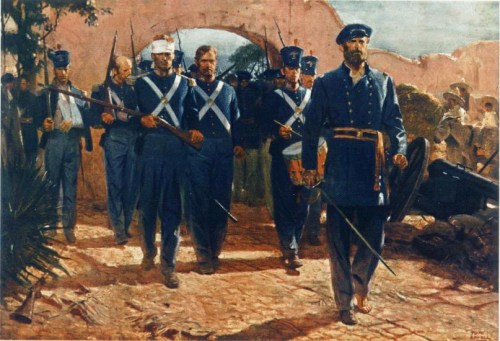 Quitman and Battalion of Marines Entering Mexico City (Gen. John A. Quitman was the first President of the Aztec Club of 1847.) Tom Lovell. For the U. S. Marine Corps. On February 2, 1848, the Treaty of Guadalupe Hidalgo was signed. It was ratified by the U.S. Senate on March 10, but powerful opposition to it developed in Mexico. Not until May 30 were ratifications exchanged by the two governments. Preparations began immediately to evacuate American troops from Mexico. On June 12 the occupation troops marched out of Mexico City, and on August 1, 1848, the last American soldiers stepped aboard their transports at Vera Cruz and quitted Mexican soil. By the Treaty of Guadalupe Hidalgo the United States agreed to pay Mexico $15 million and to assume the unpaid claims by Americans against Mexico. In return Mexico recognized the Rio Grande as the boundary of Texas and ceded New Mexico (including the present states of Arizona, New Mexico, Utah, and Nevada, a small corner of present-day Wyoming, and the western and southern portions of Colorado) and Upper California (the present state of California) to the United States.
|
Glad you liked the roses, Sam. :-)
Disclaimer: Opinions posted on Free Republic are those of the individual posters and do not necessarily represent the opinion of Free Republic or its management. All materials posted herein are protected by copyright law and the exemption for fair use of copyrighted works.


