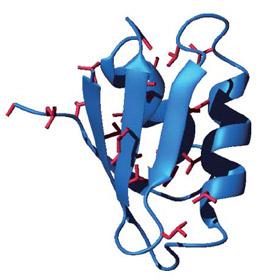
 Scientists have used NMR to look at proteins including TTHA1718 (above) inside living cells.Nature
Posted on 03/07/2009 11:51:47 PM PST by neverdem
Nuclear magnetic resonance spies the atomic details of proteins in action.
Scientists have used NMR to look at proteins including TTHA1718 (above) inside living cells.NatureThe atomic structures of proteins at work inside cells can now be probed, thanks to researchers who have modified a technique that is already widely used in labs and for medical imaging.
When a protein is inside a cell — rather than in a test tube — it behaves subtly differently because it may be interacting with other biological molecules that float around in the cellular space. Because proteins are hard to work with unless they are purified and concentrated, it has been difficult to pin down any structural changes that they might undergo in cells.
Now, a team of researchers in Japan, led by Yutaka Ito at the Tokyo Metropolitan University, has overcome these problems by adapting a well-known technique — nuclear magnetic resonance (NMR) spectroscopy — and using it to work out the three-dimensional structure of a protein inside a bacterial cell. "The 3D structure is very important for the biologist, but also for the pharmaceutical industry," says Ito.
Meanwhile, a second team in Japan, led by Masahiro Shirakawa at Kyoto University, has also used a twist on the technique to make the first measurements of proteins undergoing changes inside human cells.
NMR spectroscopy measures how different atomic nuclei interact with others in their vicinity when placed in a magnetic field. That information can be used to calculate the distance between atoms within a molecule, or to atoms of a close neighbour. Volker Dötsch, now at the University of Frankfurt, Germany, and his colleagues were the first to show that the technique could be used to look at proteins inside cells in 20011.
Dötsch managed this by labelling the protein of interest with a rare nitrogen isotope and getting bacterial cells to produce it in large amounts. He then ran an NMR experiment on the overexpressed protein and compared the results with the NMR spectrum of a non-cellular version of the protein to spot any changes.
Proteins in cells may exist for just a few hours, yet the experiments needed to get an NMR spectrum from within a cell can take up to two days, and require laborious sample preparation. As a result, Dötsch and colleagues were able to see only relatively large-scale changes to the protein and garner basic information about whether one protein was interacting with another.
Ito's team were able to improve on this by combining a range of existing NMR techniques and computer programs. They looked at a protein from the bacterium Thermus thermophilus called TTHA1718, which is thought to bind to heavy metals.
Ito predicted that water-hating, or hydrophobic, parts of a protein would be most affected inside the watery environment of a cell. So after inserting the gene encoding TTHA1718 into Escherichia coli bacteria, his team fed the microbes hydrophobic amino acids containing the 13C and 15N isotopes of carbon and nitrogen, so that the nuclei of atoms in these amino acids would show up in NMR experiments. This allowed the researchers to get their labelled protein produced in large amounts inside cells.
The team reduced the time needed for each experiment by gathering incomplete data sets and using a mathematical algorithm to fill in the missing pieces, a technique that has been used in previous NMR experiments. Finally, a computer program that carries out automated protein-structure calculations helped them to fill in the missing gaps for the parts of the protein in the cell that weren't labelled.
This gave them the entire structure of the protein as it looks inside an E. coli cell. Their work is published in Nature2.
"You don't have any tools at hand if you want to study conformational changes [of proteins in cells]," says Dötsch. Until now, that is: "This will really fill a gap," Dötsch adds.
Meanwhile, Shirakawa and his colleagues have, for the first time, managed to get an NMR read-out for three different proteins inside a human cell by using a special protein tag.
To date, NMR of proteins in eukaryotic cells has only been carried out in frog egg cells, which are big enough to be injected with the protein of interest. In work published in Nature3, however, Shirakawa and colleagues tagged their proteins with cell-penetrating peptides that help the proteins get through the cell membrane without the need for injection. Once inside, the tag is removed by enzymes that occur naturally inside the cells, setting the proteins free.
Researchers thought that proteins inside cells could be squeezed into a more rigid shape. But Shirakawa's team found that wasn't the case for at least one protein — ubiquitin — that tags other proteins for degradation inside cells.
"They showed the opposite," says Alexander Shekhtman, a protein-NMR expert from the State University of New York at Albany. "Ubiquitin became more flexible."
This flexibility has never been seen before for ubiquitin in cells, but could explain why the protein — as its name suggests — binds to so many things, Shekhtman says.
The proteins in the human cells weren't produced in high enough concentrations to allow their structures to be determined. But, says Ito, "If we can increase NMR sensitivity ten-fold I think we can do structural determination of proteins in human cells."
Dötsch agrees, and thinks that techniques will develop to make this happen. "NMR has already become a factor of ten more sensitive over the past ten years," he says. The techniques used by Ito and Shirakawa will be useful for drug companies screening their candidate molecules to see how they interact with proteins inside cells, he adds.
"I expect people will start looking at proteins that have significant flexibility in parts and look at those proteins in cells," Shekhtman predicts. For example, proteins that form fibrils are implicated in diseases such as Alzheimer's, and these could be studied now. "You can put proteins in neurons and see what the structure is," says Shekhtman.
lol
Thanks, BFL.
Disclaimer: Opinions posted on Free Republic are those of the individual posters and do not necessarily represent the opinion of Free Republic or its management. All materials posted herein are protected by copyright law and the exemption for fair use of copyrighted works.