Now you're asking me to "data-dredge."Not really. 1998 was clearly an anomalously warm year. Should an anomalously warm year be used as a starting point, or should you honestly test other time-periods (longer, shorter, different starting points) for trends? You whacked with the 1998-2007 trend, with the warmest possible starting point that could be chosen in the past 30 years. I suggested trying a different starting point, because possibly, maybe, it could be that that particular starting point influences the results a tad.
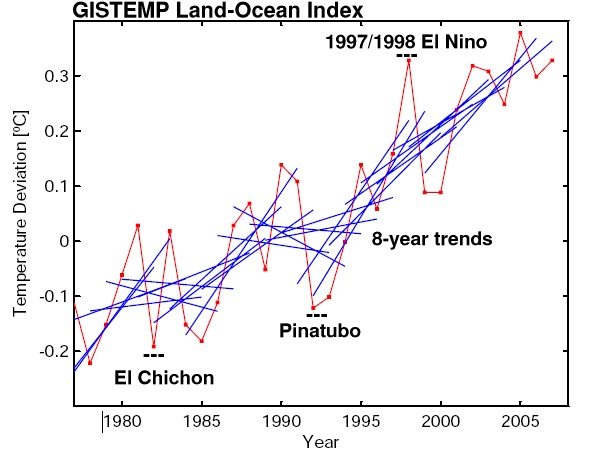
Choose a trend. Which one is significant? Which isn't? Or isn't it clear that maybe 8-9-10 years is a little bit short to be jumping to conclusions about what's significant or what isn't? And wasn't that the actual point of the authors' paper?
Or isn't it clear that maybe 8-9-10 years is a little bit short to be jumping to conclusions about what's significant or what isn't? And wasn't that the actual point of the authors' paper?Won't be able to reply after this on this thread. I'm going to be in a large project for the next several days. But no, his point was that global warming was continuing, despite the obvious plateauing in the data for the past ten years. His analysis of the 1998 - 2007 data verged on scientifically dishonest, claiming that the data supported an upward trend but holding back the silly p-values.
This plateauing is why the AGW guys are suddenly adjusting their models to predict that temperatures will be falling for the next ten years or so. Anyone who thinks the past 9 years of data have not thown a panic into the AGW world doesn't realize what these data mean. They mean: (1) Temperature has not gone up for almost ten years now. The past 3-4 years have trended down (although not statistically significantly yet--we need another year or two of data to get statistical significance); (2) The previous AGW models substantially overpredict the temperatures that have actually occurred since 1999.
So for all the "no need to not worry, temperatures are still rising" rhetoric, the reality is they are frantically going back and redoing the models at this very moment because the last 9 years establish that the existing models have been overpredicting temperatures with high statistical significance.
As a result, we now see the recent German AGW publication to this effect.
You and I had a previous discussion about this process and how constant redoing of the model produces overfitting to the back data. This is just another new parameter shoved into an unvalidated model to make it fit to new data that previous versions could not explain. But the likely reason the previous version did not work is that it was already overfit because of the high dimensionality of the parameterization of the model and a very limited data set with which to set the parameters.
I've already spent more time on this post that I can afford. God bless and good night!