Skip to comments.
Waiting for Global Cooling
National Climate Centre, Australian Bureau of Meteorology
| April 2008
| Fawcett, Jones
Posted on 05/03/2008 8:58:57 PM PDT by cogitator
An analysis of recent temperature data by two scientists at the Australia Bureau of Meteorology.
Waiting for Global Cooling (PDF)
TOPICS: Science
KEYWORDS: analysis; australia; climate; trends
Navigation: use the links below to view more comments.
first previous 1-20, 21-38 last
To: Perchant
Does that mean your la nina ended or did it take a vacation for a month?It means that the La Nina effects aren't completely negating the general warming trend. It was colder during the NH winter than average in many places, probably due to La Nina. March is a transition month, and because warming is causing an earlier spring, this earlier spring translates into a warmer month than average. If La Nina persists, its effect may be more noticeable in suppressing summer temperatures. We'll just have to observe the data.
To: ModelBreaker
Now you're asking me to "data-dredge."Not really. 1998 was clearly an anomalously warm year. Should an anomalously warm year be used as a starting point, or should you honestly test other time-periods (longer, shorter, different starting points) for trends? You whacked with the 1998-2007 trend, with the warmest possible starting point that could be chosen in the past 30 years. I suggested trying a different starting point, because possibly, maybe, it could be that that particular starting point influences the results a tad.
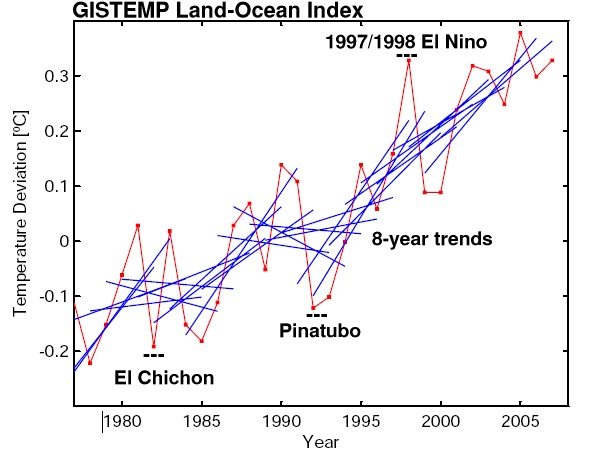
Choose a trend. Which one is significant? Which isn't? Or isn't it clear that maybe 8-9-10 years is a little bit short to be jumping to conclusions about what's significant or what isn't? And wasn't that the actual point of the authors' paper?
To: avacado
Your post the other day stated that in the USA March was the 63rd warmest in the past century. That's cold.You've got to stop being so parochial. The United States is approximately 2% of the world's surface area. North America is probably 4-5%.

Clearly, the U.S. and North America were particularly colder than normal. Find another place with a significant surface area that was particularly colder than normal.
Bing! Bing! Bing! Winner! The Pacific -- where La Nina is still holding on.
If you want to know why March is a significant "bellwether" month, see post 21.
To: PA Engineer
I swear if we start getting dumped on like 67 and 77 this winter my consensus is over. SOL wins.
24
posted on
05/04/2008 8:34:00 PM PDT
by
eyedigress
(If you aren't voting who cares about your opinion.)
To: cogitator
It means that the La Nina effects aren't completely negating the general warming trend. Wait a second. Let me try to wrap my mind around this. La nina trends were negating your warming expectations in earlier months though, weren't they? Why wouldn't they still be negated?
It seems that if your la nina weather god made any sense at all that it could only be sucking in heat energy ( into the pacific ) and if you want to say that it has a trend of sucking heat energy into the oceans, you got to expect that the oceans have gained a lot of heat during this prolonged "la nina" event that you and your fellow disciples of Al Gore have been insisting on.
With an ocean that has been super heated, as would be expected during a prolonged "la nina" event like you've been insisting on, if such an event existed by the laws of thermodynamics, you should be expecting that heat to be violently decompressed back into the atmosphere as soon as your mythical la nina event ends. Wouldn't you agree?
By the way, you don't believe in "cold energy", do you? I read some nasa claim in a google cache ( the original text had been removed ) that stated "la nina" somehow churns up the cold from the deep ocean and cools the atmosphere with it. Insane stuff that my tax dollars pay for. Do you agree with the theory or do you have another explanation for how your la nina fallacy cools the earth? If so, be specific about what it does with the heat. Where does it hide or sequester it?
25
posted on
05/04/2008 11:15:40 PM PDT
by
Perchant
To: cogitator
Or isn't it clear that maybe 8-9-10 years is a little bit short to be jumping to conclusions about what's significant or what isn't? And wasn't that the actual point of the authors' paper?Won't be able to reply after this on this thread. I'm going to be in a large project for the next several days. But no, his point was that global warming was continuing, despite the obvious plateauing in the data for the past ten years. His analysis of the 1998 - 2007 data verged on scientifically dishonest, claiming that the data supported an upward trend but holding back the silly p-values.
This plateauing is why the AGW guys are suddenly adjusting their models to predict that temperatures will be falling for the next ten years or so. Anyone who thinks the past 9 years of data have not thown a panic into the AGW world doesn't realize what these data mean. They mean: (1) Temperature has not gone up for almost ten years now. The past 3-4 years have trended down (although not statistically significantly yet--we need another year or two of data to get statistical significance); (2) The previous AGW models substantially overpredict the temperatures that have actually occurred since 1999.
So for all the "no need to not worry, temperatures are still rising" rhetoric, the reality is they are frantically going back and redoing the models at this very moment because the last 9 years establish that the existing models have been overpredicting temperatures with high statistical significance.
As a result, we now see the recent German AGW publication to this effect.
You and I had a previous discussion about this process and how constant redoing of the model produces overfitting to the back data. This is just another new parameter shoved into an unvalidated model to make it fit to new data that previous versions could not explain. But the likely reason the previous version did not work is that it was already overfit because of the high dimensionality of the parameterization of the model and a very limited data set with which to set the parameters.
I've already spent more time on this post that I can afford. God bless and good night!
To: Tolerance Sucks Rocks
Run the numbers anyway. With an original p of 0.67 for the one data set, there’s probably a good chance that p will still exceed 0.05I did. In my previous post, I told you that that four of the 125 data slices (one of them being the one you picked) show a statistically significant upward trend at the 95% confidence level (I didn't look for negative trends). That means P<=0.05 for those four only.
By random chance, we would expect that 6 would show a statistically significant trend by random chance. Of those 3, on average would be negative and three would be positive. So the fact that only four show a significant upward trend means that the upward trends found were most likely, random fluctuations due to picking the most favorable possible look at the data.
To: ModelBreaker
Even if you won't see this:
(1) Temperature has not gone up for almost ten years now. The past 3-4 years have trended down (although not statistically significantly yet--we need another year or two of data to get statistical significance); You (and others) keep getting this wrong. 1998 was about 0.2 C warmer than it would have been without an El Nino. (See my profile.) It should only have gotten as warm as 1998, according to the ~0.2 C warming trend, about NOW. The temperatures NOW are consistent with the ~0.2 C warming trend that started in the late 1970s. The 1998 El Nino was inconsistently/anomalously warm because of a big El Nino that year. So saying "Temperature has not gone up for almost ten years now" is very inaccurate. It is more accurate to say that global temperatures over the past 3-4 years have now reached the temperature achieved during the anomalous El Nino year of 1998.
(2) The previous AGW models substantially overpredict the temperatures that have actually occurred since 1999.
Cite one that does.
To: Perchant
La nina trends were negating your warming expectations in earlier months though, weren't they? Why wouldn't they still be negated?I don't think your statement above is accurate. The overall effect of La Nina could be a slight reduction of global temperature this year. This entire year. Over the entire globe. That doesn't mean that seasonal changes won't happen.
that stated "la nina" somehow churns up the cold from the deep ocean and cools the atmosphere with it. Insane stuff that my tax dollars pay for. Do you agree with the theory or do you have another explanation for how your la nina fallacy cools the earth? If so, be specific about what it does with the heat. Where does it hide or sequester it?
The best I can do is show you diagrams of how La Nina works. Note what happens to the thermocline in the Pacific.
Normal situation:

El Nino condition:

La Nina condition:

Based on these diagrams, do you see where the cold surface waters of a La Nina event come from? Is there anything else I can add that would substantially improve your understanding?
Bonus question: what happens to the thermocline in the western Pacific? What might this mean for the heat storage capability of the Pacific water column?
To: cogitator
Why whip out the charts to answer what should be a very simple question?
If you are going to say that la nina can be responsible for cooling earth's climate system during a given year, you need to be able to explain where in earth's climate system la nina is hiding the heat. Or, if those joules no longer remain in the system, how were they destroyed?
30
posted on
05/05/2008 9:19:34 AM PDT
by
Perchant
To: Perchant
Why whip out the charts to answer what should be a very simple question?Because the charts answer the question, and if you considered them you might realize what the answer is, without accusing me of believing in "insane stuff" or the "La Nina fallacy". The charts diagram the characteristics of La Nina and El Nino. Are they sufficient to allow you to understand how they work? If not, do you have any particular specific questions?
you need to be able to explain where in earth's climate system la nina is hiding the heat.
It's not hiding. Look at the La Nina diagram and examine the thermocline depth in the western Pacific. (Compare to the "normal" condition to make this clearer.)
To: cogitator
When you claim that la nina can make the global climate cooler during a given a year, you need to account for the heat that isn't accounted for in that particular cooler yearly statistic.
If you are claiming that the heat moves into the deep ocean during la nina, you need to explain why only surface ocean temperatures are relevant when drawing up statistics.
If your la nina made sense, ocean surface temps would become warmer when a la nina event begins if it is drawing heat from the atmosphere. There is something between the atmosphere and the deep ocean and it's called the ocean surface. Your claim is that the atmosphere and the ocean surface simultaneously lose joules during a la nina.
None of your charts can discredit the laws of thermodynamics, no matter how hard you wish they could.
32
posted on
05/05/2008 10:30:23 AM PDT
by
Perchant
To: cogitator

Forget El Nino, the error bars from 1995 and the 2008 overlap which means there has been no statistically significant warming during that time. So says Richard Lindzen. And I think he is absolutely correct.
33
posted on
05/05/2008 10:57:04 AM PDT
by
jwalsh07
(El Nino is climate, La Nina is weather.)
To: Perchant
When you claim that la nina can make the global climate cooler during a given a year, you need to account for the heat that isn't accounted for in that particular cooler yearly statistic.OK.
If you are claiming that the heat moves into the deep ocean during la nina, you need to explain why only surface ocean temperatures are relevant when drawing up statistics.
Regarding the first part of the sentence above, that is not the claim (and note that the claim is not "mine".) Regarding the second half of the sentence, I have no idea what you mean.
If your la nina made sense, ocean surface temps would become warmer when a la nina event begins if it is drawing heat from the atmosphere.
La Nina events do not "draw heat" from the atmosphere. They allow increased heating of the western Pacific warm pool by solar radiation. Which would've been apparent if you had actually considered the diagrams and thought about what was happening.
Children of the Tropics: El Niño and La Niña
See paragraph beginning "Recent work..."
Your claim is that the atmosphere and the ocean surface simultaneously lose joules during a la nina.
First of all, I don't think that "losing joules" is the right way to express a cooling process. I believe that would apply to a heating process, i.e., if something is heated by a heat source, then the heat source "loses" joules that are gained by the something that is heating up.
Now, when the air mass directly above the cooler ocean waters gets cooled by those waters, the heat gets displaced, essentially upward, by the cooler air below. A warmer air mass will radiate more energy to space. Also, cooler air aloft will cause condensation, and the latent heat of condensation may account for the rest of the heat. More rainfall over the western Pacific is expected during a La Nina.
To: jwalsh07
That strikes me as erroneous. You can’t just blankly state that because the lower bound of one error bar overlaps with the higher bound of a different error bar (and are these 1-, 2-, or 3-sigma error bars?) that there is no statistically significant trend. Error bar range is not considered when a significance test is done. Even I know that.
To: cogitator
First of all, I don't think that "losing joules" is the right way to express a cooling process. Well, according to Hansen, gaining joules is the right way to explain the heating process. He actually explained this in terms of additional watts per cubic meter of atmosphere gained by the added co2 in the atmosphere that would be analogous with a small light bulb lit within that cubic meter. You'll obviously light fewer Christmas tree lights when that cubic meter of atmosphere is cooler. Therefore your la nina has caused the loss of joules ( or watts, calories, whatever you like ) in the atmosphere and ocean surface, if you believe in the la nina fallacy that is.
Now, when the air mass directly above the cooler ocean waters gets cooled by those waters, the heat gets displaced, essentially upward, by the cooler air below.
Heat moves toward cold. It does not get into shoving contests with your "cold energy". What does this blast of cold air get displaced with in your 2nd law denying imagination? Wouldn't it have to be something warmer? Once it clicks in your mind that it would have to be displaced with something warmer, you can contemplate where that warmth came from and maybe you'll realize that your theory is invalid.
A warmer air mass will radiate more energy to space.
Is this factored in your climate models? This would mean sinks increase as your greenhouse effect increases and even more than equilibrium meaning that the greenhouse effect causes cooling. Think about what you are asserting before you assert it.
Also, cooler air aloft will cause condensation, and the latent heat of condensation may account for the rest of the heat. More rainfall over the western Pacific is expected during a La Nina.
La nina does what is convenient for your kind to claim it does during any particular point in time. Case in point:
March 10, 2000
Web posted at: 10:01 p.m. EST (0301 GMT)
ATLANTA (CNN) -- The warm, dry weather associated with the "La Nina" weather phenomenon brought the warmest winter in U.S. history, and could bring a rough fire season to the Southeast United States, according to two separate U.S. government reports released Friday.
Eight years later you want to blame la nina when the winter is colder than your climate change panic predictions indicate.
36
posted on
05/05/2008 1:48:05 PM PDT
by
Perchant
To: Perchant
I'd rather not get bogged down in semantics. And I'm perfectly sure that the 1st and 2nd laws of thermodynamics don't get violated by El Nino and La Nina events.
I'm also sure that if I filled a bathtub containing water at room temperature with a lot of ice, the air in the bathroom containing the bathtub would also slowly get colder. Would you agree that is what would happen? Were any thermodynamic laws violated in the cooling of the room? Where did the heat in the room go? (Answer: mostly to heat the water, transfer-of-energy process establishing thermal equilibrium).
Note that when the ice was first poured into the bathtub (unless there was a very strong circulation fan going), putting your hand just above the surface of the water would have detected very cool air. The water has cooled the "boundary layer" just above the surface. That layer was not well-defined before the ice was added because conditions were essentially at equilibrium. So now there is a layer of cold air with a layer of warm air above it. This change will alter the movement of air in the room. When it happens in the Pacific Ocean, it alters the movement and characteristics of the air masses above the Pacific Ocean surface.
A warmer air mass will radiate more energy to space. Is this factored in your climate models? This would mean sinks increase as your greenhouse effect increases and even more than equilibrium meaning that the greenhouse effect causes cooling.
It's not that simple. However, the atmospheric manifestation of the anthropogenic greenhouse effect is an upward movement of the tropopause, caused due to the climate system's never-ending search for equilibrium. This has been measured and observed. In case you think I don't know what I'm talking about, read:
Rising Height of Atmospheric Boundary Points to Human Impact on Climate
Moving on... in a related area, some of the observed stratospheric cooling is due to anthropogenic global warming. Why? Because the longwave radiation is trapped by the increasing concentrations of greenhouse gases. The stratosphere is warmed by the outgoing LR, so if that flux is reduced, then the stratosphere will cool off. Which it is. A warmer air mass radiates more longwave "spaceward" -- so to summarize, yes, all of this is in the models.
So, to summarize:
-- the larger area of cooler water in the Pacific characteristic of a La Nina event cools off the overlying air mass. Because air masses move, this cooler air will move around the world, and contribute to lower surface air temperatures in many regions of the globe. The surface waters will gradually warm during this process.
-- at the same time, the thermocline depth in the western Pacific deepens. This allows for greater storage of heat in the western Pacific water column. Also, reduced cloud cover in the western Pacific during a La Nina may also increase the heat content of these waters due to increased solar irradiance.
Final conclusion: the increased area of cooler water in the Pacific during a La Nina event causes lower surface air temperatures. Even if the mechanism is misunderstood, that's what happens.
(Further badgering will not engender a reply. A substantive question free of nuance and insinuation might.)
To: cogitator
I'm also sure that if I filled a bathtub containing water at room temperature with a lot of ice, the air in the bathroom containing the bathtub would also slowly get colder. Would you agree that is what would happen? As a result of the water getting warmer. Your la nina theory fallacy has the water cooling as it cools the atmosphere.
38
posted on
05/05/2008 2:44:31 PM PDT
by
Perchant
Navigation: use the links below to view more comments.
first previous 1-20, 21-38 last
Disclaimer:
Opinions posted on Free Republic are those of the individual
posters and do not necessarily represent the opinion of Free Republic or its
management. All materials posted herein are protected by copyright law and the
exemption for fair use of copyrighted works.
FreeRepublic.com is powered by software copyright 2000-2008 John Robinson