Neither is the "black" on a CRT... it is limited by the color of the screen when everything is turned off, which sometimes is actually a gray-green.
It is the ratio that can be attained by the brightest white to the least "white" gray that is important. The brighter the other areas of the screen, the "blacker" the others will appear in comparison.
To get an idea of how this works, the rectangles in the gray scaled large rectangle are the same shade of gray:
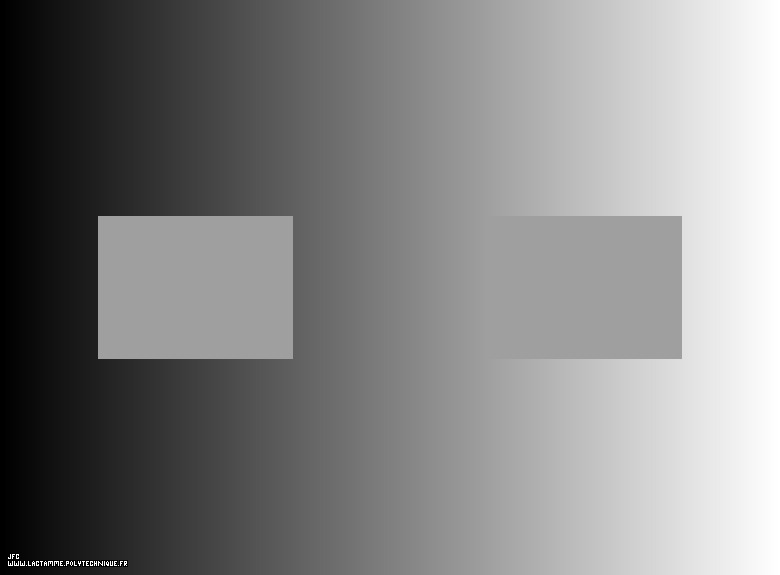
It only the contrast ratio that changes as you move from left to right. The one on the right appears "blacker" than the one on the left because of the other elements around it. In other words, if you can make the white whiter, then the black will seem blacker.
The best CRTs have a flat black mask and a very fine dot pitch (under .2 mm best are about .15mm ). In addition, CRTs are analog devices and can adjust their brightness in an infinite range between full bright and off... a LCD is digital and brightness is always in steps (usually 256) between full bright and off... meaning that a CRT can display the full range of possible colors and shades while a LCD is limited to 16,777,216 colors.