Skip to comments.
Texas Adopts 1847 Colt Walker As Official State Handgun
guns.com ^
| May 23, 2021
| Chis Eger
Posted on 06/16/2021 11:05:33 AM PDT by PROCON
click here to read article
Navigation: use the links below to view more comments.
first previous 1-20, 21-40 last
To: PROCON; et al
21
posted on
06/16/2021 2:15:32 PM PDT
by
S.O.S121.500
(Had ENOUGH Yet ? ........................ Enforce the Bill of Rights .........It is the LAW. )
To: S.O.S121.500
Interesting links, thanks.
22
posted on
06/16/2021 2:34:54 PM PDT
by
PROCON
(Our rights do not come from government, therefore they cannot take them away.)
To: DesertRhino
Should’ve been the Patterson (sic) or the dragoon. Those were much more important. The Paterson (correct spelling) was much more fragile than the Colt 1847 Dragoon (the actual name of the Colt Model now called the Walker). It was not called a “Walker” in 1847… It was referred to as a Colt “Dragoon Style” .44 caliber Revolver in the literature, but only gained the “Walker” moniker later. Captain Walker always referred to it as a Dragoon style gun when referencing its design on correspondence with Samuel Colt during their discussions as to what he wanted and expected.
What you are referring to were improved large frame Colts that were developed after the “Walker” that addressed deficiencies in the original design. The first of these were a group of Dragoons built on Walker frames with distinctive Dragoon barrels in the Walker serial number range, made by Colt to replace Walkers that were destroyed in service to the Texas Rangers. These are now called the “Fluck Dragoons”, after John Fluck, the collector who discovered their existence in the 1940s and documented their manufacture through diligent research. I have brokered one of these very rare guns (rarer than actual surviving Walkers) that came out of the woodwork in the mid-1970s, along with a genuine Walker Flask and Walker double horse holster rig. There are about 40 known surviving examples of the Fluck Dragoons of the approximately 300 manufactured to replace the destroyed Walkers. It’s now know through further research done in 1998 that another ~700 Pre-first model Colt Dragoons similar to the ones made to replace the Texas Ranger Dragoons (Walkers) were made for Mounted US Army Soldiers that were similar in their own serial number range. There are about 125 or so of these surviving.
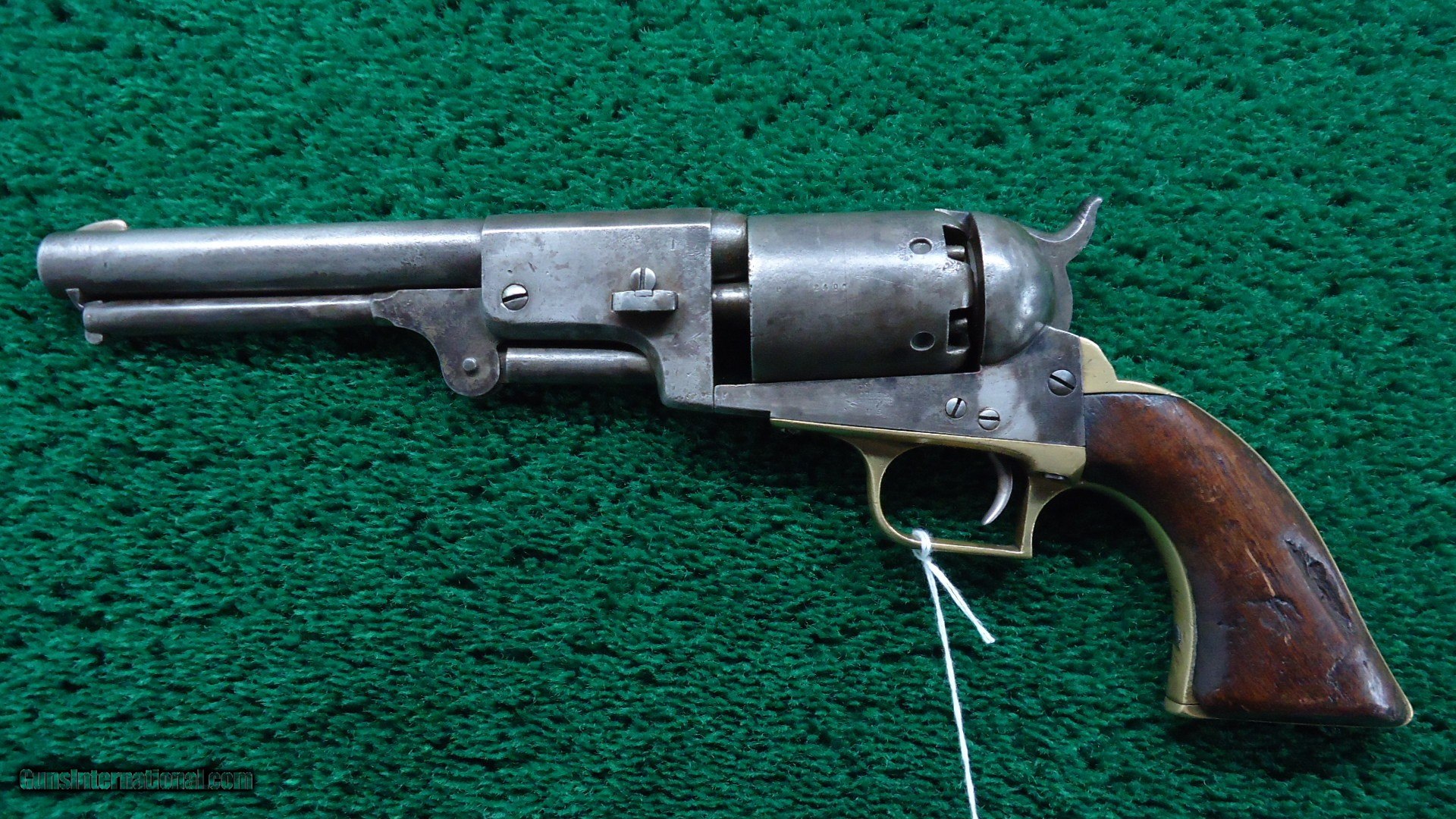
Rare Pre-First Model “Fluck” Dragoon In making these, Colt simplified the machining of the frame to grip fitting which continued with all the following designs.
For Texas, the iconic “Walker” Colt was most certainly more important to the state than the New Jersey Paterson or the following models of Dragoon revolvers made by Colt. In fact, until the introduction of the .357 magnum in the mid-1930s, the Colt Walker, even though it was in black powder, was the most powerful handgun in existence.
23
posted on
06/16/2021 2:53:15 PM PDT
by
Swordmaker
(My pistol self-identifies as an iPad, so you must accept it in gun-free zones, you hoplophobe bigot!)
To: Swordmaker
Incidentally, each pair of the “Fluck” Dragoons sold under contract to the US Army included a shoulder stock. Now that stock is extremely rare! The Texas Rangers did not get such a stock unless they special ordered it on their own dime. Some did, I understand.
24
posted on
06/16/2021 3:01:59 PM PDT
by
Swordmaker
(My pistol self-identifies as an iPad, so you must accept it in gun-free zones, you hoplophobe bigot!)
To: Swordmaker
There wouldn’t have been a Walker without a Paterson. And the Paterson was the first time a badly outnumbered ranger force prevailed at Bandera pass over Comanches.
More important.
25
posted on
06/16/2021 3:10:17 PM PDT
by
DesertRhino
(Dog is man's best friend, and moslems hate dogs. Add that up. ....)
To: PROCON
Little Bill Daggot said they were prone to blow up in the shooter’s hand. That’s how Corky Corkran managed to get hisself shot.
26
posted on
06/16/2021 3:11:57 PM PDT
by
LouAvul
(Lying headlines from fake news articles written by pimps masquerading as journalists.)
To: PROCON
As an aside, I’ve read that Convicted Felons can legally own Black Powder Firearms.
Not sure if it’s true. Just came to mind reading this Thread.
27
posted on
06/16/2021 3:15:12 PM PDT
by
Kickass Conservative
(THEY LIVE, and we're the only ones wearing the Sunglasses.)
There are a total of 164 known Walkers surviving today in museums and private collections in varying condition from the almost factory new, such as the “Sea Captain’s Walker” to relic, rusted inoperable. However, as one collector noted, “A Walker is a Walker.”.
28
posted on
06/16/2021 3:21:03 PM PDT
by
Swordmaker
(My pistol self-identifies as an iPad, so you must accept it in gun-free zones, you hoplophobe bigot!)
To: Swordmaker
Interesting story. Shame R. L. Wilson is gone or he could tell us how many cigarettes it would be worth. 😄
To: TokarevM57
Thanks,
I’m searching for the
Story about one Texas Ranger killed and his
Pistol taken.
Sometime later the Pistol
Was recovered from a hostile.
Fascinating Story.
30
posted on
06/16/2021 3:29:00 PM PDT
by
Big Red Badger
(Be Still and Know that I Am God. Rev 19)
To: Swordmaker
“Fluke”
First I’ve heard that.
Notice the Cylinder has been shortened,
Not as much Powder.
31
posted on
06/16/2021 3:39:33 PM PDT
by
Big Red Badger
(Be Still and Know that I Am God. Rev 19)
To: DesertRhino
There wouldn’t have been a Walker without a Paterson. And the Paterson was the first time a badly outnumbered ranger force prevailed at Bandera pass over Comanches. There I can agree with you… but those Patersons were a few personally purchased weapons, not ones officially purchased for the use of all Rangers. It did, however, convince Samual Walker of the beneficial nature of repeating firearms over even larger .58 caliber single shot weapons that could take up to a minute to reload. He knew what he wanted and got it.
By the way, Colt did make a few Paterson .36 caliber revolvers with loading levers he tried to market to the military as “Dragoons.” They did not get any traction at all with those to whom he showed them. They were too complicated to operate and clean. Plus they were far too expensive, at about four times the cost of a single shot percussion pistol, when all the accessories were included. The Patersons had a tendency to chain fire across cylinders and also their close tolerances meant that a little dirt or black powder fouling resulted in them locking up at inopportune times, like in the middle of a firing session, requiring breaking them down and a full cleaning with soap and water. The hidden trigger was a problem, too. Sometimes, it would not deploy. Not good if you really, really needed it. `
I would argue that the “Walker” was the first true Dragoon revolver, made to Samuel Walker’s specifications… and that is a purely Texan thing. They make ‘um BIG in Texas. GRIN! Colt apparently was not thinking anything that big a caliber. Walker was.
32
posted on
06/16/2021 3:48:10 PM PDT
by
Swordmaker
(My pistol self-identifies as an iPad, so you must accept it in gun-free zones, you hoplophobe bigot!)
To: LouAvul
Little Bill Daggot said they were prone to blow up in the shooter’s hand. That’s how Corky Corkran managed to get hisself shot. He was right. Almost 300 of the original shipment of 1000 “Walkers” to the Texas Rangers had their cylinders blow out in proof testing and were returned for new cylinders! The metallurgy of 1847 was simply not that good in that era. There was a lot of advancement between then and 1853 where they learned to improve the steel quality… but they also learned that 60 grains of black powder was just not a good idea when Colt recommended 50 grains maximum in the Walker. Colt got smart for the next round of Dragoons and made a shorter cylinder that wouldn’t take 60 grains and a bullet, which is why the Walker remained the most powerful handgun for 88 years until the .357 Magnum was introduced in 1934. People STILL loaded 60 grains and took their chances on blowing the cylinders. It’s also why less than 160 of them survive to this day.
By 1860, the quality of steel was good enough that Colt could introduce the much lighter weight 1860 ARMY .44 caliber with a much thinner walled cylinder without worrying that the cylinders would explode. It was built on the same frame as the light 1851 .36 caliber Navy Colt, with the frame cut to accept a larger stepped cylinder. Technology, ain’t it wonderful?
33
posted on
06/16/2021 3:59:24 PM PDT
by
Swordmaker
(My pistol self-identifies as an iPad, so you must accept it in gun-free zones, you hoplophobe bigot!)
To: Big Red Badger
Notice the Cylinder has been shortened,
Not as much Powder. Exactly… Black Powder is scalable. The more you put in, the more power. … until it blows out the end of the barrel it keeps burning.
The Fluck Dragoon I brokered literally came in across my counter when I managed a gun shop by a guy who did not know what it was. He had been given it by a buddy he met at a gun range while shooting his replica 1949 Colt Pocket Pistol.
The guy said “I got an old gun like that, just bigger… got if from my great uncle.”
After they finished shooting, they went to this guy’s house and he pulled out a pair of pajamas wrapping a bulky object. It was a double horse holster with a single gun in it… the gun. The guy also had a big brass flask. The guy said he had no use for it and since he didn’t care for old things, and he was going through a divorce, he GAVE it to the other guy!
So this guy came in to my shop to know what it was…
I recognized it immediately as a Dragoon, but the strange features of it did not fit the standard 1st Model Dragoon. He left it with me to research it. I found it was a very rare Fluck Dragoon… the 29th one known (before this one, only 28 were documented to survive circa 1972-73!)… and the holster rig was an extremely rare Walker double Horse Holster rig, far rarer than any Walker… and the flask was a genuine original Colt WALKER flask! All of these were “Holy Grail” Colt collector items. . . And they just fell into this guys possession. Talk about luck.
The gun had some of the original finish left on it… and the leather of the holster was dry, but not cracking. The flask was excellent with some verdigris. The serial number of the gun was in the high 1300s, well within the Walker range.
There have been another eleven or so Fluck Dragoons in the Walker range come out of the woodwork since that one in the 45 years or so since that one was found.
34
posted on
06/16/2021 4:27:29 PM PDT
by
Swordmaker
(My pistol self-identifies as an iPad, so you must accept it in gun-free zones, you hoplophobe bigot!)
To: PROCON
The Italian knock offs are cheap to own. The gun is a pain to load but a pleasure to shoot. Mine is very accurate.
35
posted on
06/16/2021 4:31:56 PM PDT
by
central_va
(I won't be reconstructed and I do not give a damn...)
To: Swordmaker
Horse Holster!
To stumble into That!
I started collecting them
20 yrs ago. Got a Colt
Reproduction. Ubertis’
and a San Marino.
Fascinating pieces.
I can’t wait to light
Them up Again!
36
posted on
06/16/2021 8:11:00 PM PDT
by
Big Red Badger
(Be Still and Know that I Am God. Rev 19)
37
posted on
06/16/2021 8:39:06 PM PDT
by
Rio
To: Big Red Badger
Horse Holster!
To stumble into That! Even images of the original issue Walker horse holster rig is hard to find amount the holsters designed to hold up that 4 ½ pound hog leg without causing he who is carrying to list to the right or left, or loose his pants. But I did finally succeed in finding a photo of an original issue horse holster for the pair of Dragoon “Walker” revolvers as issued to the Texas Rangers.
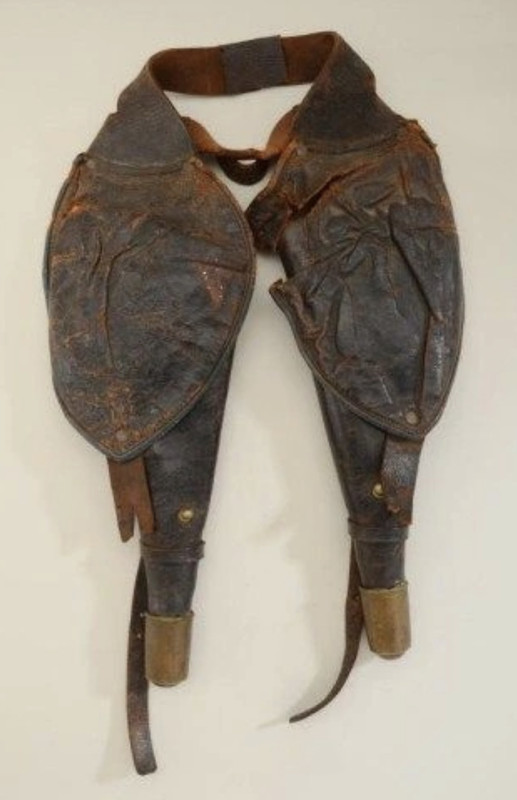
Walker Horse Holsters as issued to Texas Rangers I too have several reproduction Walker’s including a modern Colt, Uberti, a double cased set (you want to talk heavy), and a single cased one with a glass lid. The crowning star if my Dragoon sized guns is not a modern copy but an antique copy of a Colt that I picked up in the early 70s from someone who did not know what it was… a Tucker and Sherrard Texas Dragoon made during the Civil War for the Confederacy and looks and feels just like a Colt 2nd Model Dragoon. Extremely Rare and worth huge amounts of money today. The Tucker and Sherrard Armory failed to deliver on its Confederate contract partly because for every gun delivered to the Confederacy at $40 per gun, they sold one to two out the back door at $60 to $100… and failed to meet their agreed goals in the contract.
.jpg)
Example of a Tucker and Sherrard Dragoon (sometimes spelled “Sherrod” in
CSA government docs), in about the same condition as mine.
38
posted on
06/17/2021 7:52:17 AM PDT
by
Swordmaker
(My pistol self-identifies as an iPad, so you must accept it in gun-free zones, you hoplophobe bigot!)
To: Swordmaker
Exquisite!
Thank You for That!
I’m not a fan of
Horses but I’d rent one
Just to throw a pair
Of Walker’s on the Saddle!
.
I have a Walker/Dragoon
Commissioned by a Texas
Museum with a remarkable
Story!
Unfortunately I don’t have
Access to it!
.
“Skin that Smoke Wagon and
Go to Work,Boy!”
.
Tombstone
39
posted on
06/17/2021 8:27:40 AM PDT
by
Big Red Badger
(Be Still and Know that I Am God. Rev 19)
To: Rio
and Ya Never seen Clint
Load that “Smoke Pole!”
40
posted on
06/17/2021 9:36:02 AM PDT
by
Big Red Badger
(Be Still and Know that I Am God. Rev 19)
Navigation: use the links below to view more comments.
first previous 1-20, 21-40 last
Disclaimer:
Opinions posted on Free Republic are those of the individual
posters and do not necessarily represent the opinion of Free Republic or its
management. All materials posted herein are protected by copyright law and the
exemption for fair use of copyrighted works.
FreeRepublic.com is powered by software copyright 2000-2008 John Robinson
